Question
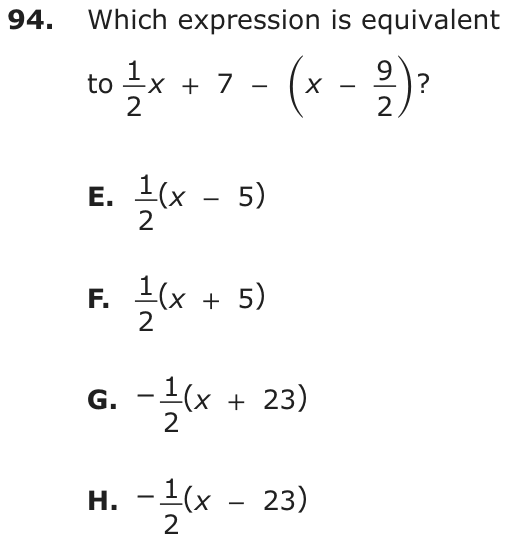
Which expression is equivalent to ?
- A
- B
- C
- D
Show the answer
Correct answer: D
First, distribute the negative sign, which is the same as multiplying both terms in the parentheses by −1.
Next, combine like terms:
Then, factor the common factor of from both terms, paying careful attention to the signs:
Question analysis
An algebra question asking which factored expression equals one half x plus 7 minus the quantity x minus nine halves. Students distribute the subtraction, combine like terms with fractions, and match a factored form. Signs are the danger at every step, and the choices differ only in the signs and numbers inside the parentheses.
- NYS standards
- 7.EE.1 linear expressions with rational coefficients
- Grade level
- Grade 7 content, by NYS standard
- Compared with grade 7
- Above grade 7 Grade 7 students expand and simplify linear expressions with fractions. Here a subtracted group must be distributed and the result factored by a negative fraction, two places where a sign is easily lost, a longer chain than typical grade 7 work.
- Estimated difficulty
- Hard: combines ideas, needs a plan, and has more than one tempting wrong answer.
- Thinking it demands
- Depth of knowledge 1, recall and reproduction · mainly apply
- What makes it hard
- Error-prone arithmetic moderate
- An answer in an unexpected form moderate
- A very close wrong answer moderate
- Solution
- 3 steps
- Reading level
- Question and choices: about grade 15, 10 words.
- Students, last 30 days
- Not enough answers yet to show (it takes 10).
Why it is hard, traps and wrong answers (shows the answer)
Why it is hard
Two separate sign decisions decide this question: distributing the subtraction over x − 9/2, and factoring a negative half out of +23/2. Students who handle the first correctly often stumble on the second and choose the look-alike with +23. Expanding each choice, rather than factoring by hand, is quicker and safer, since it turns the comparison into matching −1/2x + 23/2 term by term.
Error-prone arithmetic moderate Working it out
The minus before (x − 9/2) must change two signs, and the result mixes halves with whole numbers: 1/2x − x and 7 + 9/2 both need care. (Brown & Burton, 1978; Junker & Sijtsma, 2001)
An answer in an unexpected form moderate Choosing the answer
The simplified result, −1/2x + 23/2, appears nowhere; every choice is factored by ±1/2, so students must factor out −1/2 themselves or expand each choice to compare. (Enright, Morley & Sheehan, 2002)
A very close wrong answer moderate Choosing the answer
The answer, −1/2(x − 23), and −1/2(x + 23) differ only in the sign inside the parentheses, and the simplified form’s +23/2 makes the plus sign look right. (Embretson & Wetzel, 1987; Gorin & Embretson, 2006; Ascalon et al., 2007)
Strategy: Change the sign of both terms inside the parentheses, combine the x terms and the constants, then expand each choice to see which one matches rather than factoring yourself.
Traps
- Order of operations: Working left to right, or distributing a minus sign wrongly, gives a choice.
- Negatives and direction: Arithmetic with negative numbers, the order of a subtraction, or direction on a number line. (Moving a term across the equals sign without changing its sign is a faulty procedure.)
- Answer in another form: The right answer is written differently from the way you worked it out.
The wrong answers, classified
A Order of operations (Brown & Burton, 1978)
Gives the minus to x but not to −9/2, so the constants make 7 − 9/2 = 5/2, then drops the leading negative when factoring: 1/2(x − 5).
B Negatives and direction (Brown & Burton, 1978)
Combines 1/2x − x as +1/2x, subtracting the smaller coefficient from the larger, and also leaves −9/2 unchanged, so the result is 1/2x + 5/2 = 1/2(x + 5).
C Negatives and direction (Brown & Burton, 1978)
Simplifies correctly to −1/2x + 23/2 but keeps +23 when factoring out −1/2, though dividing +23/2 by −1/2 gives −23.
Worked solution, step by step
Formulas used
- Subtracting a group
- b and c are the two terms inside the parentheses. Terms are the parts joined by plus or minus signs. A minus sign in front of parentheses takes away the whole group. So it changes the sign of every term inside, not only the first one.
- Distributive property
- a is the number outside the parentheses. b and c are the terms inside. Multiply a by each term inside. It works because a groups of (b + c) hold a of each. Use it to multiply out the choices and compare them.
Sort out the question
Equivalent means equal for every value of x. The choices are written in a different form from the problem. So simplify the problem first. Then multiply out the choices and compare.
Remove the parentheses
The minus sign in front of the parentheses takes away both terms inside. So x becomes −x, and becomes .
Watch out: If you change only the sign of x, the numbers become . That mistake leads to choice A or B.
Combine the x terms
Like terms have the same letter part. The x terms are and −x. Write x as so the fractions match.
The result is negative, because you take away more x than you have.
Combine the numbers
Now combine the plain numbers, 7 and . Write 7 as fourteen halves so the bottoms match. Then add.
The expression simplifies to .
Multiply out choices C and D
Only C and D start with , so test those. Use the distributive property. A negative times a negative is positive.
The first line is choice C, and the second is choice D. Only D matches.
Watch out: Choice C looks almost the same. But it gives , not .
So the answer is D, .
Check your answer
Try x = 1 in the problem: . Now put x = 1 into choice D: . Both give 11, so they match.
More questions like this
The original DOE question