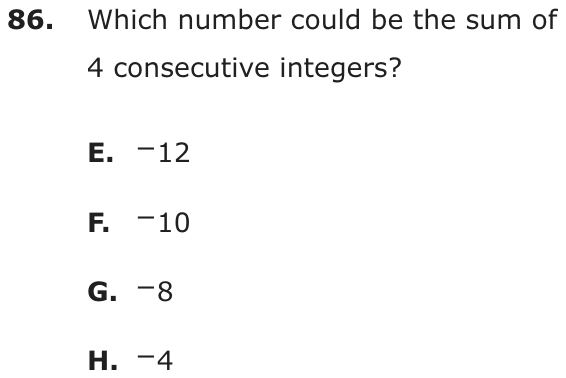
Question
Which number could be the sum of 4 consecutive integers?
- A−12
- B−10
- C−8
- D−4
Show the answer
Correct answer: B
The sum of 4 consecutive integers can be expressed as:
Set that expression equal to each of the options and solve for n:
Option A:
is not an integer.
Option B:
is an integer.
Option C:
is not an integer.
Option D:
is not an integer.
The only option for which n is an integer is −10.
Question analysis
A number properties question about consecutive integers: which of four negative numbers could be the sum of 4 consecutive integers? Students write the sum with a variable, or add runs of negative integers, and test each choice. Keeping signs straight with negative numbers, and remembering that the integers must be whole numbers, is the tricky part.
- Grade level
- Grade 7 content, by NYS standard
- Compared with grade 7
- At grade 7 Grade 7 consecutive-integer problems usually give the sum and ask for the integers. This one reverses the task: students test which negative total is possible at all, using the structure of the sum rather than one equation.
- Estimated difficulty
- Moderate: several steps, or a close reading with one strong distractor.
- Thinking it demands
- Depth of knowledge 2, skills and concepts · mainly apply
- What makes it hard
- Every choice must be checked moderate
- No obvious method minor
- Error-prone arithmetic minor
- Solution
- 3 steps
- Reading level
- Question and choices: about grade 8, 9 words.
- Corrected from the DOE handbook
- A stray word in the explanation’s last sentence was removed.
- Students, last 30 days
- Not enough answers yet to show (it takes 10).
Why it is hard, traps and wrong answers (shows the answer)
Why it is hard
Three of the four choices are multiples of 4, and that is the whole trap: a student who pictures the sum as four times some integer finds three choices that seem to work. The sum of four consecutive integers is 4n + 6, so it is always even but never a multiple of 4. Trying the most natural run, −4, −3, −2 and −1, lands on −10 at once and is the fastest check.
Every choice must be checked moderate Choosing the answer
The stem asks which number “could be” the sum, so no single equation gives the answer; each of −12, −10, −8 and −4 has to be tested against the form a four-integer sum must take. (Embretson & Wetzel, 1987)
No obvious method minor Working it out
Nothing points to the shortcut that n + (n + 1) + (n + 2) + (n + 3) = 4n + 6 is always 2 more than a multiple of 4, or to simply adding a run such as −1, −2, −3 and −4. (Schoenfeld, 1985)
Error-prone arithmetic minor Working it out
Every choice is negative, so solving 4n + 6 = −12 or adding a run of integers means subtracting 6 from a negative number and dividing a negative by 4. (Brown & Burton, 1978; Junker & Sijtsma, 2001)
Strategy: Write the integers as n, n + 1, n + 2 and n + 3, add them, and set the sum equal to each choice to see which one gives a whole-number n.
Traps
- Misunderstands the concept: A wrong belief about a concept: that percents can be added, that area grows like length, that averages can be averaged, that a bigger denominator means a bigger fraction.
- A faulty procedure: A systematic but wrong procedure: adding fractions straight across, applying an exponent to each term of a sum, dropping a sign when moving a term.
- Misreads the question: Misses or misreads a condition or a word in the question: "at least", "each", "remaining", "not".
The wrong answers, classified
A Misunderstands the concept (Smith, diSessa & Roschelle, 1993; De Bock et al., 1998; Ni & Zhou, 2005)
Assumes four consecutive integers add to a multiple of 4, as if they had a whole-number middle, and takes −12 = 4 × (−3), the first such choice.
C A faulty procedure (Brown & Burton, 1978; Tatsuoka, 1983)
Writes n + (n + 1) + (n + 2) + (n + 3) as 4n, dropping the 1 + 2 + 3, so −8 = 4 × (−2) seems to give a whole-number n.
D Misreads the question (Hegarty, Mayer & Monk, 1995)
Solves 4n + 6 = −4 to get n = −2.5 and accepts it, since −2.5, −1.5, −0.5 and 0.5 add to −4, though they are not integers.
What was corrected from the DOE handbook, and why
- Explanation: The handbook ends with “The only option for which n is an integer answer is −10.” The word “answer” does not belong in that sentence; the site reads “The only option for which n is an integer is −10.” The working above it is unchanged: only 4n + 6 = −10 gives an integer, n = −4, and −4 + (−3) + (−2) + (−1) = −10.
Worked solution, step by step
Formulas used
- Sum of 4 consecutive integers
- n is the smallest of the four integers. Each next integer is 1 more than the one before, so they are n, n + 1, n + 2 and n + 3. Adding them gives four n’s, plus 1 + 2 + 3, which is 6. Use it to add any four integers in a row.
Sort out the question
Integers are whole numbers and their negatives, like −2, 0 and 5. They have no fractions or decimals. Consecutive integers come one right after another, like 7, 8, 9, 10 or −3, −2, −1, 0.
You need the choice that can be the sum of four consecutive integers. The sum is what you get when you add them.
Write the sum with a letter
You don’t know the integers yet. So call the smallest one n. Each next one is 1 more: n + 1, n + 2 and n + 3. Use the formula. Collect the four n’s, then add the numbers.
Any four consecutive integers add up to 4n + 6.
Test each choice
Set 4n + 6 equal to each choice and solve for n. First subtract 6 from both sides. Then divide both sides by 4.
Choice 4n + 6 4n n A −12 −18 −4.5 B −10 −16 −4 C −8 −14 −3.5 D −4 −10 −2.5 n must be an integer. Only choice B gives one: n = −4.
Name the four integers
Start at n = −4 and count up by 1. The integers are −4, −3, −2 and −1.
Watch out: Choices A, C and D are multiples of 4. A multiple of 4 is 4 times an integer, like 4 × (−3) = −12. It is tempting to think four integers must add to one of those. But the sum is 4n + 6, and the extra 6 gets in the way. Choice D works only with n = −2.5, and that is not an integer.
So the answer is B, −10.
Check your answer
Add the integers: . That is choice B. Also, 4n + 6 is always 2 more than a multiple of 4. And −10 is 2 more than −12, which is 4 × (−3).
More questions like this
The original DOE question