Question
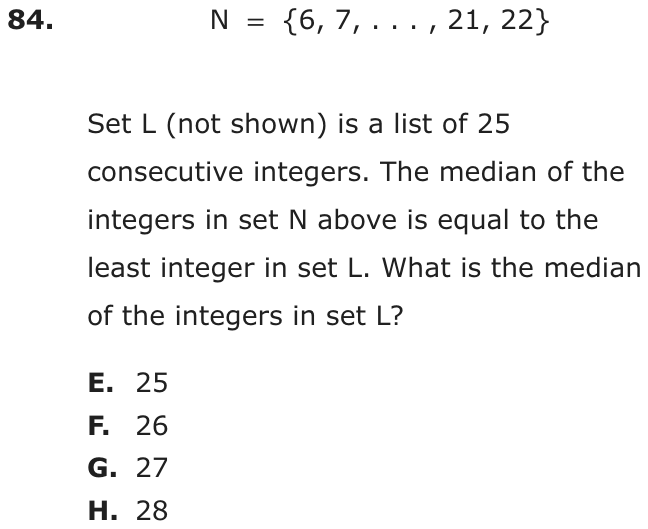
Set L (not shown) is a list of 25 consecutive integers. The median of the integers in set N above is equal to the least integer in set L. What is the median of the integers in set L?
- A25
- B26
- C27
- D28
Show the answer
Correct answer: B
First, find the median of set N. There are 17 integers in set N, so the 9th integer is the median. The 9th integer is 14.
The least integer in set L is equal to the median of set N, so the least integer in set L is 14.
There are 25 integers in set L, so the median is the 13th integer. That integer is 26.
Question analysis
Set N lists the consecutive integers from 6 to 22, and set L is a list of 25 consecutive integers whose least member equals the median of N. Students find the median of set L. It chains two median questions together, and counting positions in a run of consecutive integers invites off-by-one slips.
- NYS standards
- 6.SP.5c range, center, and overall pattern
- Grade level
- Grade 6 content, by NYS standard
- Compared with grade 7
- Above grade 7 Medians of short lists are grade 6 content. This item hides both lists, one behind set notation with an ellipsis and one not shown at all, and links them, so it needs more planning and careful counting than typical grade 7 work.
- Estimated difficulty
- Hard: combines ideas, needs a plan, and has more than one tempting wrong answer.
- Thinking it demands
- Depth of knowledge 2, skills and concepts · mainly apply
- What makes it hard
- A very close wrong answer moderate
- No obvious method moderate
- Reading a figure, table or graph minor
- Solution
- 3 steps
- Reading level
- Question and choices: about grade 5, 39 words.
- Students, last 30 days
- Not enough answers yet to show (it takes 10).
Why it is hard, traps and wrong answers (shows the answer)
Why it is hard
The question chains two medians, and both depend on counting members correctly in runs of consecutive integers. The easy slip is between position and distance: the 13th member of L is 12 steps above its first, not 13. With four consecutive choices, every counting error has a home, so writing out the first and last members of L, 14 and 38, and averaging them is the safest check.
A very close wrong answer moderate Choosing the answer
The choices 25, 26, 27 and 28 are consecutive, so a count that is off by one position lands on a neighboring choice with nothing to flag it. (Embretson & Wetzel, 1987; Gorin & Embretson, 2006; Ascalon et al., 2007)
No obvious method moderate Working it out
Set L is never listed; its median has to be found from its least member, 14, and its size, 25, by working out that the middle is the 13th member. (Schoenfeld, 1985)
Reading a figure, table or graph minor Understanding the question
Set N is written with an ellipsis, {6, 7, …, 21, 22}, so its 17 members must be counted, and 22 − 6 = 16 undercounts by one. (Lesh, Post & Behr, 1987; Kirsch & Mosenthal, 1990)
Strategy: Find N's median by averaging its least and greatest members. L's median is its middle member, so work out that member's position and count up from L's least member.
Traps
- Counting the ends: Inclusive or exclusive ends, fence posts, consecutive numbers: an answer that is one too many or too few, or an endpoint drawn open where it belongs closed (or the reverse).
- Numbers taken from the question: Combines the numbers in the question without a model of the situation, or is simply a number that appears in the question.
The wrong answers, classified
A Numbers taken from the question (Hegarty, Mayer & Monk, 1995)
Gives 25, the number of integers in set L stated in the question, instead of finding which integer sits in the middle.
C Counting the ends (Brown & Burton, 1978)
Counts 13 places up from 14 instead of 12, mixing up the median’s position, 13th, with its distance from the first integer.
D Little reason to choose it (Haladyna & Downing, 1993; Rodriguez, 2005)
No common working gives 28, which is twice N’s median of 14 and matches no count along set L, so it mostly draws guesses.
Worked solution, step by step
Formulas used
- Counting the integers in a list
- This counts the whole numbers in a list that goes up by 1, like 6, 7, 8. Subtracting gives the number of steps from the first number to the last. You add 1 because the first number counts too.
- Position of the median
- The count is how many numbers are in a list that is in order. When the count is odd, the median is at this position. It has the same number of values before it and after it.
Sort out the question
Set N is 6, 7, and so on up to 22. The dots stand for every integer in between. Integers are whole numbers. Set L has 25 consecutive integers, one right after another. Its least number equals the median of N. You need the median of L.
Count the numbers in set N
Set N has 17 integers. Watch out: misses one, because the first number counts too.
Find the median of set N
The median is the 9th number. 6 is the 1st, so the 9th is 8 steps up: 6 + 8 = 14. The median of N is 14.
Find the middle place in set L
So set L starts at 14 and has 25 integers. Find the position of its median.
The median of L is its 13th number.
Count up to the 13th number
14 is the 1st number. The 13th is 12 steps after it.
Watch out: the 13th number is 12 steps up, not 13. Adding 13 gives 27, choice C. And 25 is how many numbers L has, not its median. So the answer is B, 26.
Check your answer
Set L runs from 14 to . For consecutive integers, the median is halfway between the ends: . That matches. The same trick gives N’s median: .
More questions like this
The original DOE question