Question
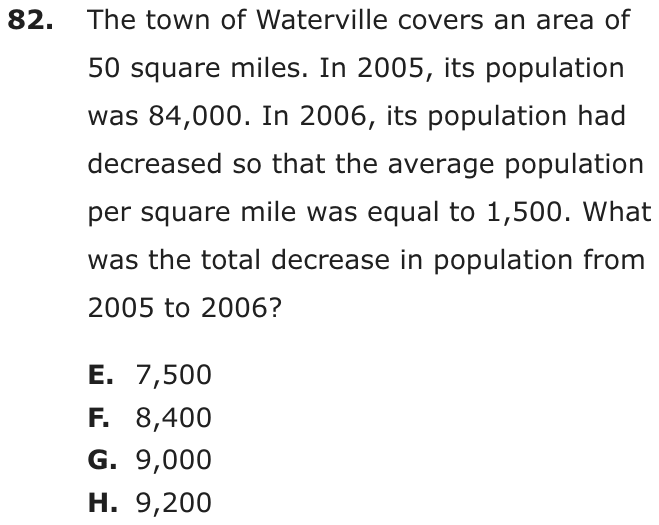
The town of Waterville covers an area of 50 square miles. In 2005, its population was 84,000. In 2006, its population had decreased so that the average population per square mile was equal to 1,500. What was the total decrease in population from 2005 to 2006?
- A7,500
- B8,400
- C9,000
- D9,200
Show the answer
Correct answer: C
Let p represent the population of Waterville in 2006. The population per square mile is:
Solve for p:
The population decrease from 2005 to 2006 is .
Question analysis
The town of Waterville covers 50 square miles and had 84,000 people in 2005. By 2006 the population had dropped so that there were 1,500 people per square mile on average. Students find how much the population decreased, turning the population density into a total population before subtracting.
- NYS standards
- 6.RP.3b unit rate problems
- Grade level
- Grade 6 content, by NYS standard
- Compared with grade 7
- At grade 7 Using a rate such as people per square mile is grade 6 content. Here it is one step inside a two-step problem with large round numbers, which matches typical grade 7 multi-step rate work.
- Estimated difficulty
- Straightforward: two steps or one careful reading.
- Thinking it demands
- Depth of knowledge 2, skills and concepts · mainly apply
- What makes it hard
- Turning words into math moderate
- Many steps minor
- Solution
- 2 steps
- Reading level
- Question and choices: about grade 8, 39 words.
- Students, last 30 days
- Not enough answers yet to show (it takes 10).
Why it is hard, traps and wrong answers (shows the answer)
Why it is hard
The question gives a total for 2005 but only a rate for 2006, so the two years cannot be compared until the rate becomes a population. After that, one subtraction finishes it. Students who stop at the 2006 population, or who reach for a number shaped like 84,000, land on listed choices, while the near miss above the answer comes from no sensible working.
Turning words into math moderate Understanding the question
“The average population per square mile was equal to 1,500” is a density, which has to become a total, 1,500 × 50 = 75,000, before it can be compared with 84,000. (Hegarty, Mayer & Monk, 1995; Koedinger & Nathan, 2004)
Many steps minor Working it out
The 2006 population is only a midpoint; subtracting it from 84,000 is a second step, and the question asks for that decrease, not either population. (Daniel & Embretson, 2010; Enright, Morley & Sheehan, 2002)
Strategy: Multiply 1,500 people per square mile by 50 square miles to get the 2006 population, then subtract it from the 2005 population.
Traps
- Stops one step early: A choice is a number from partway through the solution.
- Numbers taken from the question: Combines the numbers in the question without a model of the situation, or is simply a number that appears in the question.
The wrong answers, classified
A Stops one step early (King et al., 2004; Gierl et al., 2017)
Finds the 2006 population, 1,500 × 50 = 75,000, and stops; 7,500, one zero short, is the choice whose digits match it.
B Numbers taken from the question (Hegarty, Mayer & Monk, 1995)
Takes a tenth of the 2005 population, 84,000 ÷ 10, a number built from the question rather than from the density.
D Little reason to choose it (Haladyna & Downing, 1993; Rodriguez, 2005)
No common working gives 9,200; it lies just above the right decrease and needs an arithmetic slip with no reason behind it, so it mostly draws guesses.
Worked solution, step by step
Formulas used
- Population per square mile
- The population is the number of people who live in a place. The area is its size, here in square miles. Dividing gives the average number of people for each square mile. To get back the population, multiply people per square mile by the area.
Sort out the question
Waterville covers 50 square miles. In 2005, 84,000 people lived there. In 2006, there were 1,500 people per square mile, on average. You need how many fewer people lived there in 2006 than in 2005.
Find the 2006 population
Let p be the 2006 population. Use the formula.
To undo dividing by 50, multiply both sides by 50.
So 75,000 people lived there in 2006.
Find the decrease
A decrease is how much a number went down. Subtract the 2006 population from the 2005 population.
The population went down by 9,000 people.
Give the answer
Watch out: 75,000 is the 2006 population, not the decrease. Choice A, 7,500, looks like it but has one zero fewer. The question asks how much the population dropped. So the answer is C, 9,000.
Check your answer
Work with people per square mile instead. In 2005, there were people per square mile. In 2006, there were 1,500. That is 180 fewer per square mile, and fewer people.
More questions like this
The original DOE question