Question
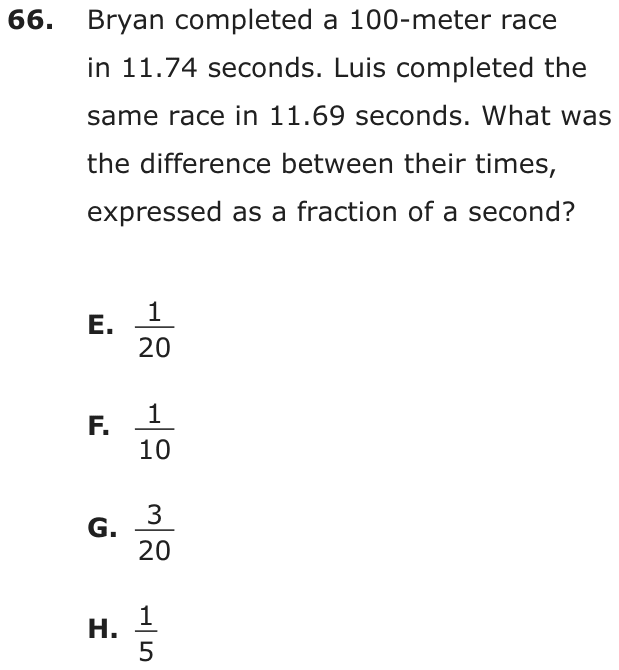
Bryan completed a 100-meter race in 11.74 seconds. Luis completed the same race in 11.69 seconds. What was the difference between their times, expressed as a fraction of a second?
- A
- B
- C
- D
Show the answer
Correct answer: A
First, subtract Luis’s time from Bryan’s time: .
Then, convert to a fraction:
.
Question analysis
Bryan ran a 100-meter race in 11.74 seconds and Luis ran the same race in 11.69 seconds. Students find the difference between their times and express it as a fraction of a second. It tests subtracting decimals and rewriting a decimal as a fraction in lowest terms.
- NYS standards
- 6.NS.3 multi-digit decimal operations
- Grade level
- Grade 6 content, by NYS standard
- Compared with grade 7
- Below grade 7 Subtracting decimals and writing a decimal as a fraction are skills from before grade 7. The two times are close, so the subtraction is quick, and the only care needed is with place value and simplifying.
- Estimated difficulty
- Routine: one familiar step, little to misread.
- Thinking it demands
- Depth of knowledge 2, skills and concepts · mainly apply
- What makes it hard
- Solution
- 2 steps
- Reading level
- Question and choices: about grade 5, 32 words.
- Students, last 30 days
- Not enough answers yet to show (it takes 10).
Why it is hard, traps and wrong answers (shows the answer)
Why it is hard
Two quick skills settle this question: lining up the decimals to subtract, and naming the result as a fraction in lowest terms. The two times differ only in their last two digits, so the subtraction is short, but it needs a borrow that some students skip. The fraction step is where a decimal’s digit gets mistaken for a denominator.
Error-prone arithmetic minor Working it out
Subtracting 11.69 from 11.74 needs a borrow in the hundredths, 14 − 9, after which the tenths cancel to 0, the step where place value goes wrong. (Brown & Burton, 1978; Junker & Sijtsma, 2001)
Something you must already know minor Working it out
The difference, 0.05, must be read as five hundredths and reduced as a fraction; the question gives no help with converting a decimal. (Anderson & Krathwohl, 2001)
Strategy: Line up the decimal points, subtract, write the difference as a number of hundredths over 100, and reduce the fraction.
Traps
- A faulty procedure: A systematic but wrong procedure: adding fractions straight across, applying an exponent to each term of a sum, dropping a sign when moving a term.
- Misunderstands the concept: A wrong belief about a concept: that percents can be added, that area grows like length, that averages can be averaged, that a bigger denominator means a bigger fraction.
The wrong answers, classified
B An arithmetic slip (Junker & Sijtsma, 2001)
Looks only at the tenths, 11.7 − 11.6 = 0.1, dropping the hundredths, a place-value slip that doubles the true gap.
C A faulty procedure (Brown & Burton, 1978; Tatsuoka, 1983)
Subtracts the smaller digit from the larger in each place, 9 − 4 = 5 and 7 − 6 = 1, getting 0.15, which is 3/20.
D Misunderstands the concept (Smith, diSessa & Roschelle, 1993; De Bock et al., 1998; Ni & Zhou, 2005)
Gets 0.05 but reads its digit 5 as a denominator, writing 1/5, instead of five hundredths, 5/100.
Worked solution, step by step
Formulas used
- Decimals as hundredths
- The second place after the decimal point is the hundredths place. So a decimal with two places counts hundredths, and you can write its digits over 100. For example, 0.37 is 37/100. Then simplify by dividing the top and bottom by the same number.
Sort out the question
Bryan ran the race in 11.74 seconds. Luis ran it in 11.69 seconds. The difference is how much longer one time is than the other. You need it as a fraction of a second.
Subtract the two times
Subtract the smaller time from the larger one. Line up the decimal points.
In the hundredths place, 4 is less than 9. So regroup: trade 1 tenth for 10 hundredths. Then 14 − 9 = 5 hundredths. The tenths are now 6 − 6 = 0.
Watch out: don’t just take the smaller digit from the larger one in each place. That gives 0.15, which is , choice C.
Write the difference as a fraction
The 5 is in the hundredths place, so 0.05 is 5 hundredths.
Now simplify. Divide the top and bottom by 5.
Give the answer
Watch out: 0.05 is not . One fifth is 0.2, which is four times as big. So the answer is A, .
Check your answer
Turn back into a decimal: . Then add it to Luis’s time: . That is Bryan’s time, so the difference is right.
More questions like this
The original DOE question