Question

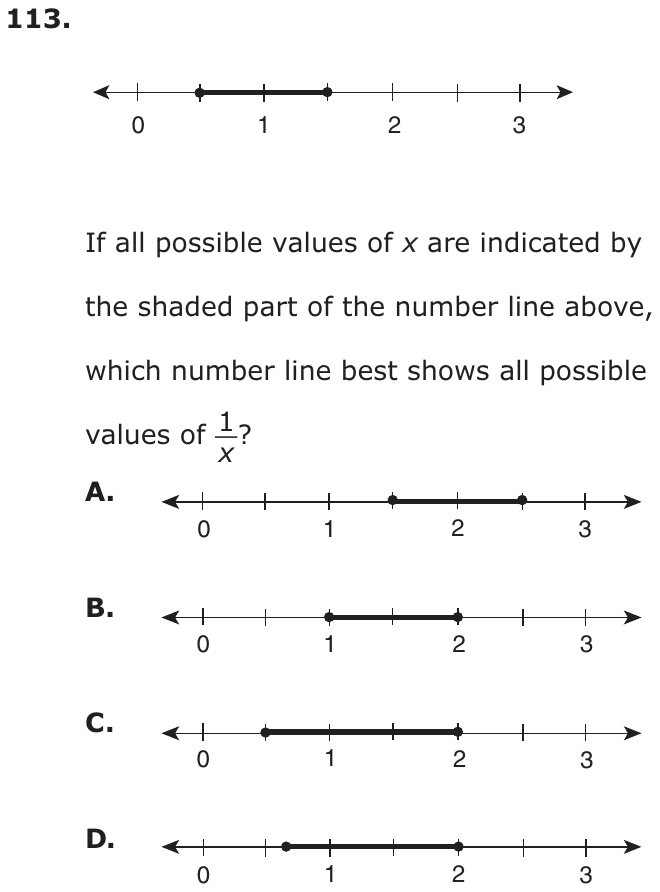
If all possible values of x are indicated by the shaded part of the number line above, which number line best shows all possible values of ?
- A

- B

- C

- D

Show the answer
Correct answer: D
The shaded region goes from to . So, the possible values of would be between the reciprocal of and the reciprocal of , which are 2 and , respectively. Find the number line in the answer options that has a shaded region that ranges from to 2, which is option D.
Question analysis
This number line question shades all possible values of x from one half to three halves and asks which number line shows all possible values of 1/x. Students find reciprocals of fractions and work out how a whole range of values changes. Keeping track of what happens to each end of the range, and placing fractions accurately on the line, makes it tricky.
- NYS standards
- Grade level
- Grade 6 content, by NYS standard
- Compared with grade 7
- Above grade 7 Reciprocals of single fractions are grade 6 work. Applying them to every value in a shaded range at once, and working out where the new range begins and ends, is reasoning about a whole set of numbers that grade 7 classes rarely practice.
- Estimated difficulty
- Hard: combines ideas, needs a plan, and has more than one tempting wrong answer.
- Thinking it demands
- Depth of knowledge 2, skills and concepts · mainly apply
- What makes it hard
- Reading a figure, table or graph moderate
- A very close wrong answer moderate
- Variables instead of numbers minor
- Solution
- 3 steps
- Reading level
- Question and choices: about grade 12, 27 words.
- Students, last 30 days
- Not enough answers yet to show (it takes 10).
Why it is hard, traps and wrong answers (shows the answer)
Why it is hard
Few students have flipped an interval before, so the question rewards testing its two ends and noticing that the order reverses. The harder part comes at the end: 2/3 falls between the tick marks, and a graph ending at the nearby 1/2 tick looks right at a glance. Students who believe a reciprocal is always at least 1, or who shift the interval instead of flipping it, reach the other graphs.
Reading a figure, table or graph moderate Understanding the question
The shaded segment's ends sit on unlabeled half-unit ticks, 1/2 and 3/2, and each choice must be read the same way, with 2/3 falling between ticks rather than on one. (Lesh, Post & Behr, 1987; Kirsch & Mosenthal, 1990)
A very close wrong answer moderate Choosing the answer
The graph from 1/2 to 2 matches the right graph's right end and differs at the left end by only a sixth of a unit, 1/2 against 2/3. (Embretson & Wetzel, 1987; Gorin & Embretson, 2006; Ascalon et al., 2007)
Variables instead of numbers minor Understanding the question
The question asks about 1/x for every x in a range, so a whole interval must be transformed, and its ends swap: the smallest x gives the largest 1/x. (Koedinger & Nathan, 2004; Enright, Morley & Sheehan, 2002)
Strategy: Take the reciprocal of each end of the shaded part, ask whether a bigger x gives a bigger or a smaller 1/x, and look for the graph whose endpoints are exactly those values.
Traps
- Misreads the figure: Reads a value, label or tick spacing in a figure, table or graph wrongly.
- Misunderstands the concept: A wrong belief about a concept: that percents can be added, that area grows like length, that averages can be averaged, that a bigger denominator means a bigger fraction.
- Wrong operation: Adds instead of multiplying, divides the wrong way round, turns a ratio or rate upside down, or undoes a step in the wrong direction (subtracts what should be added back).
The wrong answers, classified
A Wrong operation (Hegarty, Mayer & Monk, 1995; King et al., 2004)
Adds 1 to each endpoint instead of taking reciprocals, sliding the shaded part from 1/2–3/2 one unit right, to 3/2–5/2.
B Misunderstands the concept (Smith, diSessa & Roschelle, 1993; De Bock et al., 1998; Ni & Zhou, 2005)
Gets 2 from 1/2 but assumes a reciprocal cannot be less than 1, as flipping a proper fraction suggests, so it starts the shading at 1 instead of 2/3.
C Misreads the figure (Lesh, Post & Behr, 1987; Kirsch & Mosenthal, 1990)
Finds the reciprocals 2/3 and 2 but places 2/3 at the half-unit tick, 1/2, though 2/3 lies a third of the way from that tick toward 1.
Worked solution, step by step
Formulas used
- Reciprocal
- a and b are the top and bottom of a fraction. The reciprocal flips the fraction upside down. The number 1 over x is the reciprocal of x. A number times its reciprocal always makes 1.
Sort out the question
x can be any number in the shaded part of the first number line. You need the number line that shows every possible value of , the reciprocal of x. The reciprocal is the number flipped upside down, like for 2.
Read the shaded part
The ticks come every half unit. The shading starts at the tick halfway between 0 and 1, which is . It ends halfway between 1 and 2, which is , or . Both dots are filled in, so both ends count.
Find the reciprocals of the ends
Flip each end of the shaded part.
So the ends of the new shading are 2 and .
Notice that the ends swap
When x gets bigger, gets smaller. So the smallest x, , gives the biggest value, 2. The biggest x, , gives the smallest, . So runs from to 2, ends included.
Find the matching number line
lies between the half tick and 1, a third of the way from to 1. Line D starts there and ends at 2. Watch out: line C starts at the half tick, , not at . Line B starts at 1.
So the answer is D, the line shaded from to 2.
Check your answer
Test a value in the middle. x = 1 is shaded, and . On line D, 1 is shaded too. Test an end: , so really is the reciprocal of .
More questions like this
The original DOE question