Question
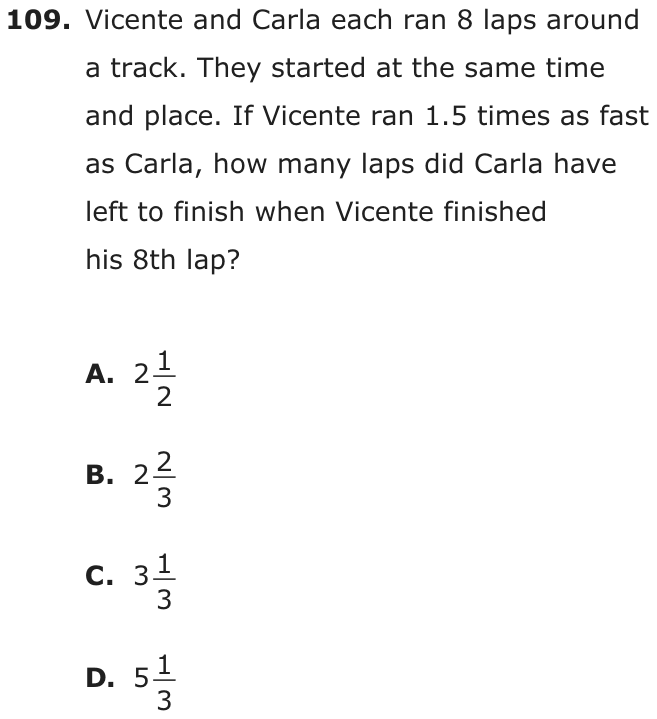
Vicente and Carla each ran 8 laps around a track. They started at the same time and place. If Vicente ran 1.5 times as fast as Carla, how many laps did Carla have left to finish when Vicente finished his 8th lap?
- A
- B
- C
- D
Show the answer
Correct answer: B
Vicente ran 1.5 times as fast as Carla, so that means for every lap Carla finished, Vicente finished 1.5 laps. Set up a proportion to calculate c, the number of laps Carla had completed when Vicente finished 8 laps:
| Cross multiply. | |
| Apply the multiplicative inverse property; divide both sides of the equation by 1.5. | |
So, the number of laps Carla still had to finish is .
Question analysis
This ratio word problem says Vicente and Carla each ran 8 laps, starting at the same time and place, and Vicente ran 1.5 times as fast. It asks how many laps Carla still had to run when Vicente finished. Students reason with a speed ratio and mixed numbers, and giving the laps run rather than the laps remaining is an easy slip.
- NYS standards
- Grade level
- Grade 7 content, by NYS standard
- Compared with grade 7
- Above grade 7 Grade 7 rate problems usually give a speed and a time. Here only the ratio of two speeds is given, so students must reason that distances run in the same time share that ratio, then work with a fractional number of laps.
- Estimated difficulty
- Hard: combines ideas, needs a plan, and has more than one tempting wrong answer.
- Thinking it demands
- Depth of knowledge 2, skills and concepts · mainly apply
- What makes it hard
- Turning words into math moderate
- Error-prone arithmetic moderate
- A very close wrong answer minor
- Solution
- 3 steps
- Reading level
- Question and choices: about grade 4, 44 words.
- Students, last 30 days
- Not enough answers yet to show (it takes 10).
Why it is hard, traps and wrong answers (shows the answer)
Why it is hard
No time is given, so students must reason that in equal time distance scales with speed, which turns the race into one division and one subtraction. Both steps hide a trap: the division by 1.5 leaves a remainder that is easy to misread, and subtracting a mixed number from 8 needs regrouping. The result of the first step, Carla's laps run, is itself a choice, so the question also rewards rereading what is asked.
Turning words into math moderate Understanding the question
The phrase “1.5 times as fast” has to become distances in the same time: while Vicente runs 8 laps, Carla runs 8 ÷ 1.5, not 8 − 1.5 or 8 × 1.5. (Hegarty, Mayer & Monk, 1995; Koedinger & Nathan, 2004)
Error-prone arithmetic moderate Working it out
Dividing 8 by 1.5 gives 16/3, or 5 1/3, a division by a decimal with a remainder, and 8 − 5 1/3 then needs a whole regrouped into thirds. (Brown & Burton, 1978; Junker & Sijtsma, 2001)
A very close wrong answer minor Choosing the answer
The choice 2 1/2 is only a sixth of a lap from 2 2/3, so a rough estimate of how far Carla trails cannot separate them; only the exact quotient does. (Embretson & Wetzel, 1987; Gorin & Embretson, 2006; Ascalon et al., 2007)
Strategy: In the same amount of time the faster runner covers 1.5 times the distance, so divide Vicente's laps by 1.5 to get Carla's, then subtract that from 8.
Traps
- Answers a different question: A choice is right for another quantity: the other unknown, the rest instead of the part, the part instead of the whole.
- A faulty procedure: A systematic but wrong procedure: adding fractions straight across, applying an exponent to each term of a sum, dropping a sign when moving a term.
The wrong answers, classified
A A faulty procedure (Brown & Burton, 1978; Tatsuoka, 1983)
Works 80 ÷ 15 as 5 remainder 5 and writes 5.5, turning the remainder into a decimal digit, so Carla seems to have run 5 1/2 laps and 2 1/2 remain.
C A faulty procedure (Brown & Burton, 1978; Tatsuoka, 1983)
Finds 5 1/3 correctly but subtracts it from 8 by taking 5 from 8 and keeping the 1/3, getting 3 1/3 instead of regrouping a whole.
D Answers a different question (King et al., 2004; Hegarty, Mayer & Monk, 1995)
Finds how many laps Carla had run when Vicente finished, 8 ÷ 1.5 = 5 1/3, and gives that instead of the laps she still had left.
Worked solution, step by step
Formulas used
- Distance, rate and time
- d is the distance, r is the rate or speed, and t is the time. When two runners run for the same time, the faster one goes farther by the same factor as the speed. So 1.5 times as fast means 1.5 times as far.
- Dividing by a fraction
- a is any number and m over n is a fraction. Dividing by a fraction is the same as multiplying by its reciprocal, the fraction flipped upside down.
Sort out the question
Vicente and Carla each run 8 laps, starting together. Vicente runs 1.5 times as fast as Carla. You need how many laps Carla still has to run when Vicente finishes. First find how far Carla has run at that moment.
Compare their distances
They have run for the same time. So Vicente’s distance is 1.5 times Carla’s. Let c be the laps Carla has run.
To find c, divide 8 by 1.5.
Divide 8 by 1.5
Write 1.5 as the fraction .
Carla has run laps. Watch out: that is how far she has run, not what is left. Stopping here gives choice D.
Find the laps she has left
Watch out: 8 − is not . You must break 1 whole into thirds first. Answering is choice C.
So the answer is B, laps.
Check your answer
Multiply back: . So when Carla has run laps, Vicente has run 8. And , her full race.
More questions like this
The original DOE question