Question
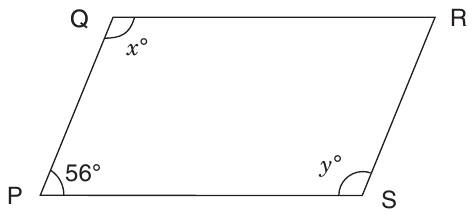
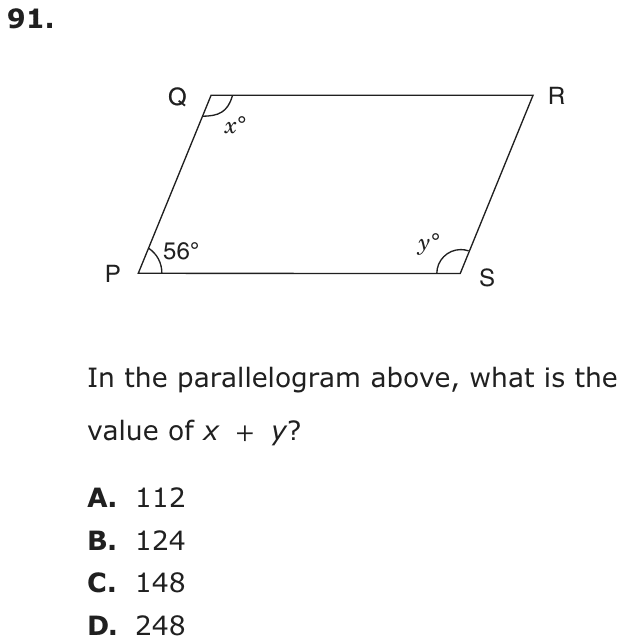
In the parallelogram above, what is the value of ?
- A112
- B124
- C148
- D248
Show the answer
Correct answer: D
In a parallelogram, opposite angles are congruent, so the measure of the unmarked angle is 56°. The sum of the interior angles of a parallelogram is equal to 360°. Use that information to solve the problem:
Question analysis
This geometry question shows parallelogram PQRS with a 56° angle at P and unknown angles x and y at Q and S, and asks for the sum x + y. Students need angle facts about parallelograms: opposite angles match, and the four angles total 360°. Stopping after finding only one angle, or adding the wrong pair, are the common mistakes.
- NYS standards
- Grade level
- Grade 8 content, by NYS standard
- Compared with grade 7
- At grade 7 The parallelogram facts needed, equal opposite angles and a 360° angle sum, rest on grade 8 reasoning about parallel lines and triangles. Once they are known, the arithmetic is short, about the size of a typical grade 7 angle problem.
- Estimated difficulty
- Straightforward: two steps or one careful reading.
- Thinking it demands
- Depth of knowledge 2, skills and concepts · mainly apply
- What makes it hard
- Solution
- 2 steps
- Reading level
- Question and choices: about grade 10, 10 words.
- Students, last 30 days
- Not enough answers yet to show (it takes 10).
Why it is hard, traps and wrong answers (shows the answer)
Why it is hard
Two short angle facts finish the question, but the figure marks three of the four corners, and the unmarked one at R is easy to forget. Students who find one obtuse angle stop with half the total, and those who add the two 56° angles give the part already known. Checking that the four angles, 56, 124, 56 and 124, add to 360 confirms the sum.
Something you must already know moderate Working it out
The figure gives one angle and no rules: students must bring both that opposite angles of a parallelogram are equal and that a quadrilateral's angles total 360°, or that neighboring angles add to 180°. (Anderson & Krathwohl, 2001)
Reading a figure, table or graph minor Understanding the question
The labels x and y sit at Q and S, opposite corners, while the corner R across from the 56° angle at P carries no label at all. (Lesh, Post & Behr, 1987; Kirsch & Mosenthal, 1990)
Strategy: Mark the angle at R equal to the angle at P, since opposite angles of a parallelogram are equal, then take both away from the total of a quadrilateral's four angles.
Traps
- Stops one step early: A choice is a number from partway through the solution.
- Answers a different question: A choice is right for another quantity: the other unknown, the rest instead of the part, the part instead of the whole.
The wrong answers, classified
A Answers a different question (King et al., 2004; Hegarty, Mayer & Monk, 1995)
Adds the two 56° angles at P and R, 56 + 56 = 112, giving the part of the 360° already known instead of the two angles that remain.
B Stops one step early (King et al., 2004; Gierl et al., 2017)
Finds one unmarked angle, 180 − 56 = 124, and stops before adding the equal angle at the opposite corner.
C Little reason to choose it (Haladyna & Downing, 1993; Rodriguez, 2005)
No angle fact in the parallelogram gives 148, which is exactly 100 less than the right total, so it mostly catches guesses or a stray subtraction slip.
Worked solution, step by step
Formulas used
- Opposite angles of a parallelogram
- A parallelogram is a four-sided shape whose opposite sides are parallel. P and R are opposite corners: they don’t share a side. Opposite angles of a parallelogram are always equal.
- Angles of a four-sided shape
- P, Q, R and S are the four corners. Their angles always add up to 360 degrees. A line from one corner to the opposite corner cuts the shape into two triangles, and each triangle’s angles add up to 180 degrees.
- Neighboring angles of a parallelogram
- P and Q are corners next to each other, joined by one side. In a parallelogram, their angles add up to 180 degrees. The same is true of any two neighboring corners.
Sort out the figure
PQRS is a parallelogram. The angle at corner P is 56°. The angle at Q is x°, and the angle at S is y°. The angle at R has no label. You need x + y, the angles at Q and S added together.
Find the angle at R
R is across from P, so they are opposite corners.
So the angle at R is 56°, the same as at P.
Use the 360° total
Watch out: 112 is the two angles you already know, not x + y. Answering 112 is choice A.
Find x and y one at a time
Q is next to P, so use the neighbor rule.
S is also next to P, so y = 124 too. Then , the same total. Watch out: stopping at one angle, 124, gives choice B. The question asks for both added together.
So the answer is D, 248.
Check your answer
Add all four angles: . That is the right total for a four-sided shape. Also, the angles at Q and S look wider than a right angle in the figure, and 124° is wider than 90°.
More questions like this
The original DOE question