Question
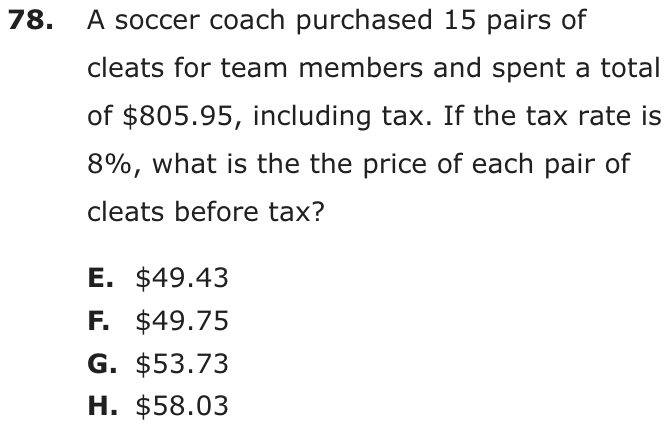
A soccer coach purchased 15 pairs of cleats for team members and spent a total of $805.95, including tax. If the tax rate is 8%, what is the price of each pair of cleats before tax?
- A$49.43
- B$49.75
- C$53.73
- D$58.03
Show the answer
Correct answer: B
Since the total cost of $805.95 includes an 8% tax, this means that the cost of 15 pairs of cleats before tax was multiplied by 1.08 to find the total cost of the cleats including the tax. So, first, use division to find the cost of the 15 pairs of cleats before tax:
Then, divide that quotient by 15 to find the price of 1 pair of cleats:
Question analysis
A soccer coach pays $805.95, tax included, for 15 pairs of cleats, and the tax rate is 8%. Students find the price of one pair before tax. The total already includes the tax, so students must work backward from a percent increase, and a common shortcut lands very close to the right price.
- Grade level
- Grade 7 content, by NYS standard
- Compared with grade 7
- Above grade 7 Typical grade 7 tax problems add tax to a price. This one works backward from a total that already includes the tax, a reverse percent step many students find unfamiliar, and then shares the cost among 15 pairs.
- Estimated difficulty
- Hard: combines ideas, needs a plan, and has more than one tempting wrong answer.
- Thinking it demands
- Depth of knowledge 2, skills and concepts · mainly apply
- What makes it hard
- Turning words into math moderate
- A very close wrong answer moderate
- Error-prone arithmetic moderate
- Solution
- 2 steps
- Reading level
- Question and choices: about grade 5, 33 words.
- Corrected from the DOE handbook
- A repeated word in the question was corrected.
- Students, last 30 days
- Not enough answers yet to show (it takes 10).
Why it is hard, traps and wrong answers (shows the answer)
Why it is hard
Removing a tax is harder than adding one, because the 8% was taken of an amount the problem never states. Taking 8% off the $805.95 total feels natural and lands within 32 cents of the answer, which is why this question is hard. A quick check exposes it: 15 pairs at $49.75 cost $746.25, and adding 8% of that gives exactly $805.95.
Turning words into math moderate Understanding the question
The phrase "spent a total of $805.95, including tax" makes $805.95 equal to 108% of the pre-tax cost, so the tax is removed by dividing by 1.08, not by taking 8% off. (Hegarty, Mayer & Monk, 1995; Koedinger & Nathan, 2004)
A very close wrong answer moderate Choosing the answer
$49.43 and $49.75 are 32 cents apart, and taking 8% off the total lands on the lower one; no estimate separates them, only dividing by 1.08. (Embretson & Wetzel, 1987; Gorin & Embretson, 2006; Ascalon et al., 2007)
Error-prone arithmetic moderate Working it out
805.95 ÷ 1.08 = 746.25 and 746.25 ÷ 15 = 49.75 are long decimal divisions by hand; dividing by 15 first, to 53.73, and then by 1.08 is no easier. (Brown & Burton, 1978; Junker & Sijtsma, 2001)
Strategy: Treat the total as 108% of the pre-tax cost: divide $805.95 by 1.08, then divide by 15 pairs, and check by adding 8% back.
Traps
- Percent of the wrong amount: Finding the whole from a part, or a percent change measured from the wrong starting amount.
- Answers a different question: A choice is right for another quantity: the other unknown, the rest instead of the part, the part instead of the whole.
- Wrong operation: Adds instead of multiplying, divides the wrong way round, turns a ratio or rate upside down, or undoes a step in the wrong direction (subtracts what should be added back).
The wrong answers, classified
A Percent of the wrong amount (Parker & Leinhardt, 1995)
Takes 8% of the $805.95 total and subtracts it, 805.95 × 0.92 ÷ 15 ≈ $49.43, though the tax was 8% of the smaller pre-tax cost.
C Answers a different question (King et al., 2004; Hegarty, Mayer & Monk, 1995)
Divides the $805.95 total by 15 pairs without removing the tax, which gives the price of a pair with tax rather than before it.
D Wrong operation (Hegarty, Mayer & Monk, 1995; King et al., 2004)
Divides the total by 15 and then multiplies by 1.08 instead of dividing, adding the tax a second time: 53.73 × 1.08 ≈ $58.03.
What was corrected from the DOE handbook, and why
- Stem: The handbook’s question reads “what is the the price of each pair of cleats before tax?”, with “the” printed twice (p. 80, question 78). The site now reads “what is the price of each pair of cleats before tax?”
Worked solution, step by step
Formulas used
- Price with tax
- The price is the cost before tax. t is the tax rate, a percent. Tax is extra money added on top. You pay the whole price, 100%, plus t percent more. So for 8% tax you multiply by 1.08.
- Undoing a multiplication
- a is the unknown, b is the number it was multiplied by, and c is the result. Dividing by b undoes multiplying by b. Use it to work backward to the amount before tax.
Sort out the question
The coach bought 15 pairs of cleats, which are sports shoes. He paid $805.95 in all, and that includes 8% tax. Tax is extra money added to the price. You need the price of one pair before tax.
Write the total with tax
The tax is 8% of the cost before tax. So the coach paid 100% + 8% = 108% of that cost. 108% is 1.08. Call the pre-tax cost of all 15 pairs c.
Divide to remove the tax
To undo multiplying by 1.08, divide by 1.08. Move both decimal points two places right first.
All 15 pairs cost $746.25 before tax. Watch out: don’t take 8% of $805.95 and subtract it. The tax was 8% of the smaller pre-tax cost. That way leads to $49.43, choice A.
Find the price of one pair
All 15 pairs cost the same, so share the cost equally.
Watch out: dividing $805.95 by 15 without removing the tax gives $53.73, choice C. That price still includes the tax. So the answer is B, $49.75.
Check your answer
Work forward. 15 pairs at $49.75 cost dollars. The tax is dollars. Then , the total in the question.
More questions like this
The original DOE question