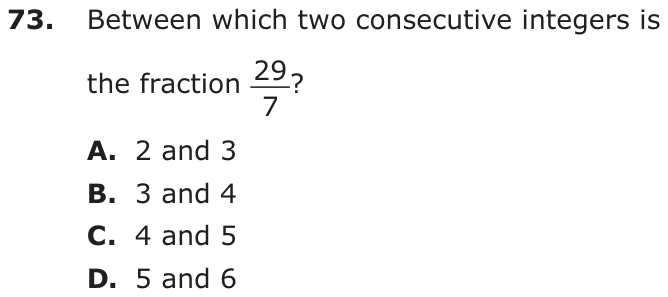
Question
Between which two consecutive integers is the fraction ?
- A2 and 3
- B3 and 4
- C4 and 5
- D5 and 6
Show the answer
Correct answer: C
First, convert to a mixed number: . The two consecutive integers on either side of are 4 and 5.
Question analysis
This question asks between which two consecutive whole numbers the fraction 29/7 lies. Students divide to turn the improper fraction into a mixed number, or compare it with nearby multiples of 7. It is a quick check of number sense with fractions, where a remainder must be read correctly.
- Grade level
- Grade 6 content, by NYS standard
- Compared with grade 7
- Below grade 7 Changing an improper fraction to a mixed number and placing it between whole numbers is review well before grade 7. This takes one division with a small divisor and nothing more.
- Estimated difficulty
- Routine: one familiar step, little to misread.
- Thinking it demands
- Depth of knowledge 1, recall and reproduction · mainly apply
- What makes it hard
- Solution
- 2 steps
- Reading level
- Question and choices: about grade 5, 13 words.
- Students, last 30 days
- Not enough answers yet to show (it takes 10).
Why it is hard, traps and wrong answers (shows the answer)
Why it is hard
Dividing 29 by 7 gives 4 with a remainder of 1, so the fraction is 4 1/7 and lies just past 4. The one decision is which side of 4 the remainder puts it on, and a positive remainder always moves the value up. Writing the mixed number before looking at the choices makes the pair obvious.
A very close wrong answer minor Choosing the answer
The pairs 3 and 4 and 4 and 5 both contain 4, so knowing that 29/7 is about 4 is not enough; only the remainder, 29 − 28 = 1, puts it above 4. (Embretson & Wetzel, 1987; Gorin & Embretson, 2006; Ascalon et al., 2007)
Strategy: Find the largest multiple of 7 that is not more than 29, write the fraction as a mixed number, and read off the whole numbers on each side.
Traps
- Counting the ends: Inclusive or exclusive ends, fence posts, consecutive numbers: an answer that is one too many or too few, or an endpoint drawn open where it belongs closed (or the reverse).
The wrong answers, classified
A Little reason to choose it (Haladyna & Downing, 1993; Rodriguez, 2005)
No division of 29 by 7 lands below 3, since 7 × 3 = 21 is far short of 29; only misreading 29/7 as 2.9 gets there, so it mostly catches guesses.
B Counting the ends (Brown & Burton, 1978)
Finds the whole-number part, 4, but takes it as the upper end of the pair, as if 29/7 fell just short of 4 instead of just past it.
D Little reason to choose it (Haladyna & Downing, 1993; Rodriguez, 2005)
Nothing puts 29/7 above 5, since 7 × 5 = 35 is more than 29; even rounding 4 1/7 up gives 5 as the upper end, so it mostly catches guesses.
Worked solution, step by step
Formulas used
- Fraction to mixed number
- a over b is a fraction whose top is bigger than its bottom. q is the quotient, how many whole times b fits into a. r is the remainder, what is left over. The leftover stays over the same bottom number.
Sort out the question
Consecutive integers are whole numbers that come one right after the other, like 4 and 5. You need the two that falls between. So find the whole number just below it and the one just above it.
Divide 29 by 7
A fraction bar means divide. How many 7s fit in 29?
28 is the biggest multiple of 7 that is not more than 29. A multiple of 7 is 7 times a whole number. Then . So 29 ÷ 7 is 4 with 1 left over.
Write it as a mixed number
is a little more than 4 and less than 5. Watch out: it is just past 4, not just short of it. So 4 is the lower number of the pair. Picking 3 and 4 is choice B. So the answer is C, 4 and 5.
Check your answer
Multiply each end by 7. and . The top of the fraction, 29, is between 28 and 35. So is between 4 and 5. As a decimal it is about 4.14.
More questions like this
The original DOE question