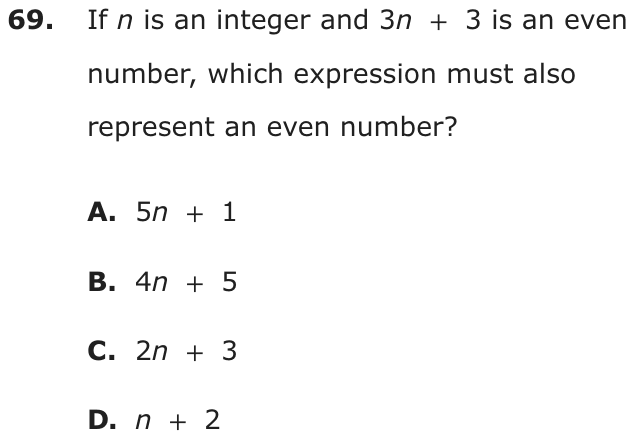
Question
If n is an integer and is an even number, which expression must also represent an even number?
- A
- B
- C
- D
Show the answer
Correct answer: A
The expression is equal to , and it is given that this is an even number. The expression must also represent an even number, because 3 is an odd number: if were odd, would be the product of two odd numbers, which is an odd number. If is an even number, then n must be an odd number. Choose an odd number to substitute for n in the answer options to find which expression represents an even number:
Let .
Option A:
Option B:
Option C:
Option D:
Since 16 is the only even number, the correct answer is option A.
Question analysis
This number properties question says that 3n + 3 is even for an integer n and asks which of four expressions must also be even. Students reason about odd and even numbers written with a variable. The hidden step is deciding what the given fact says about n itself before testing the expressions.
- Grade level
- Grade 7 content, by NYS standard
- Compared with grade 7
- Above grade 7 Grade 7 students rewrite and evaluate expressions, but rarely reason about whether an expression is odd or even for every value of a variable. Here that reasoning comes in two layers: first about n, then about each choice.
- Estimated difficulty
- Moderate: several steps, or a close reading with one strong distractor.
- Thinking it demands
- Depth of knowledge 2, skills and concepts · mainly analyze
- What makes it hard
- Solution
- 3 steps
- Reading level
- Question and choices: about grade 9, 23 words.
- Corrected from the DOE handbook
- The explanation gave the wrong reason why n + 1 must be even; the reason was corrected.
- Students, last 30 days
- Not enough answers yet to show (it takes 10).
Why it is hard, traps and wrong answers (shows the answer)
Why it is hard
The question hides its key step: 3n + 3 = 3(n + 1), and since 3 is odd, n + 1 must be even, so n is odd. A student who skips that step and tests a convenient even value never checks the condition and lands on a wrong expression. Once n is known to be odd, any odd test value, such as 1, picks out 5n + 1 at once.
Variables instead of numbers moderate Understanding the question
No value of n is given; the only fact is that 3n + 3 is even, and it has to be turned into a fact about n itself, that n is odd, before any choice is judged. (Koedinger & Nathan, 2004; Enright, Morley & Sheehan, 2002)
Something you must already know minor Working it out
The parity rules are assumed, not stated: an odd number times an odd number is odd, and an even number plus an odd number is odd. (Anderson & Krathwohl, 2001)
Every choice must be checked minor Choosing the answer
Each expression has to be tested with an odd n or by parity rules; three of the four come out odd whenever n is odd, so none can be dismissed on sight. (Embretson & Wetzel, 1987)
Strategy: First work out what 3n + 3 being even says about n, by factoring out 3 or testing small integers, then check each expression with a value of n that fits.
Traps
- Misreads the question: Misses or misreads a condition or a word in the question: "at least", "each", "remaining", "not".
- Misunderstands the concept: A wrong belief about a concept: that percents can be added, that area grows like length, that averages can be averaged, that a bigger denominator means a bigger fraction.
The wrong answers, classified
B Misunderstands the concept (Smith, diSessa & Roschelle, 1993; De Bock et al., 1998; Ni & Zhou, 2005)
Sees the even term 4n and treats the whole expression as even, overlooking that adding the odd 5 makes 4n + 5 odd for every integer n.
C Misunderstands the concept (Smith, diSessa & Roschelle, 1993; De Bock et al., 1998; Ni & Zhou, 2005)
Assumes an expression that starts with 2n must be even, though 2n + 3 is an even number plus 3 and so is always odd.
D Misreads the question (Hegarty, Mayer & Monk, 1995)
Tests n = 2 without checking the condition, though 3(2) + 3 = 9 is odd; with n = 2, only n + 2 = 4 comes out even.
What was corrected from the DOE handbook, and why
- Explanation: The DOE’s explanation said that n + 1 must be even “because 3 is an odd number and the product of an odd number and an even number is an even number.” That fact does not show that n + 1 is even; the reason is that if n + 1 were odd, 3(n + 1) would be the product of two odd numbers, which is odd, and it is given as even. The site now gives that reason. The answer, A, is unchanged.
Worked solution, step by step
Formulas used
- Pulling out a common factor
- a is a factor, a number being multiplied, that both terms share. b and c are what is left. This is the distributive property run backward. It turns a sum into a product, which is easier to reason about.
- Multiplying odd numbers
- An even number splits into pairs, like 2, 4 or 6. An odd number has one left over, like 1, 3 or 5. An odd number of odd groups always leaves one extra. So the product is odd.
- Adding odd and even numbers
- Two odd numbers each have one left over. Together the two extras make a pair, so the sum is even. An even number plus an odd number still has one left over, so the sum is odd.
Sort out the question
n is an integer, a whole number that can be positive, negative or 0. You are told that is even. You need the expression that must be even too. Must means it is even every time. First find out what the fact tells you about n.
Pull out the 3
Both terms in have a factor of 3. Pull it out.
So 3 times is an even number.
Decide whether n is odd or even
3 is odd. If were odd, would be odd times odd. That is always odd. But we are told it is even. So must be even. One less than an even number is odd. So n is odd. Watch out: don’t test n = 2. Then , which is odd. With n = 2, only comes out even, choice D.
Test each choice with an odd n
Pick an odd number, n = 3. It fits, since is even.
- A: , even
- B: , odd
- C: , odd
- D: , odd
Only A is even.
Make sure A always works
Must means every odd n, not just 3. If n is odd, 5n is odd times odd, so it is odd. Odd plus 1 is even. So is always even. Watch out: 4n is even, but adding the odd 5 makes odd, choice B. In the same way, is always odd, choice C. So the answer is A, .
Check your answer
Try another odd number, n = 1. Then , which is even, so n = 1 fits. And is even too. The other three choices give 9, 5 and 3, all odd. Choice A wins again.
More questions like this
The original DOE question