Coordinate plane
Question 1 of 3
2024 Test A Math, question 21Question
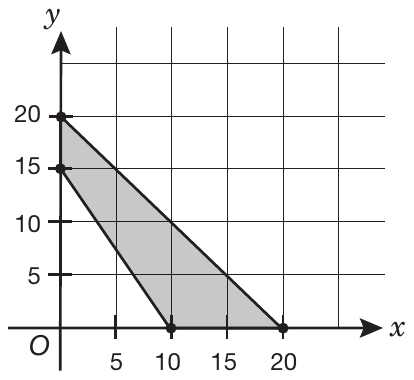
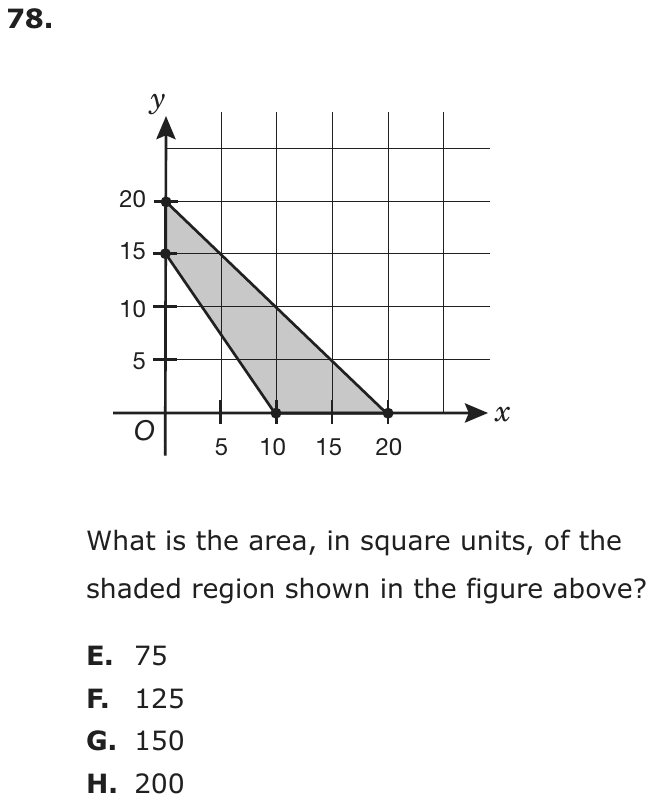
What is the area, in square units, of the shaded region shown in the figure above?
- A75
- B125
- C150
- D200
Show the answer
Correct answer: B
The area of the shaded region, in square units, is the area of the triangle created by the shaded and unshaded regions minus the area of the triangle created by the unshaded region.
The area of the triangle created by the shaded and unshaded regions is 200 square units.
The area of the triangle created by the unshaded region is 75 square units.
Subtract to find the area of the shaded region.
Question analysis
A coordinate geometry question: two line segments cross a grid, one from (0, 20) to (20, 0) and one from (0, 15) to (10, 0), and the region between them is shaded. Students find the shaded area. The shape is not a standard figure, so they need to see it as one triangle with another removed.
- Grade level
- Grade 6 content, by NYS standard
- Compared with grade 7
- At grade 7 Area of triangles is grade 6 content; finding a composite area by subtraction is the kind of task grade 7 students meet regularly. Points on the axes make every length easy to read.
- Estimated difficulty
- Straightforward: two steps or one careful reading.
- Thinking it demands
- Depth of knowledge 2, skills and concepts · mainly apply
- What makes it hard
- Reading a figure, table or graph moderate
- No obvious method minor
- Something you must already know minor
- Solution
- 3 steps
- Reading level
- Question and choices: about grade 6, 16 words.
- Students, last 30 days
- Not enough answers yet to show (it takes 10).
Why it is hard, traps and wrong answers (shows the answer)
Why it is hard
The shaded shape has no name, so the question is about seeing it as a difference of two right triangles whose legs lie on the axes. Once that is seen, both areas are one-line calculations. The wrong choices come from stopping after either triangle or from pairing a base from one segment with a height from the other.
Reading a figure, table or graph moderate Understanding the question
All four lengths come from where the two segments meet the axes, at 20 and 15 on the y-axis and at 10 and 20 on the x-axis, read against grid lines 5 units apart. (Lesh, Post & Behr, 1987; Kirsch & Mosenthal, 1990)
No obvious method minor Working it out
The shaded region is a four-sided shape with no formula of its own; it has to be seen as the large triangle with the small one removed. (Schoenfeld, 1985)
Something you must already know minor Working it out
The area of a triangle, one half of base times height, is assumed and not given. (Anderson & Krathwohl, 2001)
Strategy: Find the area of the large right triangle under the outer segment and subtract the area of the smaller triangle under the inner segment, reading the legs from the axes.
Traps
- Stops one step early: A choice is a number from partway through the solution.
- Answers a different question: A choice is right for another quantity: the other unknown, the rest instead of the part, the part instead of the whole.
- Misreads the figure: Reads a value, label or tick spacing in a figure, table or graph wrongly.
The wrong answers, classified
A Answers a different question (King et al., 2004; Hegarty, Mayer & Monk, 1995)
Finds the area of the small unshaded triangle, 1/2 × 10 × 15 = 75, and gives that region instead of the shaded one.
C Misreads the figure (Lesh, Post & Behr, 1987; Kirsch & Mosenthal, 1990)
Pairs the outer segment's x-intercept, 20, with the inner segment's y-intercept, 15, as if they bounded one triangle: 1/2 × 20 × 15 = 150.
D Stops one step early (King et al., 2004; Gierl et al., 2017)
Finds the area of the large triangle, 1/2 × 20 × 20 = 200, and stops before subtracting the unshaded triangle inside it.
Worked solution, step by step
Formulas used
- Area of a triangle
- A is the area. b is the base, the side the triangle sits on. h is the height: the straight-up distance from the base to the top corner, at a right angle to the base. You take half because a triangle is half of a rectangle with the same base and height.
Sort out the figure
The grid lines are 5 units apart. Two slanted segments run from the y-axis down to the x-axis. The outer one goes from 20 on the y-axis to 20 on the x-axis. The inner one goes from 15 on the y-axis to 10 on the x-axis. The shaded region is the strip between them. You need its area, in square units.
See the shape as two triangles
The shaded region has four sides, and it has no simple formula. But look at the big triangle under the outer segment, with its corner at O. It is the shaded strip plus the small white triangle. So the shaded area is the big triangle minus the small one.
Find the area of the big triangle
The big triangle has a right angle at O. Its base runs along the x-axis from 0 to 20, so it is 20 units. Its height runs up the y-axis from 0 to 20, so it is 20 units.
Watch out: this is the whole big triangle. Stopping here gives 200, choice D.
Find the area of the small triangle
The small triangle also has its right angle at O. Its base is 10 units, from 0 to 10 on the x-axis. Its height is 15 units, from 0 to 15 on the y-axis.
Watch out: 75 is the white triangle, choice A, not the shaded part. Also, pair the base and height of the same triangle. Mixing 20 and 15 gives 150, choice C.
Subtract to find the shaded area
Take the small white triangle away from the big triangle.
The shaded area is 125 square units. So the answer is B, 125.
Check your answer
In the figure, the shaded strip looks bigger than the white triangle. So the shaded area should be more than half of the big triangle, which is . 125 is more than 100. And , the whole big triangle.
More questions like this
The original DOE question
Question 2 of 3
2023 Test B Math, question 56Question
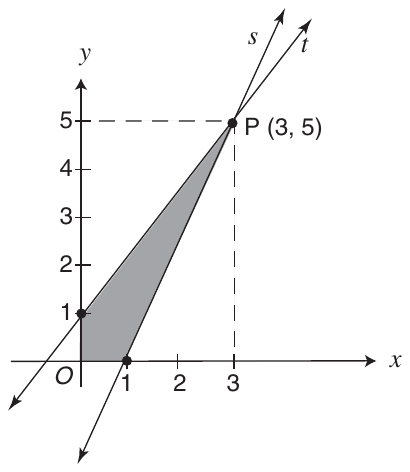
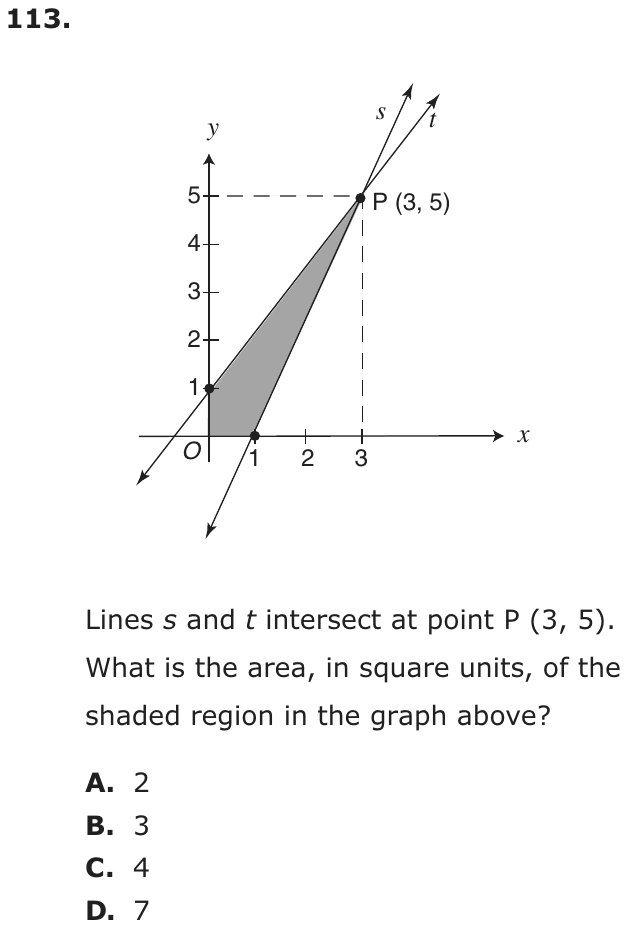
Lines s and t intersect at point P (3, 5). What is the area, in square units, of the shaded region in the graph above?
- A2
- B3
- C4
- D7
Show the answer
Correct answer: C
First, find the area of the rectangle in the graph:
Then, find the areas of the two right triangles that are not shaded:
Upper triangle:
Lower triangle:
The area of the shaded region, in square units, is calculated by subtracting the total area of the two right triangles from the area of the rectangle:
Question analysis
Two lines meet at the point (3, 5) on a coordinate grid, and the shaded region between them and the axes is a four-sided shape. Students find its area in square units. The shape is not a standard figure, so no single area formula applies to it directly.
- Grade level
- Grade 6 content, by NYS standard
- Compared with grade 7
- At grade 7 Areas of triangles and rectangles are grade 6 content, and grade 7 students often find composite areas. This region is an irregular four-sided shape with two slanted sides, so students need a plan, and the lengths come from coordinates rather than labels.
- Estimated difficulty
- Moderate: several steps, or a close reading with one strong distractor.
- Thinking it demands
- Depth of knowledge 2, skills and concepts · mainly apply
- What makes it hard
- No obvious method moderate
- Reading a figure, table or graph moderate
- Many steps minor
- Solution
- 4 steps
- Reading level
- Question and choices: about grade 4, 23 words.
- Students, last 30 days
- Not enough answers yet to show (it takes 10).
Why it is hard, traps and wrong answers (shows the answer)
Why it is hard
The question rewards a plan more than computation: the region has no name, so students must see it inside the dashed rectangle from O to P, with two right triangles cut away. Reading each triangle’s legs from the axes is the second hurdle, since the 1-unit intercepts shorten one leg of each, to 4 instead of 5 and to 2 instead of 3. Only one wrong choice, from using one coordinate as both heights, has a clear working behind it, so most errors here are guesses after a failed plan.
No obvious method moderate Working it out
The shaded shape has four sides, two of them slanted, and no formula of its own; it must be boxed in the 3-by-5 rectangle with two triangles removed, or cut along OP. (Schoenfeld, 1985)
Reading a figure, table or graph moderate Understanding the question
No lengths are labeled; every one comes from the coordinates of P (3, 5), the y-intercept 1 of line s and the x-intercept 1 of line t. (Lesh, Post & Behr, 1987; Kirsch & Mosenthal, 1990)
Many steps minor Working it out
The rectangle, two triangle areas and a subtraction make four computations, 15, 6 and 5, then 15 − 11, each built from different coordinates. (Daniel & Embretson, 2010; Enright, Morley & Sheehan, 2002)
Strategy: Draw the rectangle from O to P, find the areas of the two unshaded right triangles inside it from the coordinates, and subtract both from the rectangle's area.
Traps
- Misreads the figure: Reads a value, label or tick spacing in a figure, table or graph wrongly.
The wrong answers, classified
A Little reason to choose it (Haladyna & Downing, 1993; Rodriguez, 2005)
No common working gives 2; no rectangle or triangle built from the coordinates leaves that area, so it mostly draws students who judge the narrow region by eye.
B Misreads the figure (Lesh, Post & Behr, 1987; Kirsch & Mosenthal, 1990)
Cuts the region along OP into two triangles with bases of 1 but uses 3, the x-coordinate of P, as the height of both: 1.5 + 1.5 = 3.
D Little reason to choose it (Haladyna & Downing, 1993; Rodriguez, 2005)
No common working gives 7; half of the 3-by-5 rectangle, 7.5, comes closest, so it mostly draws students who guess the region fills about half.
Worked solution, step by step
Formulas used
- Area of a rectangle
- A is the area, in square units. l is the length and w is the width. Multiplying them counts the unit squares that fill the rectangle.
- Area of a triangle
- A is the area. b is the base, one side. h is the height: the distance from the base straight up to the far corner. A right triangle has a square corner, and the two sides that meet there are the base and height. A triangle is half of a rectangle with the same base and height.
Sort out the shaded region
The shaded region has four corners: O at (0, 0), (0, 1) on the y-axis, P at (3, 5), and (1, 0) on the x-axis. Line t meets the y-axis at (0, 1), and line s meets the x-axis at (1, 0). There is no easy formula for this shape. But the dashed lines make a rectangle around it. So find the rectangle’s area and take away the white parts.
Find the rectangle’s area
The rectangle has corners O, (3, 0), P and (0, 5). It is 3 units wide and 5 units tall.
The rectangle’s area is 15 square units.
Find the upper triangle’s area
The white triangle at the top left has corners (0, 1), (0, 5) and P. Its square corner, or right angle, is at (0, 5). One side runs up the y-axis from 1 to 5, so it is 4 units. The other runs across from 0 to 3, so it is 3 units.
Its area is 6 square units.
Find the lower triangle’s area
The white triangle at the bottom right has corners (1, 0), (3, 0) and P. Its square corner is at (3, 0). One side runs along the x-axis from 1 to 3, so it is 2 units. The other goes up from 0 to 5, so it is 5 units.
Its area is 5 square units.
Watch out: The lines cross the axes at 1, not at O. So these sides are 4 and 2, not 5 and 3.
Subtract the white triangles
Take both triangles away from the rectangle.
The shaded area is 4 square units.
So the answer is C, 4.
Check your answer
Cut the shaded region along a line from O to P. One piece has a base of 1 on the x-axis and a height of 5, since P is 5 units up. Its area is 2.5. The other has a base of 1 on the y-axis and a height of 3, since P is 3 units across. Its area is 1.5. Then 2.5 + 1.5 = 4. Using 3 for both heights gives 3, choice B.
More questions like this
The original DOE question
Question 3 of 3
2018 Test A Math, question 18Question
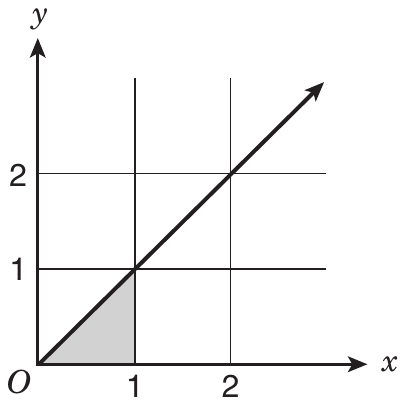
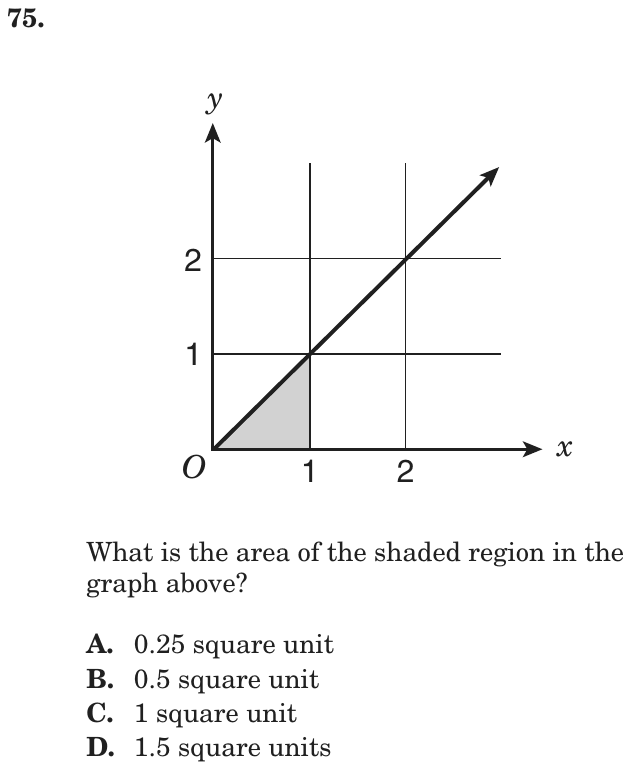
What is the area of the shaded region in the graph above?
- A0.25 square unit
- B0.5 square unit
- C1 square unit
- D1.5 square units
Show the answer
Correct answer: B
The shaded region is a right triangle. Each leg is 1 unit in length.
So the area is
or 0.5 sq unit
Question analysis
A coordinate grid question: find the area of a shaded right triangle with corners at the origin, (1, 0) and (1, 1), under a diagonal line. Students read the base and height from the grid and apply the triangle area formula. The figure does most of the work; the task is recalling the formula correctly.
- Grade level
- Grade 6 content, by NYS standard
- Compared with grade 7
- Below grade 7 Finding a triangle's area from a grid is grade 6 work, and this takes one step with whole-unit legs. It is easier than typical grade 7 area problems, which use composite figures or scale drawings.
- Estimated difficulty
- Routine: one familiar step, little to misread.
- Thinking it demands
- Depth of knowledge 1, recall and reproduction · mainly apply
- What makes it hard
- Solution
- 1 step
- Reading level
- Question and choices: about grade 2, 20 words.
- Students, last 30 days
- Not enough answers yet to show (it takes 10).
Why it is hard, traps and wrong answers (shows the answer)
Why it is hard
This is a quick formula question with legs of 1. The main risk is the one-half in the triangle formula: leaving it out gives the area of the whole grid square, which is a listed choice. Seeing that the diagonal cuts the unit square exactly in half gives a check that needs no formula at all.
Reading a figure, table or graph minor Understanding the question
The legs of the shaded triangle, from O to (1, 0) and up to (1, 1), are read off the grid lines; the line running on to (2, 2) is not part of the region. (Lesh, Post & Behr, 1987; Kirsch & Mosenthal, 1990)
Something you must already know minor Working it out
The triangle area formula, one half times base times height, is needed and not given; the shaded triangle is half of one grid square. (Anderson & Krathwohl, 2001)
Strategy: Read the two legs straight off the grid, then apply the triangle area formula, base times height divided by two.
Traps
- A formula you must know: Needs a formula the test does not give: area, circumference, volume, probability rules.
The wrong answers, classified
A Misreads the figure (Lesh, Post & Behr, 1987; Kirsch & Mosenthal, 1990)
Judges the shaded triangle by eye as a quarter of the 1-by-1 grid square instead of the half that the diagonal from O to (1, 1) cuts off.
C Wrong formula (King et al., 2004)
Multiplies base by height, 1 × 1 = 1, and leaves out the one-half, giving the whole unit square instead of the triangle.
D Little reason to choose it (Haladyna & Downing, 1993; Rodriguez, 2005)
No common working gives 1.5, which is more than the whole grid square around the shaded triangle; it mostly draws guesses.
Worked solution, step by step
Formulas used
- Area of a triangle
- A is the area. b is the base, the side the triangle sits on. h is the height: the straight-up distance from the base to the top corner, at a right angle to the base. You take half because a triangle is half of a rectangle with the same base and height.
Sort out the shaded region
The shaded region is a triangle. Its corners are O, the point (1, 0) and the point (1, 1). O is the origin, the point (0, 0) where the axes meet. The line keeps going up to (2, 2), but only the small triangle is shaded. You need its area in square units.
Read the base and height
The base lies along the x-axis, from O to 1. So the base is 1 unit. The height goes straight up from (1, 0) to (1, 1). So the height is 1 unit too. The base and height meet at a right angle, as the grid lines show.
Use the triangle formula
The area is 0.5 square unit. Watch out: don’t forget the one half. is the whole grid square, choice C. So the answer is B, 0.5 square unit.
Check your answer
The grid square from 0 to 1 has an area of 1 square unit. The slanted line cuts it corner to corner into two equal triangles. The shaded one is half the square, so 0.5 square unit.
More questions like this
The original DOE question