Verb tense or form
Question 1 of 3
2026 Practice Test B English, question 51Question
How should the paragraph be revised?
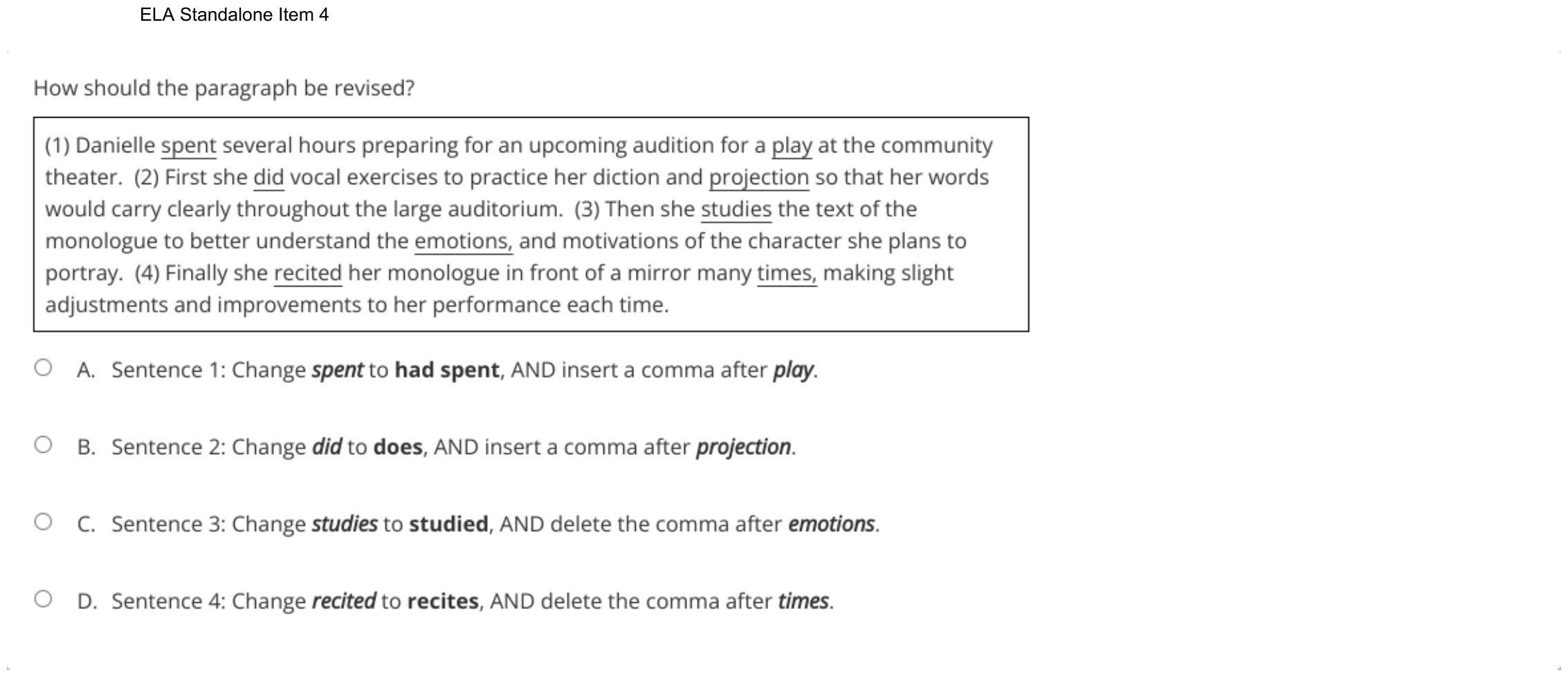
(1) Danielle spent several hours preparing for an upcoming audition for a play at the community theater. (2) First she did vocal exercises to practice her diction and projection so that her words would carry clearly throughout the large auditorium. (3) Then she studies the text of the monologue to better understand the emotions, and motivations of the character she plans to portray. (4) Finally she recited her monologue in front of a mirror many times, making slight adjustments and improvements to her performance each time.
- ASentence 1: Change spent to had spent, AND insert a comma after play.
- BSentence 2: Change did to does, AND insert a comma after projection.
- CSentence 3: Change studies to studied, AND delete the comma after emotions.
- DSentence 4: Change recited to recites, AND delete the comma after times.
Show the answer
Correct answer: C
The question asks how the paragraph should be revised.
A. Incorrect. The revisions in this option introduce new errors. The word “spent” is correct in the simple past tense because it encompasses the actions described throughout the rest of the paragraph, all of which happened during those “several hours.” Additionally, adding a comma after the word “play” would be incorrect because it would unnecessarily separate the prepositional phrase “at the community theater” from the rest of the sentence.
B. Incorrect. The revisions in this option introduce new errors. The word “did” is correct as written in the past tense because the past tense is used throughout the paragraph. There is no comma needed after the word “projection” because “so” is functioning not as a conjunction but rather as part of the conjunction phrase “so that,” which does not take a comma.
C. CORRECT. Changing the word “studies” from the present tense to the past tense “studied” is necessary to match the past tense established in the paragraph (“spent,” “recited”). Additionally, the comma after the word “emotions” needs to be removed because the words “emotions and motivations” are part of a group (series) of two elements, and when there are only two elements in a series, a comma is not used.
D. Incorrect. The revisions in this option introduce new errors. The word “recited” is correct as written in the past tense because the past tense is used throughout the paragraph. Also, removing the comma after “times” is incorrect because the comma is needed in order to separate the modifying phrase “making slight adjustments and improvements to her performance each time” from the main clause.
Question analysis
This grammar and punctuation question gives a four-sentence paragraph about Danielle preparing for an audition at the community theater, with eight spots underlined. Each answer choice pairs a verb change with a comma change in a single sentence, so students must judge verb tense and comma use together and accept a choice only if both of its edits are needed.
- Grade level
- Grade 6 reading and task
- Compared with grade 7
- Below grade 7 Keeping verb tense consistent and using commas correctly are taught before grade 7, and this paragraph is short and plain. Each choice bundles two edits, so a student who spots one real error can confirm the answer with the other.
- Estimated difficulty
- Routine: one familiar step, little to misread.
- Thinking it demands
- Depth of knowledge 1, recall and reproduction · mainly apply
- What makes it hard
- Evidence
- Answered from one paragraph or stanza
- Reading level
- Question and choices: about grade 10, 133 words.
- Students, last 30 days
- Not enough answers yet to show (it takes 10).
Why it is hard, traps and wrong answers (shows the answer)
Why it is hard
The shift to “Then she studies” stands out in a story told in the past tense with “spent,” “did” and “recited,” and finding either half of the right option is enough to choose it. That makes this one of the easiest editing questions. Students who miss it usually trust a half-remembered comma rule, such as a comma before “so,” and stop checking the verb in the same option.
A rule that doesn't sound wrong minor Working it out
Only two nouns, “emotions” and “motivations,” follow “the,” so the comma between them has no job, yet a habit of putting commas before “and” in lists hides it. (Connors & Lunsford, 1988)
Every choice must be checked minor Choosing the answer
The four options each pair a tense change with a comma change, one option per sentence, and an option is right only when both of its edits repair real errors. (Embretson & Wetzel, 1987)
Strategy: Find the tense of the paragraph's first verb, check every underlined verb against it, and then confirm that the comma change in the same choice is needed too.
The wrong answers, classified
A Verb tense or form (Connors & Lunsford, 1988)
Thinks “had spent” is needed because the preparing came before the audition, and accepts a comma after “play” that would cut off “at the community theater.”
B Punctuation (Connors & Lunsford, 1988)
Applies the rule of a comma before “so” joining two clauses, missing that “so that” opens a purpose clause with no comma, and accepts the present-tense “does.”
D Verb tense or form (Connors & Lunsford, 1988)
Notices that the tenses clash but takes the present-tense “studies” as the standard, shifts “recited” to match, and drops the comma that sets off “making slight adjustments.”
Working it out, step by step
Figure out what the question asks
This question asks how to fix the paragraph. Each choice makes two changes in one sentence: a verb change and a comma change. A choice is right only if both changes fix real errors. So check both halves.
Rule 1: keep one tense
Tense is when an action happens: past, present or future. A story should stay in one tense. Example: I woke up and eat breakfast mixes tenses. It should be I woke up and ate breakfast. This paragraph is in the past: “spent,” “did,” “recited.” But sentence 3 says “Then she studies.” That is present tense. It should be “studied.”
Rule 2: no comma between two
When only two things are joined by and, don’t put a comma between them. Example: I like apples and pears. Sentence 3 says “the emotions, and motivations.” There are only two things, so the comma should go. Fixed: the emotions and motivations of the character.
Check each choice
- A is wrong. “Spent” is already correct past tense. A comma after “play” would cut off “at the community theater.”
- B is wrong. “Does” is present tense, so it would create an error. And no comma goes before “so that.”
- C is right. “Studied” fixes the tense, and dropping the comma fixes the pair.
- D is wrong. “Recites” would create an error. The comma after “times” is needed to set off “making slight adjustments and improvements to her performance each time.”
Watch out: B tempts students who remember a comma before “so.” But “so that” tells a purpose, why she practiced, and takes no comma.
Choose the answer
So the answer is C: “Sentence 3: Change studies to studied, AND delete the comma after emotions.”
Why this answer and not the closest wrong one
B is the closest wrong answer, because many students put a comma before “so.” But “so that” explains a purpose, and it takes no comma. Also, B’s change to “does” would break the past tense. Both of C’s changes fix real errors.
More questions like this
The original DOE question
Question 2 of 3
2018 Test A English, question 2Question
Read this paragraph.
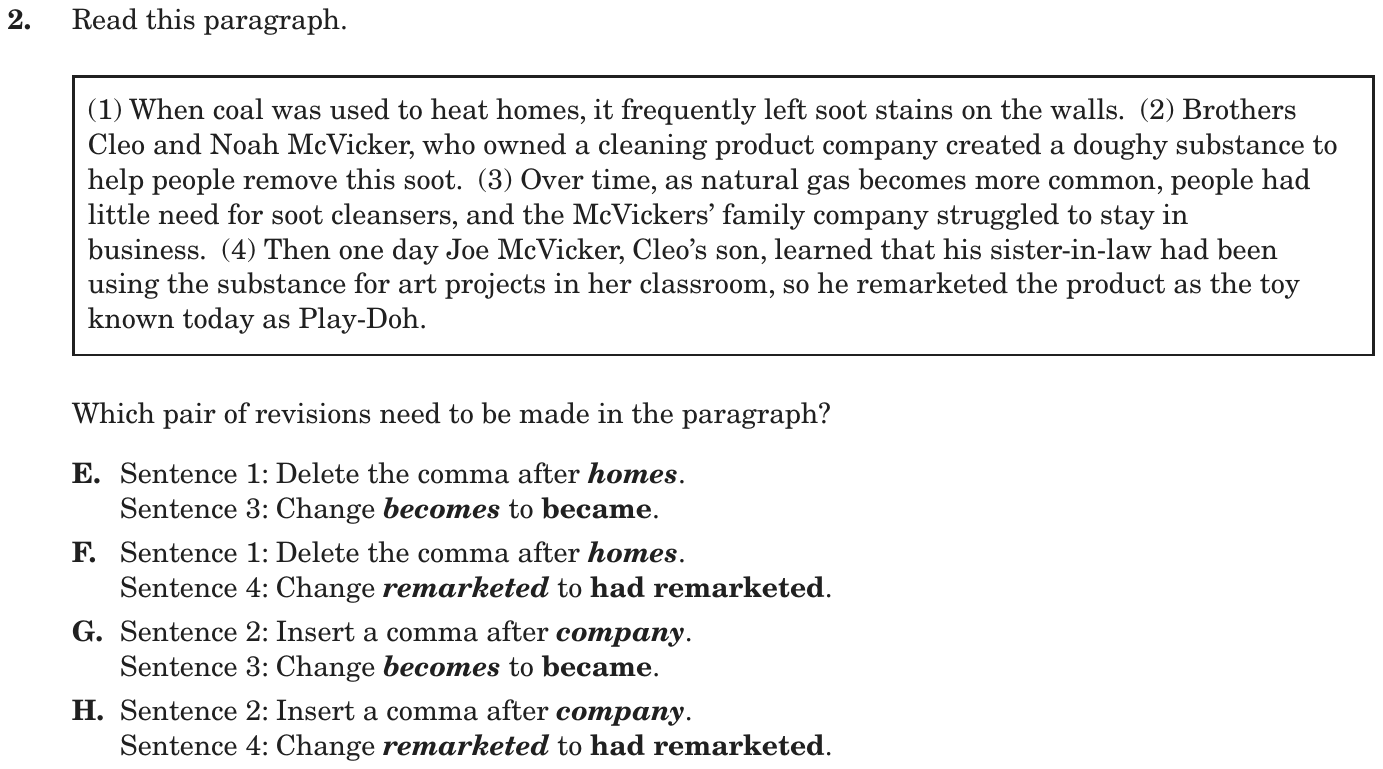
(1) When coal was used to heat homes, it frequently left soot stains on the walls. (2) Brothers Cleo and Noah McVicker, who owned a cleaning product company created a doughy substance to help people remove this soot. (3) Over time, as natural gas becomes more common, people had little need for soot cleansers, and the McVickers’ family company struggled to stay in business. (4) Then one day Joe McVicker, Cleo’s son, learned that his sister-in-law had been using the substance for art projects in her classroom, so he remarketed the product as the toy known today as Play-Doh.
Which pair of revisions need to be made in the paragraph?
- A
Sentence 1: Delete the comma after homes.
Sentence 3: Change becomes to became.
- B
Sentence 1: Delete the comma after homes.
Sentence 4: Change remarketed to had remarketed.
- C
Sentence 2: Insert a comma after company.
Sentence 3: Change becomes to became.
- D
Sentence 2: Insert a comma after company.
Sentence 4: Change remarketed to had remarketed.
Show the answer
Correct answer: C
This is the answer (C)
The question asks for the pair of revisions needed to correct the errors in the paragraph, which appear in sentence 2 and sentence 3.
Option C is correct because it is the only choice that revises the errors in both sentence 2 and sentence 3.
In sentence 2 (Option C and Option D), a comma needs to follow the word “company” to set off the phrase “who owned a cleaning product company.” A comma is necessary because the phrase is a nonrestrictive clause: the phrase provides extra information about Cleo and Noah McVicker’s line of work, but the phrase is not necessary in order to understand the meaning of the sentence.
The second error is in sentence 3 (Option A and Option C), which incorrectly shifts the verb into the present tense. The clause “as natural gas becomes more common” should be “as natural gas became more common.”
The comma after the word “homes” in sentence 1 (Option A and Option B) is necessary for separating the subordinate clause “When coal was used to heat homes” from the main clause.
In sentence 4 (Option B and Option D), the word “remarketed” is in the past tense established in the rest of the paragraph and should not change to the past perfect tense “had remarketed.”
Question analysis
This editing question gives a short paragraph about how a soot cleaner became the toy Play-Doh and asks which pair of revisions it needs. Students must check comma use and verb tense, and because each choice pairs two edits, one correct fix can hide a wrong one.
- Grade level
- Grade 6 reading and task
- Compared with grade 7
- At grade 7 Comma rules and verb tense are taught by grade 6, but here the student must judge four separate edits and accept a choice only if both of its edits are needed, which matches grade 7 demand.
- Estimated difficulty
- Moderate: several steps, or a close reading with one strong distractor.
- Thinking it demands
- Depth of knowledge 2, skills and concepts · mainly apply
- What makes it hard
- A rule that doesn't sound wrong moderate
- A very close wrong answer moderate
- Every choice must be checked minor
- Evidence
- Answered from one paragraph or stanza
- Reading level
- Question and choices: about grade 7, 155 words.
- Students, last 30 days
- Not enough answers yet to show (it takes 10).
Why it is hard, traps and wrong answers (shows the answer)
Why it is hard
The paragraph holds two errors of different kinds, an unclosed “who” clause and a slip into present tense, and the other two proposed edits change text that is already correct. Students who catch the tense shift but not the comma are left between two pairs, and many then delete the sound comma after the opening “When” clause. The question rewards finding both errors in the paragraph before reading the pairs.
A rule that doesn't sound wrong moderate Working it out
The “who owned a cleaning product company” clause opens with a comma but never closes, and sentence 2 still reads smoothly aloud, so the missing comma after “company” is easy to miss. (Connors & Lunsford, 1988)
A very close wrong answer moderate Choosing the answer
The right pair and the pair that deletes the comma after “homes” share the “becomes” to “became” fix, so only the comma edit, after “company” or after “homes”, tells them apart. (Embretson & Wetzel, 1987; Gorin & Embretson, 2006; Ascalon et al., 2007)
Every choice must be checked minor Choosing the answer
The four pairs draw on four possible edits in four sentences, so each edit has to be judged on its own and a pair accepted only when both are needed. (Embretson & Wetzel, 1987)
Strategy: Find the errors yourself before looking at the pairs: check whether each comma is needed or missing, and check that each verb's tense fits when its event happened.
Traps
- Punctuation: A comma, semicolon, colon, dash or apostrophe used where it does not belong, or missing where it does.
- Verb tense or form: The wrong tense, an inconsistent shift of tense, or a wrong verb form.
- Fixes what isn't broken: Changes a part of the sentence that was already correct, while the real error stays; or, where the question asks which sentence has an error or should go, picks one that is correct and belongs.
The wrong answers, classified
A Punctuation (Connors & Lunsford, 1988)
Gets the “becomes” to “became” fix but, missing the unclosed “who” clause in sentence 2, deletes the comma that correctly ends the opening clause of sentence 1.
B Fixes what isn't broken (Connors & Lunsford, 1988)
Changes two correct parts, deleting the comma after an opening clause and adding a needless past perfect, while both real errors in sentences 2 and 3 stay.
D Verb tense or form (Connors & Lunsford, 1988)
Adds the needed comma after “company” but thinks the later event needs “had remarketed”, missing the real tense error, the present-tense “becomes” in sentence 3.
Working it out, step by step
Figure out what the question asks
Each choice is a pair of edits. You need the pair where both edits are needed. If even one edit in a pair changes something that was already right, that pair is wrong. The best plan is to find the errors yourself first. Then look for the pair that fixes them.
Check the comma in sentence 2
Sentence 2 says “Brothers Cleo and Noah McVicker, who owned a cleaning product company created a doughy substance.” The part “who owned a cleaning product company” is extra information. The sentence still makes sense without it. Extra information in the middle of a sentence needs a comma on both sides. Example: My aunt, who lives in Ohio, sent me a card. Sentence 2 has the first comma but not the second. So you need to add a comma after “company.”
Check the comma in sentence 1
Sentence 1 starts with “When coal was used to heat homes.” That part is a dependent clause (a group of words with a verb that can’t stand alone as a sentence). When a sentence starts with one, a comma goes after it. Example: When the bell rang, we ran outside. So the comma after “homes” is correct. Deleting it would add an error. That rules out choices A and B.
Check the verb in sentence 3
Verb tense tells when something happens. This paragraph tells a story from the past, so its verbs should stay in the past. Sentence 3 says “as natural gas becomes more common.” The word “becomes” is present tense. But the same sentence uses “had” and “struggled,” which are past tense. So change “becomes” to became.
Check the verb in sentence 4
Sentence 4 says Joe learned about the art projects, so he “remarketed” the product. Remarketed means sold it again in a new way. The form had remarketed is for something that happened before another past event. But Joe remarketed the product after he learned about the art projects. So the plain past “remarketed” is right. No change is needed.
Find the pair that matches
The two needed edits are: add a comma after “company,” and change “becomes” to “became.”
- A fixes the verb but deletes a correct comma.
- B makes two changes that are not needed.
- D adds the comma but changes a verb that was already right.
- C makes exactly the two needed edits.
So the answer is C.
Why this answer and not the closest wrong one
Choice A is the closest wrong answer, because it has the same “becomes” to “became” fix. But A also deletes the comma after “homes,” and that comma belongs after an opening “When” clause. Only C fixes both real errors and changes nothing that was already right.
More questions like this
The original DOE question
Question 3 of 3
2018 Test B English, question 4Question
Read this paragraph.
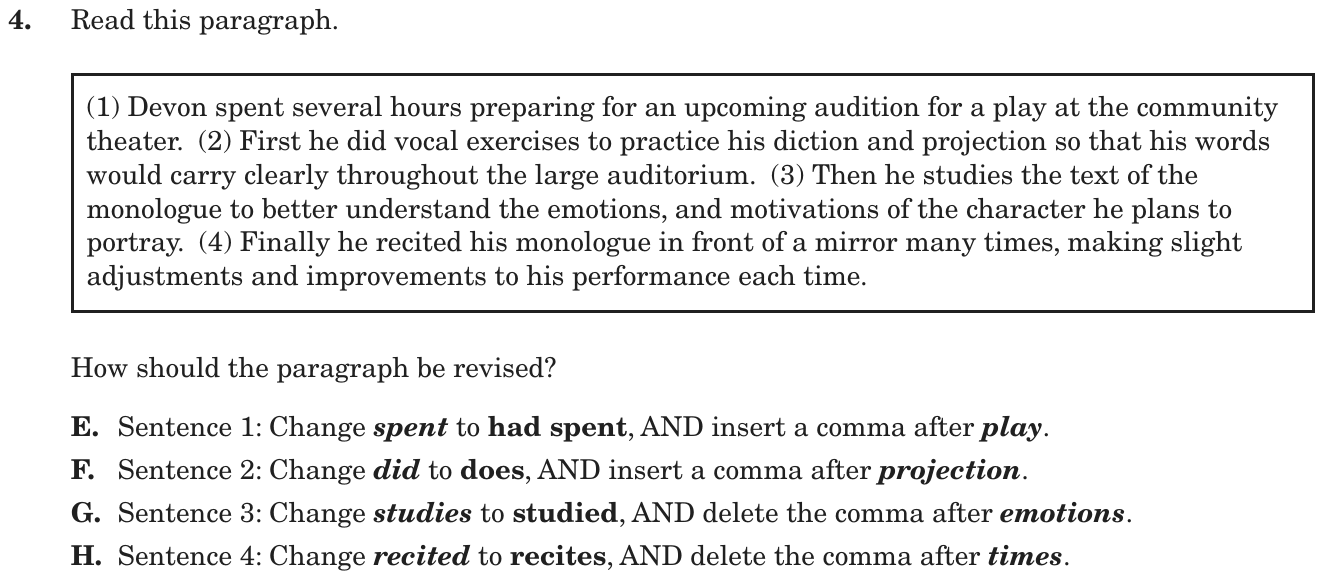
(1) Devon spent several hours preparing for an upcoming audition for a play at the community theater. (2) First he did vocal exercises to practice his diction and projection so that his words would carry clearly throughout the large auditorium. (3) Then he studies the text of the monologue to better understand the emotions, and motivations of the character he plans to portray. (4) Finally he recited his monologue in front of a mirror many times, making slight adjustments and improvements to his performance each time.
How should the paragraph be revised?
- ASentence 1: Change spent to had spent, AND insert a comma after play.
- BSentence 2: Change did to does, AND insert a comma after projection.
- CSentence 3: Change studies to studied, AND delete the comma after emotions.
- DSentence 4: Change recited to recites, AND delete the comma after times.
Show the answer
Correct answer: C
The question asks for the necessary revisions to the paragraph. Option C is correct because the errors appear in sentence 3 of the paragraph. The word “studies” is in the present tense, but it should be changed to “studied” to match the past tense established in the paragraph (“spent,” “recited”). Additionally, the comma after the word “emotions” needs to be removed because the words “emotions and motivations” are part of a group (series) of two elements, and when there are only two elements in a series, a comma is not used.
Option A is incorrect because sentence 1 does not need to be revised. The word “spent” is correct in the past tense, and there is no need to insert a comma after the word “play.”
Option B is incorrect because sentence 2 does not need to be revised. The word “did” is correct as written in the past tense, and there is no comma needed after the word “projection” because “so” is not functioning as a conjunction but rather as part of the conjunction phrase “so that,” which does not take a comma.
Option D is incorrect because sentence 4 does not need to be revised. The word “recited” is correct as written in the past tense, and the comma after “times” is needed in order to separate the modifying phrase “making slight adjustments and improvements to his performance each time” from the main clause.
Question analysis
This grammar and punctuation question gives a four-sentence paragraph about Devon preparing for a theater audition. Each answer choice pairs a verb change with a comma change in a single sentence. Students judge verb tense and comma use together, since a choice is right only if both of its edits are needed.
- Grade level
- Grade 6 reading and task
- Compared with grade 7
- Below grade 7 Verb tense consistency and basic comma use are taught before grade 7, and this paragraph is short and plain. Each choice bundles two edits, so a student who finds one real error can confirm the answer with the other.
- Estimated difficulty
- Routine: one familiar step, little to misread.
- Thinking it demands
- Depth of knowledge 1, recall and reproduction · mainly apply
- What makes it hard
- Evidence
- Answered from one paragraph or stanza
- Reading level
- Question and choices: about grade 9, 136 words.
- Students, last 30 days
- Not enough answers yet to show (it takes 10).
Why it is hard, traps and wrong answers (shows the answer)
Why it is hard
The tense error is easy to hear: “Then he studies” breaks a past-tense story told with “spent,” “did” and “recited.” Spotting either half of the correct choice is enough to find it, which is why this is one of the easier editing questions. Students who go wrong are usually drawn by a comma rule they half remember, such as a comma before “so,” and stop checking the verb.
A rule that doesn't sound wrong minor Working it out
The comma in “emotions, and motivations” separates just two items, and many students have learned to put a comma before “and” in any list without counting the items. (Connors & Lunsford, 1988)
Every choice must be checked minor Choosing the answer
Each choice bundles a verb change and a comma change in a different sentence, so all four sentences must be checked, and a choice is right only if both of its edits are needed. (Embretson & Wetzel, 1987)
Strategy: Note the tense of the paragraph’s first verb, check every other verb against it, and only then test whether the comma half of that choice is also needed.
The wrong answers, classified
A Verb tense or form (Connors & Lunsford, 1988)
Thinks “had spent” is needed because the preparing came before the audition, and accepts a comma after “play” that would split “a play at the community theater.”
B Punctuation (Connors & Lunsford, 1988)
Follows the rule of a comma before “so” joining two clauses, missing that “so that” introduces a purpose clause and takes no comma, and accepts the present-tense “does.”
D Verb tense or form (Connors & Lunsford, 1988)
Notices that the tenses clash but takes the present-tense “studies” as the standard, shifts “recited” to match, and drops the comma that sets off “making slight adjustments.”
Working it out, step by step
Figure out what the question asks
Each choice makes two changes to one sentence: a verb change and a comma change. The right choice is the one where both changes fix real errors. If either change is not needed, the choice is wrong.
Check the verb tenses
Tense is the time a verb shows: past, present or future. A paragraph should stay in one tense. Example: Yesterday I walk to school should be Yesterday I walked to school.
This paragraph tells about the past: “spent,” “did,” “recited.” But sentence 3 says “Then he studies the text.” “Studies” is present tense. It should be “studied.”
Check the comma rule for pairs
Use commas in a list of three or more things: apples, pears, and plums. But two things joined by “and” take no comma: apples and pears.
Sentence 3 says “the emotions, and motivations.” That is only two things. So the comma after “emotions” should go.
Check each choice
- A is wrong. “Spent” is already past tense. A comma after “play” would cut off “at the community theater.”
- B is wrong. “Does” would be present tense, which is the mistake, not the fix. And “so that” takes no comma before it.
- C is right. Both changes fix real errors in sentence 3.
- D is wrong. “Recites” would be present tense. The comma after “times” is needed. It sets off the describing words “making slight adjustments.”
Watch out: D notices that the tenses don’t match, but it fixes the wrong verb. Three verbs are past and one is present, so change the present one.
Choose the answer
With both fixes, sentence 3 says he studied the text to understand the emotions and motivations of the character. So the answer is C.
Why this answer and not the closest wrong one
D is tempting because it also spots the tense problem. But it changes “recited,” which was already right, to match the one wrong verb. It also removes a comma that is needed. Both of C’s edits fix real errors, so C is the only choice that works.
More questions like this
The original DOE question