7W1e concluding an argument
Question 1 of 2
2024 Test B English, question 9Passage Find Time to Volunteer
Find Time to Volunteer
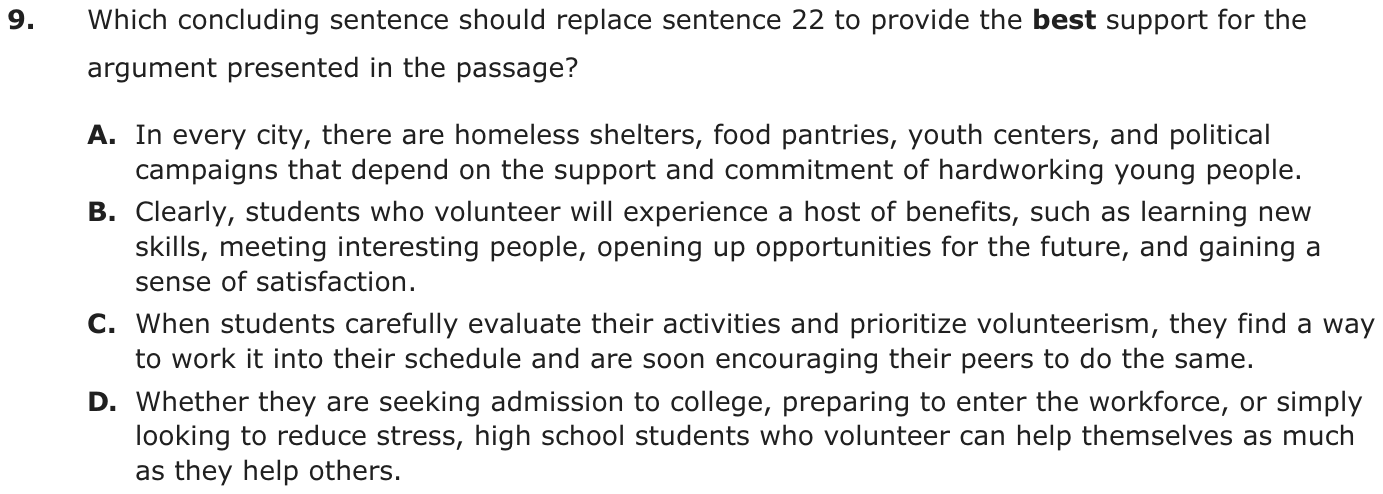
(1) Many people believe that they gain a greater sense of purpose by giving their time to serve others. (2) These are the people who spend their free time volunteering at various places within the community. (3) Those who are served benefit from the work of these volunteers. (4) However, research shows that those who volunteer also receive benefits.
(5) For many students, this proposition may sound impossible. (6) Schoolwork can require hours of study each week. (7) Volunteering at a retirement center or homeless shelter requires both time and energy. (8) Extracurricular activities fill up after-school time. (9) Family obligations and part-time jobs often have to be worked into the schedule, too. (10) However, if students can find time to volunteer, even for a few hours a month, they may find that the benefits outweigh the scheduling difficulties.
(11) To begin with, students who engage in volunteer activities acquire valuable skills and experience, which can help them focus on potential fields of study and career options. (12) Furthermore, when students list volunteer work on college applications, admissions counselors see applicants who care about making their community and college campus a better place.
(13) Volunteerism benefits more than students applying to college. (14) This type of experience is equally important for students moving directly into the workforce after high school. (15) Volunteering demonstrates initiative, dedication, and a strong work ethic, qualities that companies value in a potential employee. (16) In a CareerBuilder study, 60 percent of managers regarded volunteerism as a significant asset when considering applicants.
(17) Students who volunteer undoubtedly make a positive investment in their future, but they also affect their present quality of life. (18) Studies have shown that volunteering is good for both the mind and the body. (19) Volunteering can boost mood levels and reduce anxiety. (20) According to the Mayo Clinic,1 the feeling of doing something meaningful and the appreciation received from that action can reduce stress.
(21) Even the busiest of students can find a way to donate some time to a worthy cause. (22) Though managing different commitments may seem overwhelming at times, students are sure to feel a sense of fulfillment in volunteerism.
1Mayo Clinic: a nonprofit medical organization dedicated to treatment and research
Question
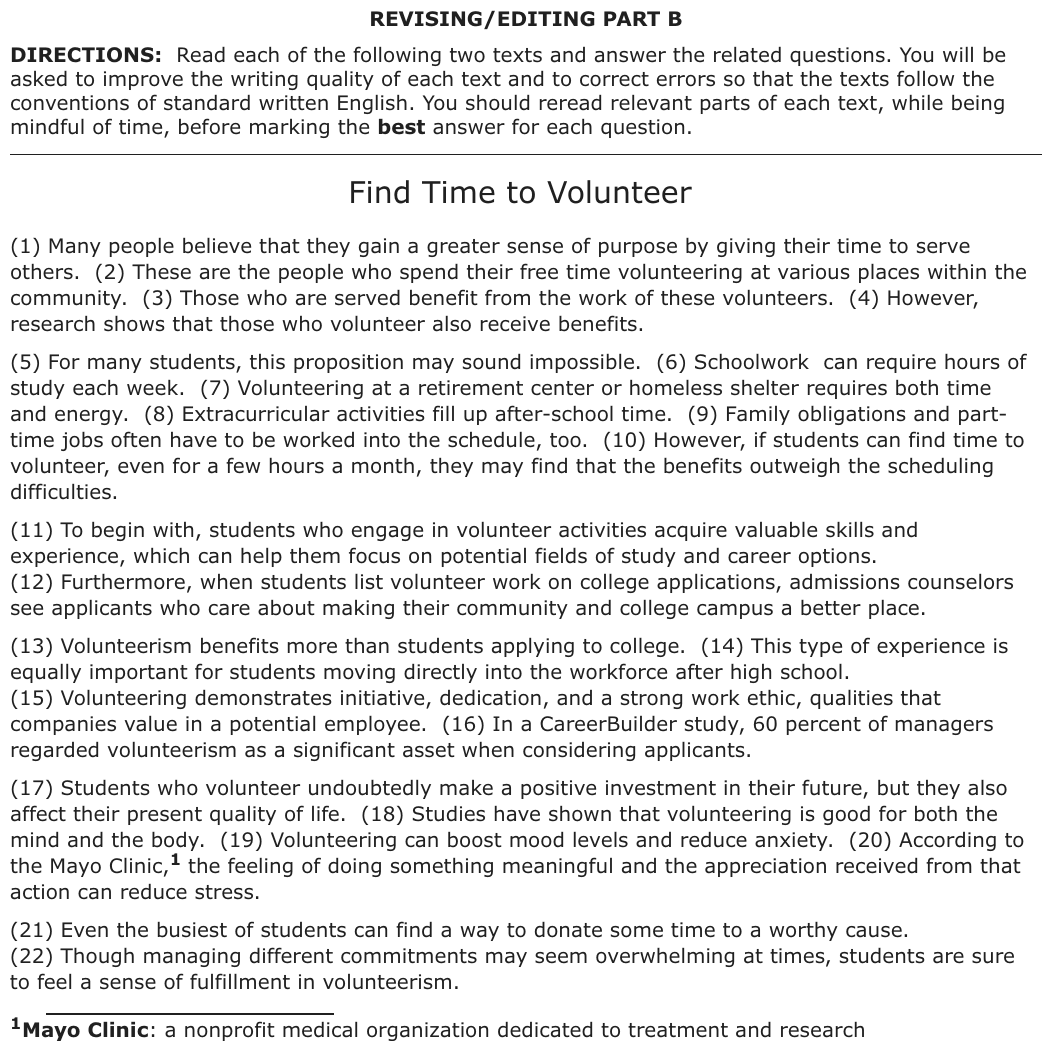
Which concluding sentence should replace sentence 22 to provide the best support for the argument presented in the passage?
- AIn every city, there are homeless shelters, food pantries, youth centers, and political campaigns that depend on the support and commitment of hardworking young people.
- BClearly, students who volunteer will experience a host of benefits, such as learning new skills, meeting interesting people, opening up opportunities for the future, and gaining a sense of satisfaction.
- CWhen students carefully evaluate their activities and prioritize volunteerism, they find a way to work it into their schedule and are soon encouraging their peers to do the same.
- DWhether they are seeking admission to college, preparing to enter the workforce, or simply looking to reduce stress, high school students who volunteer can help themselves as much as they help others.
Show the answer
Correct answer: D
The question asks which concluding sentence should replace sentence 22 to provide the best support for the argument presented in the passage.
A. Incorrect. Although the sentence lists examples of organizations that depend on “hardworking young people” as volunteers, it should not replace sentence 22, because its use of specific examples does not provide a strong conclusion to the main idea in the passage, and it does not best support the main argument that students benefit themselves and their community when volunteering.
B. Incorrect. While the sentence supports the argument that students “will experience a host of benefits” through volunteerism, it should not replace sentence 22 as a concluding sentence, because it does not best support the main argument that volunteerism benefits both the students and their community.
C. Incorrect. Although the sentence emphasizes the importance of prioritizing volunteerism, it should not replace sentence 22, because it focuses on the main idea in the second paragraph (“For many students, this proposition may sound impossible.”), rather than the main argument that volunteerism benefits both students and their community. This sentence introduces the idea that student volunteers “are soon encouraging their peers” to volunteer, which does not best support the argument presented in the passage.
D. CORRECT. This sentence should replace sentence 22 to conclude the passage because it lists specific reasons for volunteering (“Whether they are seeking admission to college, preparing to enter the workforce, or simply looking to reduce stress”) and best supports the main argument that volunteering not only helps students but can also help their community (“high school students who volunteer can help themselves as much as they help others”).
Question analysis
This conclusion question asks which sentence should replace the last line of the essay urging high school students to volunteer. Students need a closing statement that best supports the argument as a whole. Several options list benefits or name real places to volunteer, so the challenge is telling an ending that fits the whole essay from one that drifts.
- NYS standards
- 7W1e concluding an argument
- Grade level
- Grade 7 reading and task
- Compared with grade 7
- At grade 7 Writing a conclusion that sums up an argument is a grade 7 standard. Students recognize one rather than write it, but they must keep the essay’s several reasons in mind while judging four endings that all sound final.
- Estimated difficulty
- Moderate: several steps, or a close reading with one strong distractor.
- Thinking it demands
- Depth of knowledge 2, skills and concepts · mainly evaluate
- What makes it hard
- Evidence in several places moderate
- A very close wrong answer moderate
- Evidence
- Answered from the whole text
- Reading level
- Passage: about grade 11, 354 words; question and choices: about grade 15, 134 words.
- Students, last 30 days
- Not enough answers yet to show (it takes 10).
Why it is hard, traps and wrong answers (shows the answer)
Why it is hard
All four endings sound final, and the strongest wrong one is a fair-sounding list of benefits that opens with “Clearly.” The right ending wins on fit: its three reasons are the essay’s own, college, work and stress, and it keeps the opening idea that volunteers help others as well as themselves. Students who sketch the essay’s reasons paragraph by paragraph before reading the endings can see which one gathers them and which adds a point of its own.
Evidence in several places moderate Working it out
The reasons a conclusion must gather sit in three body paragraphs, college admission in paragraph 3, the workforce in paragraph 4 and stress in paragraph 5, well before sentence 22. (Kirsch & Mosenthal, 1990; Gorin & Embretson, 2006)
A very close wrong answer moderate Choosing the answer
The right ending and the “host of benefits” ending both list what volunteers gain; they part on whether the list matches the essay’s own reasons and keeps the help volunteers give others. (Embretson & Wetzel, 1987; Gorin & Embretson, 2006; Ascalon et al., 2007)
Strategy: List the essay’s reasons for volunteering, one phrase per paragraph, then pick the ending that pulls them together without bringing in a new point.
Traps
- Too narrow: A single detail offered as the central idea or a summary, or a summary that keeps minor details and leaves out an essential part.
- Off the point: Adds or keeps something that does not support the paragraph's or the passage's focus, or an introduction or conclusion that misses the main point.
The wrong answers, classified
A Off the point (Halliday & Hasan, 1976)
Likes the concrete list of shelters, pantries and campaigns, but naming groups that need young volunteers sums up none of the essay’s reasons for volunteering.
B Too narrow (King et al., 2004)
Sums up only what students gain, adding “meeting interesting people,” which the essay never mentions, and drops the point that volunteers help others too.
C Off the point (Halliday & Hasan, 1976)
Carries on sentence 21’s point that busy students can find time, then adds students recruiting their peers, so it ends on scheduling instead of the reasons to volunteer.
Working it out, step by step
Figure out what the question asks
You need a new last sentence for the essay. A good conclusion sums up the argument. It pulls the main reasons together without adding a new idea. Example: an essay on biking to school might end, Biking keeps you fit, saves money and helps clean the air. So first list this essay’s reasons.
List the essay’s reasons
- Paragraph 1: volunteers help others, and “those who volunteer also receive benefits” (sentence 4).
- Paragraph 3: volunteering helps with college applications.
- Paragraph 4: it helps students “moving directly into the workforce,” which means starting a job.
- Paragraph 5: it helps the mind and body, and it “can reduce stress.”
So a good ending names college, work and stress. It also keeps the idea that volunteers help both others and themselves.
Check each choice
- D names all three: “seeking admission to college, preparing to enter the workforce, or simply looking to reduce stress.” It ends with students who “help themselves as much as they help others.” That matches the essay.
- B lists benefits, but it adds “meeting interesting people.” The essay never says that. It also leaves out helping others.
- A lists places that need volunteers. It sums up none of the essay’s reasons.
- C is about fitting volunteering into a schedule and getting friends to join. Getting friends to join is a new idea.
Pick the answer
Watch out: B starts with “Clearly” and lists good things, so it sounds like an ending. But its list is not the essay’s list. So the answer is D.
Why this answer and not the closest wrong one
B is the closest wrong answer, because it also sums up what volunteers gain. But it adds a benefit the essay never discusses, and it drops the help volunteers give others. D gathers the essay’s own reasons, college, work and stress, and keeps both sides of the essay’s idea.
More questions like this
The original DOE question
The passage “Find Time to Volunteer” as printed (page 163)
Question 2 of 2
2018 Test B English, question 9Passage The Local Library
The Local Library
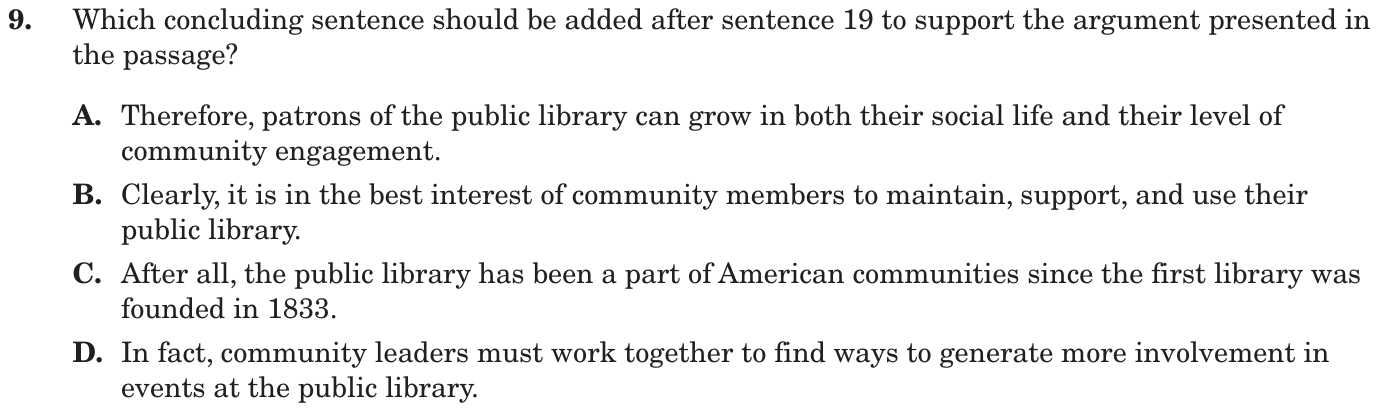
(1) According to a 2015 survey, more than two-thirds of Americans own a smartphone, which means that obtaining information or communicating with people is easier than ever before. (2) With the swipe of a finger, the tap of an icon, or a verbal command, people have instant access to articles, blogs, news, and social networking websites. (3) Even with all these immediately available sources of information, one of the best resources for many members of the community also happens to be one of the oldest. (4) The public library is a great place for people to get information.
(5) The public library serves a truly critical role in promoting community. (6) With the explosion of digital media in recent years, people in different locations can now communicate almost instantaneously. (7) And yet many people complain of feeling more isolated and alone than ever before. (8) The library stands in a rare position to help community members meet this universal need for human connection and companionship.
(9) Furthermore, libraries provide certain amenities, such as access to the Internet, for free to all people. (10) A student who does not have a computer at home can research and type a paper for school. (11) Similarly, an unemployed adult without access to the Internet can make use of library resources to find job opportunities. (12) The free items that are found at the library can help people get a lot done.
(13) Public libraries also offer a variety of resources to community members. (14) One important resource is the local librarian, who does far more than check out books and collect fines. (15) Other library resources include free or low-cost tutoring and training programs. (16) Additionally, lectures, book groups, and town meetings promote critical thinking and community engagement. (17) A typical librarian holds a master’s degree and can help library patrons navigate through the flood of information available in print and on the Internet.
(18) The hallmark of a public library is that its materials and services are accessible to all. (19) The library connects people to a network of information and resources and is an important part of a community.
Question
Which concluding sentence should be added after sentence 19 to support the argument presented in the passage?
- ATherefore, patrons of the public library can grow in both their social life and their level of community engagement.
- BClearly, it is in the best interest of community members to maintain, support, and use their public library.
- CAfter all, the public library has been a part of American communities since the first library was founded in 1833.
- DIn fact, community leaders must work together to find ways to generate more involvement in events at the public library.
Show the answer
Correct answer: B
The question asks for a concluding sentence that would follow sentence 19 and support the argument presented in the passage.
Option B is correct because it logically follows sentence 19 and supports the argument that the public library facilitates connections within a community and provides valuable services—some at no cost—by urging community members to use, maintain, and support their local public library.
Option A is incorrect because it does not provide a logical conclusion that fully supports the argument in the passage; the sentence addresses only one benefit of having a public library, ignoring the valuable services and resources it provides.
Option C is incorrect because it presents the idea that the library has been in existence since 1833, which does not logically provide a conclusion for the passage or support the argument developed in the passage.
Option D is incorrect because it presents a new claim—community leaders must work together to support library events—instead of a conclusion that supports the argument presented in the passage.
Question analysis
This conclusion question asks which sentence should be added after the library essay’s last line. Students choose a closing statement that best supports the argument as a whole. Several endings sound final, so the challenge is judging which one fits the complete argument rather than one part of it.
- NYS standards
- 7W1e concluding an argument
- Grade level
- Grade 7 reading and task
- Compared with grade 7
- At grade 7 Writing a conclusion that explains an argument’s significance is a grade 7 standard. This item asks students to recognize one rather than write it, but they must keep the essay’s full argument in mind to judge which closing sentence fits best.
- Estimated difficulty
- Moderate: several steps, or a close reading with one strong distractor.
- Thinking it demands
- Depth of knowledge 2, skills and concepts · mainly evaluate
- What makes it hard
- Evidence in several places moderate
- How sentences fit together minor
- Evidence
- Answered from the whole text
- Reading level
- Passage: about grade 11, 341 words; question and choices: about grade 12, 92 words.
- Students, last 30 days
- Not enough answers yet to show (it takes 10).
Why it is hard, traps and wrong answers (shows the answer)
Why it is hard
All four endings open with a word that sounds conclusive, “Therefore,” “Clearly,” “After all” or “In fact,” so the opening word is no guide. Students lose the point when they accept a closing line that is true to one part of the essay, or one that introduces something new such as a date or a task for community leaders. The right ending turns the essay’s reasons into a call to keep using and supporting the library.
Evidence in several places moderate Working it out
To judge whether an ending covers the whole argument, students must recall that the free Internet access and the tutoring sit in paragraphs 3 and 4, far from the last sentence. (Kirsch & Mosenthal, 1990; Gorin & Embretson, 2006)
How sentences fit together minor Working it out
Sentence 19 already calls the library “an important part of a community,” so the added line has to build on it, moving from praise to what readers should do. (Halliday & Hasan, 1976)
Strategy: Jot down the essay’s main reasons in a phrase each, then choose the ending that ties them together without bringing in a new fact or a new claim.
Traps
- Too narrow: A single detail offered as the central idea or a summary, or a summary that keeps minor details and leaves out an essential part.
- Off the point: Adds or keeps something that does not support the paragraph's or the passage's focus, or an introduction or conclusion that misses the main point.
The wrong answers, classified
A Too narrow (King et al., 2004)
Sounds conclusive with “Therefore” and restates the social and community-engagement benefits, but omits the free services and resources that make up half the argument.
C Off the point (Halliday & Hasan, 1976)
Is drawn by the authoritative “After all” and a historical date, but a founding in 1833 appears nowhere in the essay and supports none of its reasons.
D Off the point (Halliday & Hasan, 1976)
Knows a persuasive essay often ends with a call to action, but this one assigns a new task to community leaders instead of urging readers to use the library.
Working it out, step by step
Figure out what the question asks
You need a concluding sentence: a last sentence that wraps up the argument. A good conclusion pulls the main points together. It does not bring in a new fact or a new claim.
List the essay’s main reasons
- The library helps people connect with others (paragraph 2).
- It gives free things, like Internet access (paragraph 3).
- It offers librarians, tutoring and lectures (paragraph 4).
- It is open to all and is “an important part of a community” (paragraph 5).
All of these support one claim: people should value and use their library.
Decide what the ending should do
Sentence 19 already says the library “connects people to a network of information and resources.” The new last sentence should build on that. It can tell readers what to do, now that they know the reasons. This kind of ending is called a call to action.
Check each choice
- A is wrong. It covers only social life and community involvement. It leaves out the free services and resources.
- B is right. It tells community members to “maintain, support, and use” the library. That fits every reason in the essay.
- C is wrong. The year 1833 is a new fact that the essay never mentions. It proves nothing about the library’s value.
- D is wrong. It makes a new claim about what community leaders must do.
Watch out: A starts with “Therefore,” so it sounds like a conclusion. But it sums up only part of the argument.
Choose the answer
B ties all the reasons together and tells readers what to do. So the answer is B.
Why this answer and not the closest wrong one
A is the closest wrong answer. It sounds like an ending and repeats ideas from the essay. But it names only the social side of the library. B covers the whole argument: because the library does all these things, people should keep it going and use it.
More questions like this
The original DOE question
The passage “The Local Library” as printed (page 120)