Number line
Question 1 of 3
2026 Practice Test A Math, question 43Question
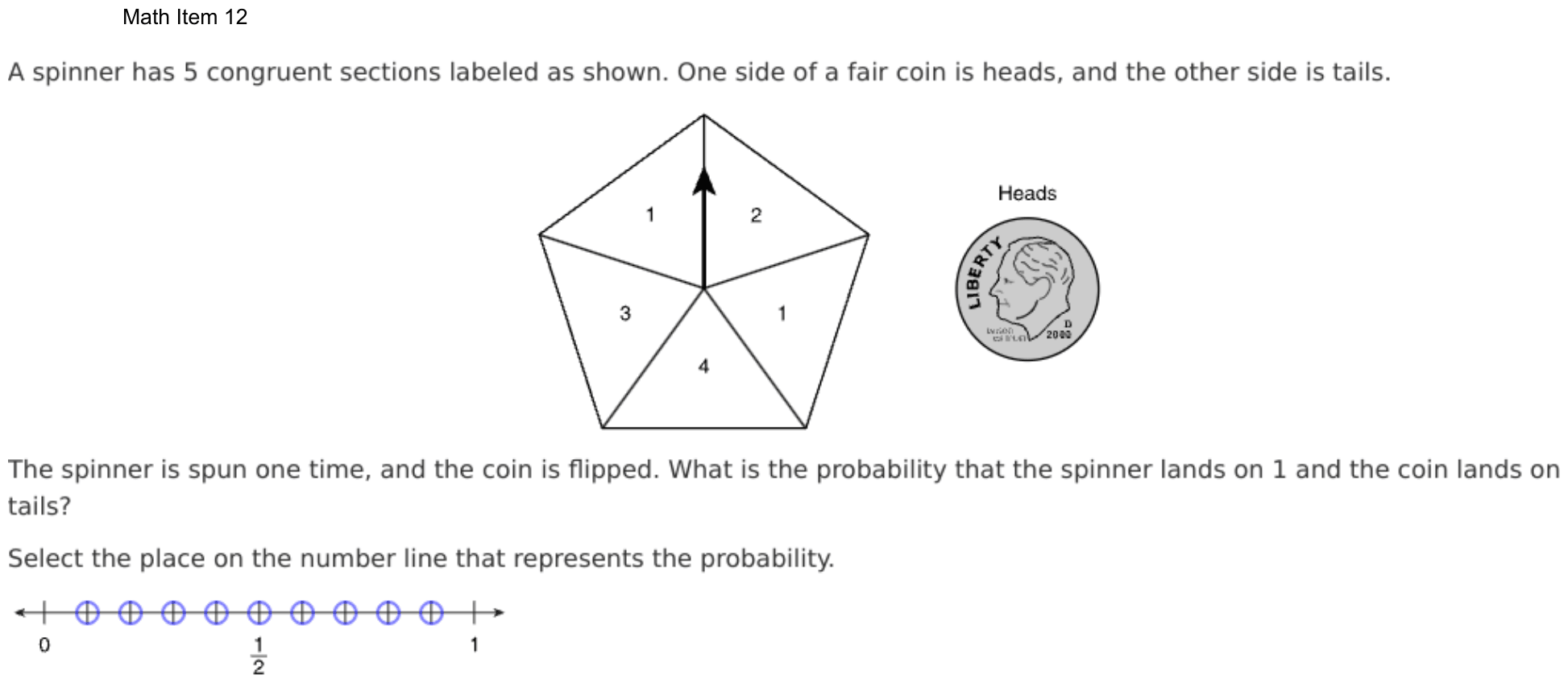
Graph the solution set for the inequality .
Select a ray. Then, move the endpoint of the ray to the correct position on the number line.
On the test you draw the ray on the number line; here, choose its endpoint, whether the endpoint is closed or open, and its direction. The DOE has not published how answers with several parts are scored; this site counts one right only when every part is right.
Show the answer
Correct answer: a ray with a closed endpoint at 1, pointing right
Solution:

Solve the inequality for x, then graph the solution on the number line:
Add 5 to both sides of the inequality:
Divide both sides by 2:
Rewrite the inequality with x on the left side:
The graph of is a closed ray (solid point) beginning at 1 and extending to the right on the number line.
Question analysis
Students graph the solution set of a two-step inequality on a number line by choosing a ray: where it starts, whether its endpoint is open or closed, and which way it points. It tests solving a linear inequality and reading its solution. The variable sits on the right of the inequality symbol, so reading the result the right way round is part of the challenge.
- Grade level
- Grade 7 content, by NYS standard
- Compared with grade 7
- At grade 7 Solving a two-step inequality and graphing its solution set is a named grade 7 skill. This one puts the variable on the right of the symbol and asks students to build the graph themselves rather than pick it from four.
- Estimated difficulty
- Moderate: several steps, or a close reading with one strong distractor.
- Thinking it demands
- Depth of knowledge 1, recall and reproduction · mainly apply
- What makes it hard
- Reading a figure, table or graph moderate
- Many steps minor
- An answer in an unexpected form minor
- Solution
- 3 steps
- Reading level
- Question and choices: about grade 6, 26 words.
- Students, last 30 days
- Not enough answers yet to show (it takes 10).
Why it is hard, traps and wrong answers (shows the answer)
Why it is hard
Solving takes two routine moves; the points are lost in turning 1 ≤ x into a picture. Because x sits on the right, the symbol seems to point left, and a student who shades the way it points draws the values below 1, which all fail. The dot must also be solid, since x = 1 makes both sides −3. Testing x = 2, where 2x − 5 = −1 and −3 ≤ −1 holds, confirms the direction.
Reading a figure, table or graph moderate Understanding the question
The solution comes out as 1 ≤ x, with x on the right, so the ≤ sign points away from the shaded side; it has to be read as x ≥ 1 before the ray is drawn. (Lesh, Post & Behr, 1987; Kirsch & Mosenthal, 1990)
Many steps minor Working it out
Two solving moves, adding 5 and then halving, come before three graph choices, the endpoint, a solid dot and a direction, and a mistake in any of the five loses the item. (Daniel & Embretson, 2010; Enright, Morley & Sheehan, 2002)
An answer in an unexpected form minor Choosing the answer
The ray is built, by picking one of four ray shapes and dragging its endpoint, rather than chosen from four finished graphs, so nothing on screen flags a ray that starts at the right number but points the wrong way. (Enright, Morley & Sheehan, 2002)
Strategy: Undo the subtraction and then the multiplication on both sides, rewrite the result with x first, decide whether the endpoint is included, and test one value on your ray in the original inequality.
Traps
- Negatives and direction: Arithmetic with negative numbers, the order of a subtraction, or direction on a number line. (Moving a term across the equals sign without changing its sign is a faulty procedure.)
- Counting the ends: Inclusive or exclusive ends, fence posts, consecutive numbers: an answer that is one too many or too few, or an endpoint drawn open where it belongs closed (or the reverse).
- A faulty procedure: A systematic but wrong procedure: adding fractions straight across, applying an exponent to each term of a sum, dropping a sign when moving a term.
The wrong answers, classified
1|closed|left Negatives and direction (Brown & Burton, 1978)
Solves to 1 ≤ x but shades the way the ≤ symbol points, a rule that holds only with x on the left, so the ray covers x ≤ 1.
1|open|right Counting the ends (Brown & Burton, 1978)
Finds the right endpoint and direction but draws an open dot, leaving out 1 itself, though the "or equal to" in ≤ includes it.
-4|closed|right A faulty procedure (Brown & Burton, 1978; Tatsuoka, 1983)
Moves the −5 to the left side without changing its sign, writing −3 − 5 = −8 ≤ 2x, so the ray starts at −4.
Worked solution, step by step
Formulas used
- Doing the same to both sides
- a and b are the two sides of an inequality, and c is any number. Adding the same number to both sides keeps the inequality true. So does dividing both sides by the same positive number. Dividing by a negative number would flip the symbol, but that does not happen here.
- Turning an inequality around
- a and b are any two numbers or terms. You may swap the two sides if you also turn the symbol around. The pointed end of the symbol always faces the smaller side. So 1 ≤ x and x ≥ 1 say the same thing.
Sort out the question
The symbol ≤ means is less than or equal to. The solution set is every value of x that makes true. You show it as a ray. A ray is a dot, called the endpoint, with an arrow going one way forever. You need three things: where the dot goes, whether it is closed or open, and which way the ray points.
Add 5 to both sides
The right side is 2x − 5. Adding 5 undoes subtracting 5, so add 5 to both sides:
Watch out: taking 5 away from −3 instead gives −8 ≤ 2x. That wrong move puts the dot at −4.
Divide both sides by 2
Now x is multiplied by 2, so divide both sides by 2. You divide by a positive number, so the symbol stays the same:
Read it with x first
says 1 is less than or equal to x. So x is 1 or any number bigger than 1. With x first, that is:
Bigger numbers are to the right on a number line, so the ray points right.
Watch out: in 1 ≤ x, the symbol seems to point left. Do not follow it. A ray pointing left from 1 shows numbers that do not work.
Choose a closed dot
The words or equal to mean 1 itself is a solution. Check it: , and −3 ≤ −3 is true. So the dot at 1 is closed, which means filled in. An open dot, an empty circle, leaves the endpoint out. Use it only for < or >.
Watch out: an open dot at 1 would leave out a number that works.
Draw the ray
On the test, choose the ray with a filled dot and an arrow pointing right. Then drag its dot to 1. On this site, choose 1 for the endpoint, then closed (filled dot) and pointing right.
So the answer is a closed dot at 1, with the ray pointing right.
Check your answer
Test a number on your ray, such as 3. , and −3 ≤ 1 is true. Now test a number off the ray, such as 0. , and −3 ≤ −5 is false. So the ray points the right way.
More questions like this
The original DOE question
Question 2 of 3
2026 Practice Test B Math, question 13Question
A basket contains 3 apples, 4 oranges, 5 bananas, and 8 pears.
If one piece of fruit is randomly pulled from the basket, what is the probability that it will be a pear?
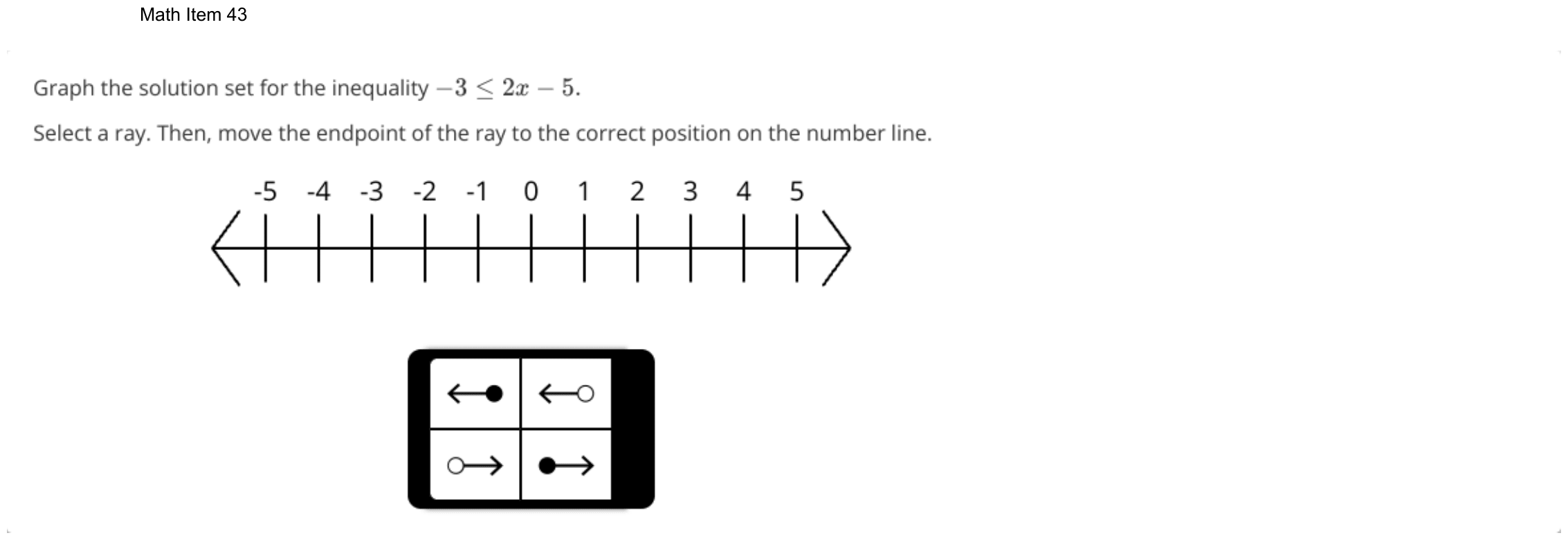
Select the place on the number line to plot the point.
On the test you click a point on the number line; here, choose it from the menu.
Show the answer
Correct answer: the point 0.4
The total number of fruits is:
The probability of picking a pear is:
Question analysis
A basket holds apples, oranges, bananas and pears, and students find the probability that a piece of fruit pulled at random is a pear, then plot it as a point on a number line from 0 to 1. It tests simple probability as a part of a whole. With no choices to pick from, the fraction has to be turned into tenths to find its place.
- Grade level
- Grade 6 content, by NYS standard
- Compared with grade 7
- Below grade 7 Finding the probability of a simple event from counts is grade 6 work in New York. This one adds four whole numbers, forms one fraction and plots it among marked tenths, a shorter and more routine task than grade 7 probability.
- Estimated difficulty
- Routine: one familiar step, little to misread.
- Thinking it demands
- Depth of knowledge 1, recall and reproduction · mainly apply
- What makes it hard
- Solution
- 3 steps
- Reading level
- Question and choices: about grade 6, 40 words.
- Students, last 30 days
- Not enough answers yet to show (it takes 10).
Why it is hard, traps and wrong answers (shows the answer)
Why it is hard
Adding the four counts to 20 and writing 8 over 20 is routine, so most students succeed. The losses come from the number line: its decimal labels make it easy to read the 8 pears as 0.8, and a part-to-part fraction such as 8/12 falls between marks and has to be rounded, which should prompt a second look. Simplifying 8/20 to 2/5 and then to 4/10 makes the mark plain.
Something you must already know minor Working it out
The question does not say that a probability is the favorable count over the whole count, here the 8 pears over all 20 pieces of fruit rather than over the other 12. (Anderson & Krathwohl, 2001)
An answer in an unexpected form minor Choosing the answer
The number line is labeled only in tenths from 0 to 1, so 8/20 has to be rewritten as a decimal before the right mark can be chosen. (Enright, Morley & Sheehan, 2002)
Strategy: Add up all the fruit for the total, write the number of pears over that total, rewrite the fraction in tenths, and select that mark on the line.
Traps
- Answers a different question: A choice is right for another quantity: the other unknown, the rest instead of the part, the part instead of the whole.
- Misunderstands the concept: A wrong belief about a concept: that percents can be added, that area grows like length, that averages can be averaged, that a bigger denominator means a bigger fraction.
The wrong answers, classified
0.8 Numbers taken from the question (Hegarty, Mayer & Monk, 1995)
Takes the 8 pears straight to the mark labeled 0.8, never dividing by the 20 pieces of fruit in the basket.
0.7 Misunderstands the concept (Smith, diSessa & Roschelle, 1993; De Bock et al., 1998; Ni & Zhou, 2005)
Compares the 8 pears with the 12 other pieces of fruit, 8/12 or about 0.67, a part-to-part ratio, and plots the nearest tenth.
0.6 Answers a different question (King et al., 2004; Hegarty, Mayer & Monk, 1995)
Puts the 12 apples, oranges and bananas over the 20 pieces of fruit, plotting the chance of not getting a pear instead of getting one.
Worked solution, step by step
Formulas used
- Probability of an event
- P is the probability, the chance that something happens. It goes from 0 (never) to 1 (always). The top counts the results you want, here pears. The bottom counts every possible result, here every piece of fruit. It works when each result is equally likely, like grabbing fruit without looking.
- Equal fractions
- a is the top of a fraction, and b is the bottom. n is any number except 0. Dividing the top and the bottom by the same number gives an equal fraction. Use it to get 10 on the bottom, which is easy to write as a decimal.
Sort out the question
The basket has 3 apples, 4 oranges, 5 bananas and 8 pears. You pull out one piece without looking. You need the probability that it is a pear. Then you plot that number as a point. The number line runs from 0 to 1, with a mark at every tenth.
Count all the fruit
The bottom of the fraction is every piece of fruit you could pull out. Add all four kinds:
There are 20 pieces of fruit in all.
Write the probability as a fraction
Use the probability formula. There are 8 pears out of 20 pieces of fruit:
Watch out: the bottom is all the fruit, not just the other fruit. compares the pears with the 12 fruits that are not pears. It is about 0.67, and it leads you to the mark at 0.7. And 12 over 20 is the chance of not getting a pear.
Change it to tenths
The number line is marked in tenths. So rewrite the fraction with 10 on the bottom. Divide the top and the bottom by 2:
Four tenths is written 0.4.
Watch out: the 8 pears do not make 0.8. That skips dividing by the 20 pieces of fruit.
Plot the point
Start at 0 and count four marks to the right: 0.1, 0.2, 0.3, 0.4. On the test, you click the mark labeled 0.4. On this site, you choose 0.4 from the menu.
So the answer is the point at 0.4.
Check your answer
The chance of not getting a pear is . A pear and not a pear cover every result, so the two must add to 1: . Also, pears are less than half of the fruit, so the point should be left of 0.5. It is.
More questions like this
The original DOE question

Question 3 of 3
2026 Practice Test C Math, question 12Question
A spinner has 5 congruent sections labeled as shown. One side of a fair coin is heads, and the other side is tails.
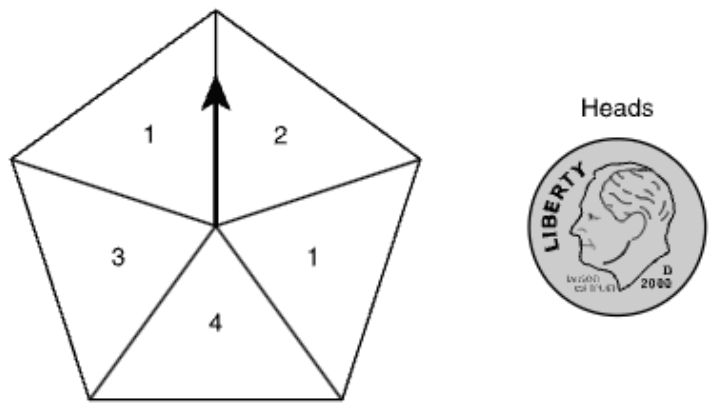
The spinner is spun one time, and the coin is flipped. What is the probability that the spinner lands on 1 and the coin lands on tails?
Select the place on the number line that represents the probability.
On the test you click a point on the number line; here, choose it from the menu.
Show the answer
Correct answer: the point 0.2
The spinner has five equal-sized sections. Two of the sections are labeled with a 1. So, the probability of landing on a 1 is two out of five, or 2/5.
A coin has two sides, one heads and one tails. So, the probability of landing on tails is one out of two, or 1/2.
The compound probability of the spinner landing on a 1 and the coin landing on tails can be calculated by multiplying 2/5 and 1/2 as shown:
Question analysis
A spinner with five equal sections is spun once and a fair coin is flipped. Students find the probability that the spinner lands on 1 and the coin shows tails, then select that point on a number line from 0 to 1. Counting the right sections and combining the two events correctly are the tricky parts.
- Grade level
- Grade 7 content, by NYS standard
- Compared with grade 7
- At grade 7 Finding the chance of two independent events together is grade 7 compound probability, here with one spinner and one coin. Counting sections from the picture and placing the result on a number line add two small steps.
- Estimated difficulty
- Moderate: several steps, or a close reading with one strong distractor.
- Thinking it demands
- Depth of knowledge 2, skills and concepts · mainly apply
- What makes it hard
- Solution
- 3 steps
- Reading level
- Question and choices: about grade 5, 59 words.
- Students, last 30 days
- Not enough answers yet to show (it takes 10).
Why it is hard, traps and wrong answers (shows the answer)
Why it is hard
The probability itself takes one multiplication of two simple fractions; the losses come before and after it. Before, the spinner has to be searched for every section labeled 1, and the coin's chance brought in as well. After, 1/5 has to be rewritten as 2/10 to find its point, since only 0, 1/2 and 1 are labeled. Checking that the result is smaller than both separate chances catches an addition.
Reading a figure, table or graph moderate Understanding the question
The two sections labeled 1, upper left and right, are not side by side, and the number line labels only 0, 1/2 and 1, so its nine points must be read as tenths. (Lesh, Post & Behr, 1987; Kirsch & Mosenthal, 1990)
Something you must already know minor Working it out
Nothing says that the chance of two independent events both happening is the product of their chances, 2/5 × 1/2, rather than their sum. (Anderson & Krathwohl, 2001)
Strategy: Count the sections labeled 1 to get the spinner's chance, take the coin's chance of tails, multiply the two because both must happen, and write the result in tenths.
Traps
- Stops one step early: A choice is a number from partway through the solution.
- Wrong operation: Adds instead of multiplying, divides the wrong way round, turns a ratio or rate upside down, or undoes a step in the wrong direction (subtracts what should be added back).
- Misreads the figure: Reads a value, label or tick spacing in a figure, table or graph wrongly.
The wrong answers, classified
0.4 Stops one step early (King et al., 2004; Gierl et al., 2017)
Finds the spinner's chance of landing on 1, two sections out of five, and plots 2/5 without multiplying by the coin's chance of tails.
0.9 Wrong operation (Hegarty, Mayer & Monk, 1995; King et al., 2004)
Adds the two chances, 2/5 + 1/2 = 9/10, instead of multiplying them, though both events must happen together.
0.1 Misreads the figure (Lesh, Post & Behr, 1987; Kirsch & Mosenthal, 1990)
Counts only one section labeled 1, so multiplies 1/5 by 1/2 and plots 1/10, missing the second 1 on the spinner.
Worked solution, step by step
Formulas used
- Probability of an event
- P is the probability, the chance that something happens. It goes from 0 (never) to 1 (always). The top counts the results you want. The bottom counts all possible results. It works when every result is equally likely, like equal sections of a spinner.
- Probability that two things both happen
- A and B are two events that do not affect each other, like a spin and a coin flip. P(A) and P(B) are their chances. Multiply them to get the chance that both happen. Needing both makes the chance smaller, never bigger.
Sort out the question
The spinner has 5 congruent sections. Congruent means the same size and shape, so each is equally likely. The coin has a heads side and a tails side. You need the chance that the spinner lands on 1 and the coin lands on tails.
Find the spinner’s chance
Two sections show 1: the upper left one and the one on the right. So 2 of the 5 equal sections give a 1:
Watch out: the two 1s are not next to each other. Counting only one gives 1/5 here, and 0.1 at the end.
Find the coin’s chance
A fair coin is equally likely to land on either side. Tails is 1 of its 2 sides:
Multiply the two chances
The spin and the flip do not affect each other, and both must happen. So multiply:
Watch out: stopping at 2/5 gives 0.4. Adding gives , or 0.9. Both are wrong.
Select the point
On the test, the number line labels only 0, 1/2 and 1. Between 0 and 1 are 9 targets, one at each tenth. 0.2 is the second target to the right of 0. On this site, choose 0.2 from the Point menu.
So the answer is the point at 0.2.
Check your answer
List every result. The spinner has 5 sections and the coin has 2 sides, so there are results, all equally likely. Just 2 of them are a 1 with tails, one for each section labeled 1. That is 2 out of 10, or 0.2.
More questions like this
The original DOE question