Passage The Best Laid Plans of Ravens
The Best Laid Plans of Ravens
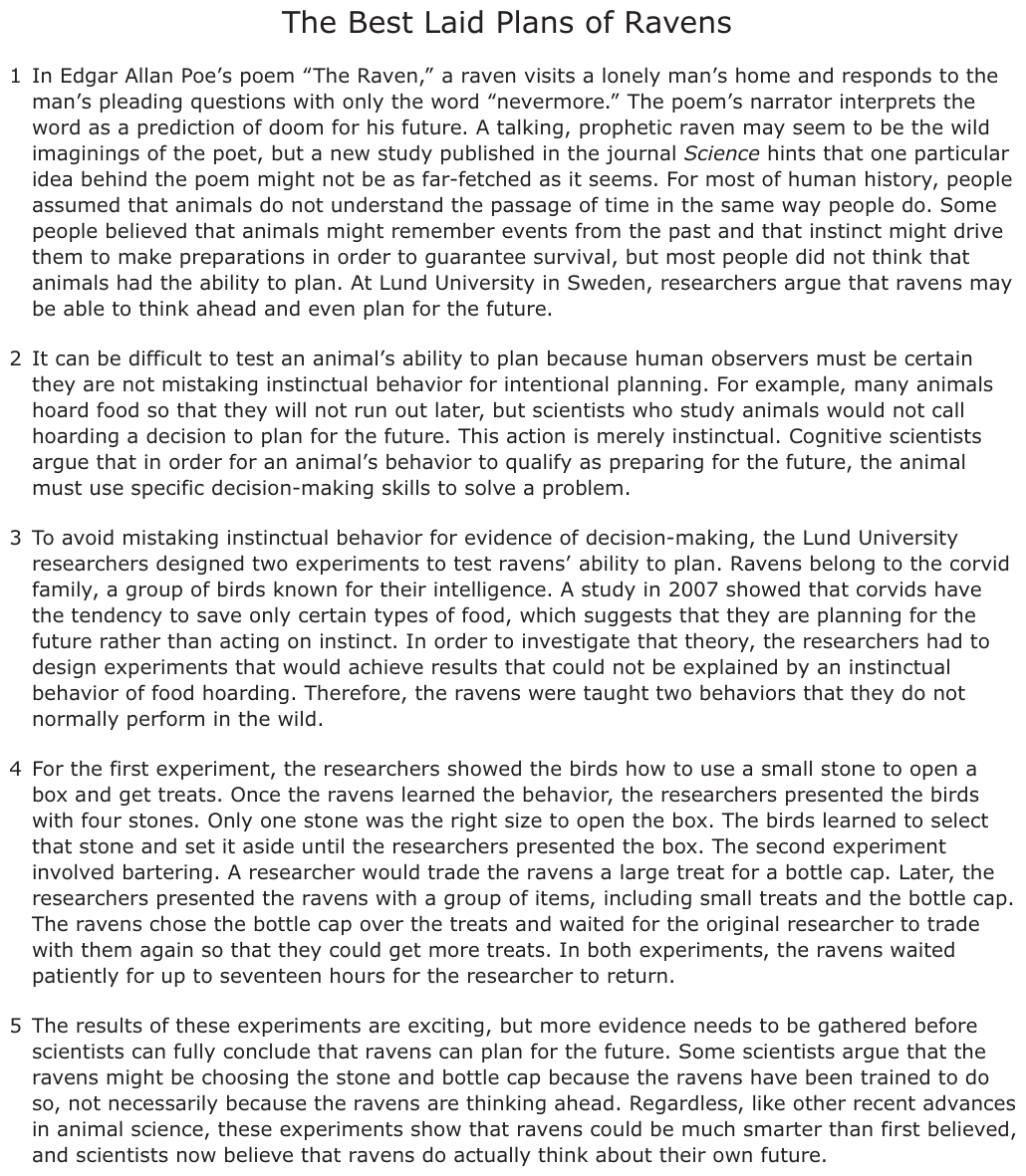
In Edgar Allan Poe’s poem “The Raven,” a raven visits a lonely man’s home and responds to the man’s pleading questions with only the word “nevermore.” The poem’s narrator interprets the word as a prediction of doom for his future. A talking, prophetic raven may seem to be the wild imaginings of the poet, but a new study published in the journal Science hints that one particular idea behind the poem might not be as far-fetched as it seems. For most of human history, people assumed that animals do not understand the passage of time in the same way people do. Some people believed that animals might remember events from the past and that instinct might drive them to make preparations in order to guarantee survival, but most people did not think that animals had the ability to plan. At Lund University in Sweden, researchers argue that ravens may be able to think ahead and even plan for the future.
It can be difficult to test an animal’s ability to plan because human observers must be certain they are not mistaking instinctual behavior for intentional planning. For example, many animals hoard food so that they will not run out later, but scientists who study animals would not call hoarding a decision to plan for the future. This action is merely instinctual. Cognitive scientists argue that in order for an animal’s behavior to qualify as preparing for the future, the animal must use specific decision-making skills to solve a problem.
To avoid mistaking instinctual behavior for evidence of decision-making, the Lund University researchers designed two experiments to test ravens’ ability to plan. Ravens belong to the corvid family, a group of birds known for their intelligence. A study in 2007 showed that corvids have the tendency to save only certain types of food, which suggests that they are planning for the future rather than acting on instinct. In order to investigate that theory, the researchers had to design experiments that would achieve results that could not be explained by an instinctual behavior of food hoarding. Therefore, the ravens were taught two behaviors that they do not normally perform in the wild.
For the first experiment, the researchers showed the birds how to use a small stone to open a box and get treats. Once the ravens learned the behavior, the researchers presented the birds with four stones. Only one stone was the right size to open the box. The birds learned to select that stone and set it aside until the researchers presented the box. The second experiment involved bartering. A researcher would trade the ravens a large treat for a bottle cap. Later, the researchers presented the ravens with a group of items, including small treats and the bottle cap. The ravens chose the bottle cap over the treats and waited for the original researcher to trade with them again so that they could get more treats. In both experiments, the ravens waited patiently for up to seventeen hours for the researcher to return.
The results of these experiments are exciting, but more evidence needs to be gathered before scientists can fully conclude that ravens can plan for the future. Some scientists argue that the ravens might be choosing the stone and bottle cap because the ravens have been trained to do so, not necessarily because the ravens are thinking ahead. Regardless, like other recent advances in animal science, these experiments show that ravens could be much smarter than first believed, and scientists now believe that ravens do actually think about their own future.
Question
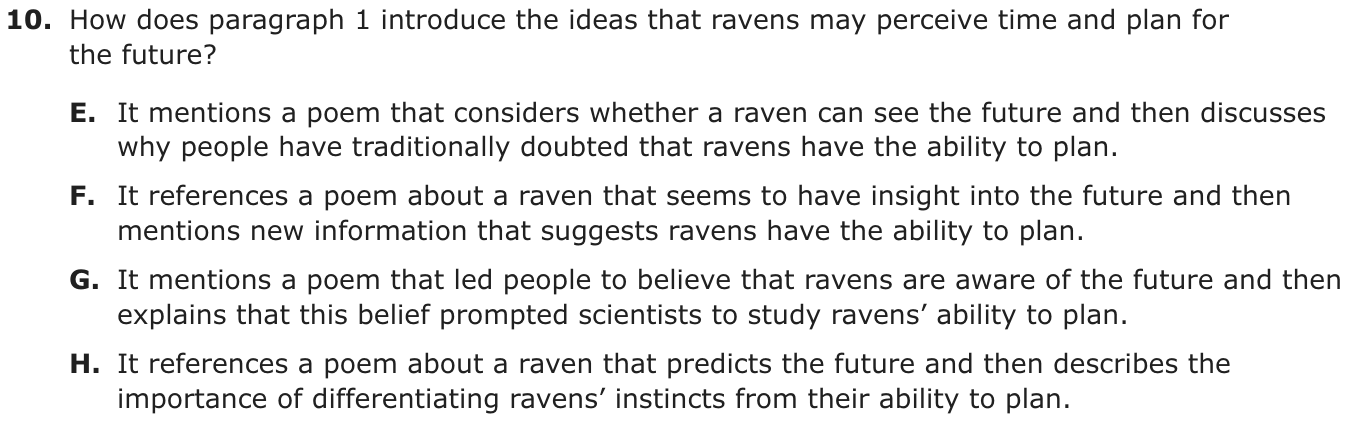
How does paragraph 1 introduce the ideas that ravens may perceive time and plan for the future?
- AIt mentions a poem that considers whether a raven can see the future and then discusses why people have traditionally doubted that ravens have the ability to plan.
- BIt references a poem about a raven that seems to have insight into the future and then mentions new information that suggests ravens have the ability to plan.
- CIt mentions a poem that led people to believe that ravens are aware of the future and then explains that this belief prompted scientists to study ravens’ ability to plan.
- DIt references a poem about a raven that predicts the future and then describes the importance of differentiating ravens’ instincts from their ability to plan.
Show the answer
Correct answer: B
The question asks how paragraph 1 introduces the ideas that ravens may perceive time and plan for the future.
A. Incorrect. In the poem referenced in paragraph 1, the narrator does not consider whether a raven can see the future but believes it is actually happening. Additionally, the discussion in paragraph 1 is about how people have historically doubted animals’ ability to plan, not about why people have doubted this ability in ravens specifically.
B. CORRECT. Edgar Allan Poe’s poem features a raven that speaks in a prophetic way. Since prophecies are a prediction of the future, the statement suggests that the raven has a sense of time. This reference is then tied to a modern study where “researchers argue that ravens may be able to think ahead and even plan for the future” (paragraph 1).
C. Incorrect. Although the idea of a raven being aware of the future in the poem is tied to a study that “hints that one particular idea behind the poem might not be as far-fetched as it seems” (paragraph 1), this connection does not prove that the poem is what prompted scientists to conduct such a study.
D. Incorrect. Paragraph 1 introduces the idea “that ravens may be able to think ahead and even plan for the future” but does not explain in detail the importance of differentiating between whether ravens act on instinct or have the ability to plan.
Question analysis
This text-structure question on “The Best Laid Plans of Ravens” asks how the article’s first paragraph introduces the ideas that ravens may sense time and plan for the future. The paragraph opens with Edgar Allan Poe’s poem “The Raven,” and every choice pairs a description of the poem with a claim about what the paragraph does next, so each half has to be checked on its own.
- Grade level
- Grade 7 reading and task
- Compared with grade 7
- At grade 7 Explaining how an opening paragraph introduces a text’s ideas is regular grade 7 structure work. Each choice here makes two claims, one about the poem and one about what follows it, so both must be checked against a single dense paragraph.
- Estimated difficulty
- Moderate: several steps, or a close reading with one strong distractor.
- Thinking it demands
- Depth of knowledge 2, skills and concepts · mainly analyze
- What makes it hard
- How, not what moderate
- Every choice must be checked moderate
- A lot to read minor
- Evidence
- Answered from one paragraph or stanza
- Reading level
- Passage: about grade 11, 599 words; question and choices: about grade 13, 127 words.
- Students, last 30 days
- Not enough answers yet to show (it takes 10).
Why it is hard, traps and wrong answers (shows the answer)
Why it is hard
Every choice describes the paragraph as a poem followed by something else, so the question turns on what comes after Poe. The middle of the paragraph, about what people long believed of animals, is the part students most often promote to the main move, though it says what people assumed, not why, and concerns animals in general. The paragraph joins the poem to the study only by saying the study “hints” that Poe’s idea is not far-fetched, and reading that as cause and effect is the other way to lose the point.
How, not what moderate Working it out
The stem asks how paragraph 1 is built, not what it says, so students must trace the move from Poe’s prophetic raven to the Lund study, with the sentences about old beliefs in between. (Anderson & Krathwohl, 2001)
Every choice must be checked moderate Choosing the answer
All four choices open with Poe’s poem and then name a second move, so the poem half barely separates them and the second half of each must be tested against the paragraph. (Embretson & Wetzel, 1987)
A lot to read minor Understanding the question
The choices run 25 to 30 words each, and paragraph 1 packs a poem, a new study, centuries of human assumptions and a Swedish university into six sentences. (Kintsch, 1998; Gorin & Embretson, 2006; Freedle & Kostin, 1993)
Strategy: Label what each sentence of paragraph 1 does, then test both halves of every choice against those labels, and reject a choice if either half describes something the paragraph does not do.
Traps
- Wrong part of the text: A choice is true of another paragraph, stanza or speaker than the one asked about.
- Twists what the text says: Uses the text's topic and ideas but changes what it says: who did it, how much, when, or why.
- Reads too much in: A reasonable-sounding conclusion that goes further than the text allows.
The wrong answers, classified
A Twists what the text says (King et al., 2004)
Builds on the paragraph’s middle, where people long assumed animals could not plan, but the paragraph never says why, speaks of animals in general, and Poe’s narrator takes the word as prophecy.
C Reads too much in (Graesser, Singer & Trabasso, 1994)
Turns the link between Poe and the study into cause and effect, though people had long assumed animals do not grasp the passage of time, and nothing says the poem sent scientists to study ravens.
D Wrong part of the text (Kirsch & Mosenthal, 1990)
Notices that paragraph 1 mentions instinct in passing and credits it with paragraph 2’s point, that observers must be sure they are not mistaking instinct for planning.
Working it out, step by step
Figure out what the question asks
This is a structure question. It asks how paragraph 1 is built, not just what it says. Every choice starts with the poem. So the second half of each choice is the part to check. Ask what the paragraph does right after the poem.
Find what the paragraph says about the poem
Paragraph 1 begins with a poem called “The Raven.” In it, a raven answers a lonely man with one word. The man hears that word “as a prediction of doom for his future.” Doom means something terrible that is going to happen. The paragraph then calls the bird a “talking, prophetic raven.” Prophetic means able to tell the future. So the raven seems to know what is coming.
Find what comes after the poem
Next the paragraph says that “a new study published in the journal Science hints that one particular idea behind the poem might not be as far-fetched as it seems.” Far-fetched means hard to believe. The last sentence names that idea: “researchers argue that ravens may be able to think ahead and even plan for the future.” So the paragraph moves from an old poem to new research about planning.
Check each choice
- A does not fit. The man does not wonder if the raven sees the future. He takes its word as a prediction.
- B fits. The raven in the poem seems to see the future. Then the paragraph reports a new study that says ravens may plan.
- C does not fit. The paragraph never says the poem made scientists start the study.
- D does not fit. Telling instinct apart from planning is the topic of paragraph 2. Instinct is behavior an animal is born with.
Watch out: A is tempting because the paragraph does say people doubted that animals could plan. But it never says why. It also talks about animals in general, not ravens.
Choose the answer
The paragraph starts with a raven that seems to know the future. Then it brings in new research that says ravens may plan. So the answer is B.
Why this answer and not the closest wrong one
A is the closest wrong choice. Both A and B begin with the poem. But A says the paragraph explains why people doubted that ravens could plan. The paragraph only says what people “assumed” about animals in general. Its real turn is to the new study and what the researchers argue. That is the second half of B.
More questions like this
The original DOE question
The passage “The Best Laid Plans of Ravens” as printed (page 12)