Question
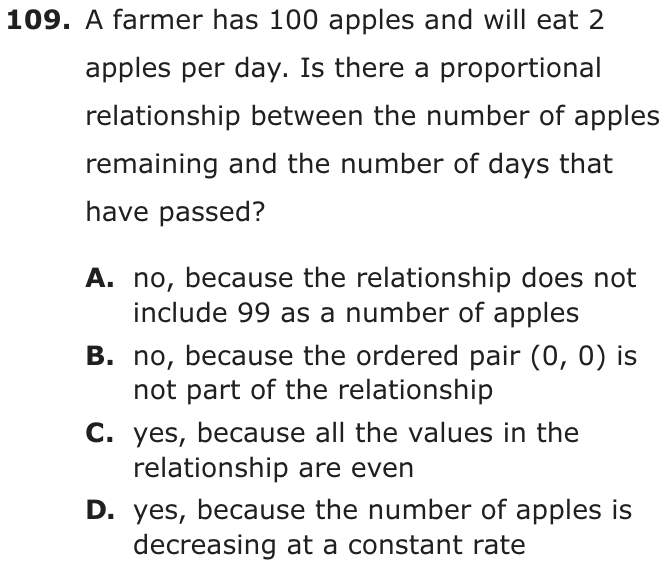
A farmer has 100 apples and will eat 2 apples per day. Is there a proportional relationship between the number of apples remaining and the number of days that have passed?
- Ano, because the relationship does not include 99 as a number of apples
- Bno, because the ordered pair (0, 0) is not part of the relationship
- Cyes, because all the values in the relationship are even
- Dyes, because the number of apples is decreasing at a constant rate
Show the answer
Correct answer: B
Proportional relationships are relationships between two variables where their ratios are equivalent. The graph of a proportional relationship will always go through the point (0, 0).
In the text of the problem, it is given that the farmer begins with 100 apples. Therefore, the ordered pair (0, 100) would be the point at which the graph of the relationship crosses the y-axis, not (0, 0). Additionally, in a proportional relationship, each pair of values represents the same ratio of .
If the relationship were proportional, the ratio for the first two days (1, 98) and (2, 96) would be equivalent.
Question analysis
A farmer starts with 100 apples and eats 2 apples per day. Students decide whether the number of apples remaining and the number of days that have passed are in a proportional relationship, choosing a yes or no answer with its reason. It tests the definition of a proportional relationship, and every reason offered has to be judged, not just the verdict.
- Grade level
- Grade 7 content, by NYS standard
- Compared with grade 7
- At grade 7 Deciding whether two quantities are proportional is core grade 7 work. Here there is no table or graph to check, only a description, so students must produce pairs of values themselves before testing them.
- Estimated difficulty
- Moderate: several steps, or a close reading with one strong distractor.
- Thinking it demands
- Depth of knowledge 2, skills and concepts · mainly understand
- What makes it hard
- Something you must already know moderate
- Every choice must be checked moderate
- Turning words into math minor
- Solution
- 2 steps
- Reading level
- Question and choices: about grade 7, 74 words.
- Students, last 30 days
- Not enough answers yet to show (it takes 10).
Why it is hard, traps and wrong answers (shows the answer)
Why it is hard
The situation is clearly linear, a steady drop of 2 apples a day, and that is the trap: a constant rate of change sounds like proportionality. The relationship starts at 100 apples on day 0, not at 0, so the ratio of apples to days falls from 98 to 48 between days 1 and 2. Half the choices say no, and only one of those gives a reason that decides the question.
Something you must already know moderate Working it out
The tests for a proportional relationship are not given: apples over days must be one constant ratio, and the graph must pass through (0, 0), which day 0 with 100 apples does not. (Anderson & Krathwohl, 2001)
Every choice must be checked moderate Choosing the answer
Each choice pairs a verdict with a reason, so a right “no” with a wrong reason, the missing 99, has to be ruled out as firmly as a wrong “yes”. (Embretson & Wetzel, 1987)
Turning words into math minor Understanding the question
No table or graph is given, so the pairs have to be built from the words: 100 apples on day 0, 98 on day 1, 96 on day 2. (Hegarty, Mayer & Monk, 1995; Koedinger & Nathan, 2004)
Strategy: List the apples left after 0, 1 and 2 days, recall the two tests for a proportional relationship, and keep only a choice whose reason is both true and decisive.
Traps
- Misunderstands the concept: A wrong belief about a concept: that percents can be added, that area grows like length, that averages can be averaged, that a bigger denominator means a bigger fraction.
The wrong answers, classified
A Misunderstands the concept (Smith, diSessa & Roschelle, 1993; De Bock et al., 1998; Ni & Zhou, 2005)
Has the right verdict, no, but rests it on a true detail that decides nothing: the count skips 99, yet missing values have no bearing on whether ratios are equal.
C Misunderstands the concept (Smith, diSessa & Roschelle, 1993; De Bock et al., 1998; Ni & Zhou, 2005)
Treats the even counts, 100, 98, 96 and so on, as a sign of proportionality, a pattern in the numbers that has nothing to do with a constant ratio.
D Misunderstands the concept (Smith, diSessa & Roschelle, 1993; De Bock et al., 1998; Ni & Zhou, 2005)
Takes a constant rate of change for proportionality: the apples do fall by 2 each day, but they start from 100, not 0, so apples ÷ days is not constant.
Worked solution, step by step
Formulas used
- Proportional relationship
- x and y are two amounts that change together. k is a fixed number, the constant of proportionality. In a proportional relationship, y ÷ x always equals k. When x is 0, y is 0 too, so the graph passes through (0, 0).
Sort out the question
The farmer starts with 100 apples and eats 2 apples each day. You must decide if apples left and days passed are proportional. Each choice gives a yes or a no and a reason. Both parts must be right.
Make a small table
Each day, take away 2 apples.
Days passed 0 1 2 Apples left 100 98 96 As pairs (days, apples), these are (0, 100), (1, 98) and (2, 96).
Test the ratios
If the relationship were proportional, apples ÷ days would be the same every day. Are and equal? Work out each one.
98 is not equal to 48. The ratio changes, so the relationship is not proportional.
Check the point (0, 0)
A proportional graph always passes through (0, 0). Here, on day 0 the farmer has 100 apples, not 0. So that pair is (0, 100). When the apples run out, 50 days have passed: (50, 0). The pair (0, 0) never happens. That is the reason in choice B.
Rule out the other choices
Watch out: choice D is tempting. The apples do drop at a constant rate, 2 each day. But they start at 100, not 0. A steady change alone is not enough.
Choice A is true, since 99 never appears, but it decides nothing. Choice C is about even numbers, which has nothing to do with a steady ratio. So the answer is B.
Check your answer
Try one more day. After 10 days the farmer has apples. Then apples ÷ days is 80 ÷ 10 = 8, not 98 or 48. The ratio keeps changing, so the answer is no, and (0, 0) is missing.
More questions like this
The original DOE question