Question
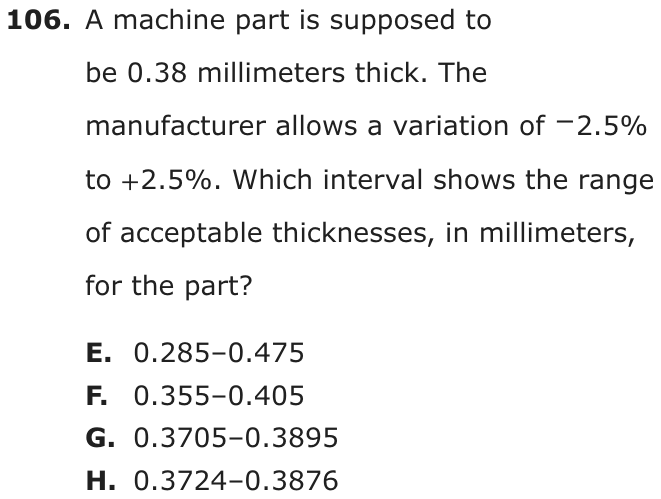
A machine part is supposed to be 0.38 millimeters thick. The manufacturer allows a variation of −2.5% to +2.5%. Which interval shows the range of acceptable thicknesses, in millimeters, for the part?
- A0.285–0.475
- B0.355–0.405
- C0.3705–0.3895
- D0.3724–0.3876
Show the answer
Correct answer: C
A variation of −2.5% to +2.5% means that the thickness of the machine part can be from 2.5% less than the standard of 0.38 mm to 2.5% greater than 0.38 mm.
The least allowed measure is
The greatest allowed measure is
Therefore, the allowable range of thicknesses is 0.3705 mm to 0.3895 mm.
Question analysis
A machine part should be 0.38 millimeters thick, and the manufacturer accepts a variation from −2.5% to +2.5%. Students choose the interval of acceptable thicknesses. It tests finding a percent of a decimal and applying it as a decrease and an increase; the percent must be turned into millimeters first, and the four-decimal-place choices need exact work.
- NYS standards
- Grade level
- Grade 7 content, by NYS standard
- Compared with grade 7
- At grade 7 Taking a percent of a number and adding or subtracting it is grade 7 percent work. The decimal percent and results to four decimal places make the arithmetic fussier than usual, so careful work matters more than the idea.
- Estimated difficulty
- Moderate: several steps, or a close reading with one strong distractor.
- Thinking it demands
- Depth of knowledge 2, skills and concepts · mainly apply
- What makes it hard
- Error-prone arithmetic moderate
- Turning words into math minor
- A very close wrong answer minor
- Solution
- 3 steps
- Reading level
- Question and choices: about grade 9, 29 words.
- Students, last 30 days
- Not enough answers yet to show (it takes 10).
Why it is hard, traps and wrong answers (shows the answer)
Why it is hard
The question rewards turning the percent into millimeters before anything else. Students who take ±2.5% as ±0.025 mm find a tidy interval, 0.355 to 0.405, and the other listed intervals come from a misplaced decimal point or from 2% in place of 2.5%. Because the right interval and its near twin differ only from the third decimal place, the product 0.38 × 0.025 has to be exact; multiplying 0.38 by 0.975 and by 1.025 is a quick double-check.
Error-prone arithmetic moderate Working it out
Two and a half percent of 0.38 is 0.025 × 0.38 = 0.0095, a product of two decimals with four decimal places, and the limits 0.3705 and 0.3895 need the same care. (Brown & Burton, 1978; Junker & Sijtsma, 2001)
Turning words into math minor Understanding the question
“A variation of −2.5% to +2.5%” has to become 2.5% of 0.38 millimeters, a length, before it is subtracted for the least thickness and added for the greatest. (Hegarty, Mayer & Monk, 1995; Koedinger & Nathan, 2004)
A very close wrong answer minor Choosing the answer
The intervals 0.3705–0.3895 and 0.3724–0.3876 both sit about 0.01 mm either side of 0.38, so an estimate cannot separate them and only the exact 0.0095 decides. (Embretson & Wetzel, 1987; Gorin & Embretson, 2006; Ascalon et al., 2007)
Strategy: Write 2.5% as a decimal, multiply it by 0.38 to find the allowed change in millimeters, then subtract it for the least thickness and add it for the greatest.
Traps
- Misunderstands the concept: A wrong belief about a concept: that percents can be added, that area grows like length, that averages can be averaged, that a bigger denominator means a bigger fraction.
- An arithmetic slip: The right method with a plausible arithmetic error: a digit, a place value or a times-table fact.
- Misreads the question: Misses or misreads a condition or a word in the question: "at least", "each", "remaining", "not".
The wrong answers, classified
A An arithmetic slip (Junker & Sijtsma, 2001)
Writes 2.5% as 0.25 instead of 0.025, so the change is 0.38 × 0.25 = 0.095 mm and the interval, 0.285 to 0.475, is ten times too wide.
B Misunderstands the concept (Smith, diSessa & Roschelle, 1993; De Bock et al., 1998; Ni & Zhou, 2005)
Reads ±2.5% as ±0.025 mm, a fixed amount, adding it to and subtracting it from 0.38 instead of first taking 2.5% of 0.38.
D Misreads the question (Hegarty, Mayer & Monk, 1995)
Uses 2% instead of 2.5%, dropping the half percent, so the change is 0.38 × 0.02 = 0.0076 and the interval, 0.3724 to 0.3876, is too narrow.
Worked solution, step by step
Formulas used
- Percent of a number
- The whole is the amount the percent is taken of. The percent tells how many out of every 100. The part is the piece you get. Dividing the percent by 100 turns it into a decimal, so you can multiply.
Sort out the question
The part should be 0.38 millimeters thick. It may be off by up to 2.5%, thinner or thicker. You need the thinnest and thickest sizes allowed, in millimeters.
The 2.5% is a percent of 0.38 mm. So first find how many millimeters 2.5% is.
Write 2.5% as a decimal
Percent means out of 100. So divide by 100, which moves the decimal point two places left.
Watch out: 2.5% is 0.025, not 0.25. Using 0.25 makes the interval ten times too wide, choice A.
Find 2.5% of 0.38
First, 25 × 38 = 950. The two numbers have 3 + 2 = 5 decimal places in all. So the answer has 5 decimal places: 0.00950, or 0.0095. The size may change by 0.0095 millimeters.
Watch out: adding and subtracting 0.025 mm itself gives 0.355 to 0.405, choice B.
Find the two limits
Subtract the change for the thinnest size. Add it for the thickest.
The part may be from 0.3705 to 0.3895 millimeters thick.
Watch out: using 2% instead of 2.5% gives 0.3724 to 0.3876, choice D. So the answer is C, 0.3705–0.3895.
Check your answer
A part 2.5% thinner is 97.5% of 0.38: . A part 2.5% thicker is 102.5% of it: . Both match. Also, 0.38 sits exactly in the middle of the interval.
More questions like this
The original DOE question