Question
COST OF ORANGES
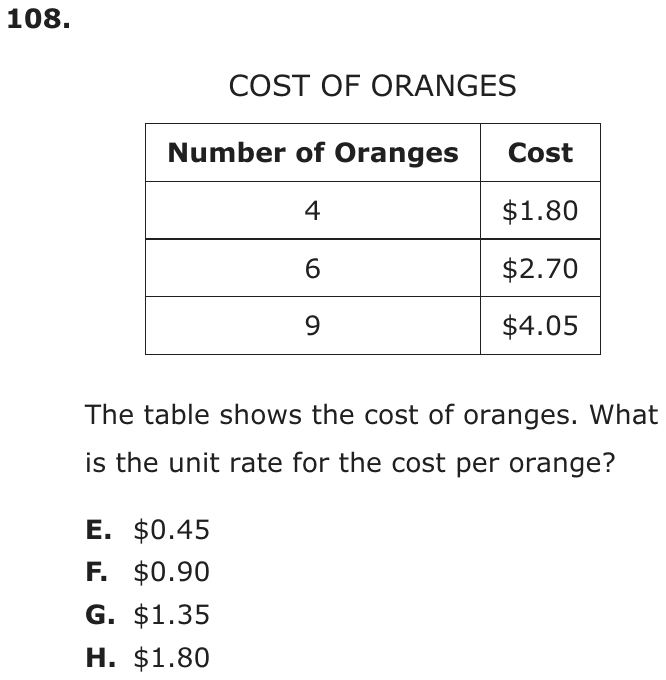
| Number of Oranges | Cost |
|---|---|
| 4 | $1.80 |
| 6 | $2.70 |
| 9 | $4.05 |
The table shows the cost of oranges. What is the unit rate for the cost per orange?
- A$0.45
- B$0.90
- C$1.35
- D$1.80
Show the answer
Correct answer: A
The unit rate (cost per orange) can be determined by dividing the cost of x oranges by x.
The unit rate is $0.45.
Question analysis
A table shows what 4, 6 and 9 oranges cost, in dollars and cents. Students find the unit rate, the cost of a single orange. It tests identifying a unit rate in a proportional table, and the tricky part is keeping straight which column holds the cost and which holds the number of oranges.
- Grade level
- Grade 7 content, by NYS standard
- Compared with grade 7
- Below grade 7 Finding a unit rate in a table belongs to grade 7 proportional relationships, but here it takes one division with money in a clearly proportional table, so the task is easier than typical grade 7 work.
- Estimated difficulty
- Routine: one familiar step, little to misread.
- Thinking it demands
- Depth of knowledge 1, recall and reproduction · mainly apply
- What makes it hard
- Solution
- 1 step
- Reading level
- Question and choices: about grade 3, 23 words.
- Students, last 30 days
- Not enough answers yet to show (it takes 10).
Why it is hard, traps and wrong answers (shows the answer)
Why it is hard
Any row gives the rate in one division, and the three rows agree, so the question is easy once unit rate is read as the cost of one orange. The traps are differences between rows, which look like a change per orange but cover two or three oranges, and the first cost in the table, which is for four. Dividing a second row confirms the result.
Reading a figure, table or graph minor Understanding the question
The table lists 4, 6 and 9 oranges but never a single orange, so the cost of one has to be computed from a row, such as $1.80 ÷ 4. (Lesh, Post & Behr, 1987; Kirsch & Mosenthal, 1990)
Something you must already know minor Working it out
The term unit rate is not defined; students must know it means the cost of one orange, a row's cost divided by its number of oranges. (Anderson & Krathwohl, 2001)
Strategy: Pick any row and divide its cost by its number of oranges; doing the same with a second row confirms that the rate stays the same.
Traps
- Answers a different question: A choice is right for another quantity: the other unknown, the rest instead of the part, the part instead of the whole.
- Numbers taken from the question: Combines the numbers in the question without a model of the situation, or is simply a number that appears in the question.
The wrong answers, classified
B Answers a different question (King et al., 2004; Hegarty, Mayer & Monk, 1995)
Subtracts the first two costs, $2.70 − $1.80 = $0.90, the price of 2 more oranges, without dividing by the 2 oranges it covers.
C Answers a different question (King et al., 2004; Hegarty, Mayer & Monk, 1995)
Subtracts the last two costs, $4.05 − $2.70 = $1.35, the price of 3 more oranges, rather than the price of one.
D Numbers taken from the question (Hegarty, Mayer & Monk, 1995)
Takes $1.80, the first cost in the table, which is what 4 oranges cost together, not one.
Worked solution, step by step
Formulas used
- Unit rate
- The unit rate is the cost of one item, here one orange. The cost is what a group of oranges costs together. Divide by the number of oranges in that group. Any row of the table gives the same rate, because each orange costs the same.
Sort out the question
The table gives the cost of 4, 6 and 9 oranges. It never shows the cost of one orange. A unit rate is the amount for one unit. Here that means the cost of one orange. You need to find it.
Divide one row
Use the first row: 4 oranges cost $1.80.
One orange costs $0.45. Watch out: $1.80 is the cost of 4 oranges, not one. Don’t pick choice D.
Check with the other rows
Every row gives $0.45, so the rate stays the same. Watch out: is the cost of 2 more oranges, choice B. is the cost of 3 more, choice C. Neither is for one orange. So the answer is A, $0.45.
Check your answer
Multiply back: and . Both match the table. Even a difference works once you divide: .
More questions like this
The original DOE question