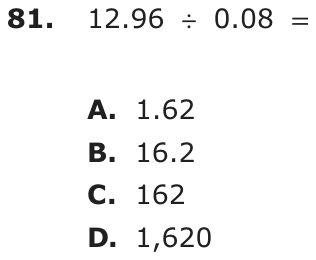
Question
- A1.62
- B16.2
- C162
- D1,620
Show the answer
Correct answer: C
Since the greatest number of decimal places is 2 (hundredths), multiply both terms by 100, and then divide:
Question analysis
This question asks students to divide 12.96 by 0.08, a decimal division with no story around it. It tests dividing multi-digit decimals with the standard algorithm. The choices differ only in where the decimal point falls, so moving the point the same number of places in both numbers is the whole challenge.
- NYS standards
- 6.NS.3 multi-digit decimal operations
- Grade level
- Grade 6 content, by NYS standard
- Compared with grade 7
- Below grade 7 Dividing multi-digit decimals is grade 6 fluency that grade 7 work builds on rather than teaches. The division comes out exactly, so the real demand is placing the decimal point correctly, a single routine skill.
- Estimated difficulty
- Straightforward: two steps or one careful reading.
- Thinking it demands
- Depth of knowledge 1, recall and reproduction · mainly apply
- What makes it hard
- Error-prone arithmetic moderate
- Solution
- 2 steps
- Reading level
- Question and choices: about grade 16+, 1 words.
- Students, last 30 days
- Not enough answers yet to show (it takes 10).
Why it is hard, traps and wrong answers (shows the answer)
Why it is hard
Every choice uses the digits 1, 6 and 2, so the question tests only where the decimal point goes. Dividing by a number less than one gives a result larger than 12.96, which feels wrong to students who expect division to shrink a number. Estimating first, 12.96 ÷ 0.08 is about 13 × 12.5, puts the result in the low hundreds and rules out the other three at once.
Error-prone arithmetic moderate Working it out
The divisor 0.08 has two decimal places, so both numbers must be multiplied by 100, turning the problem into 1,296 ÷ 8, and the quotient comes out larger than 12.96. (Brown & Burton, 1978; Junker & Sijtsma, 2001)
Strategy: Multiply the dividend and the divisor by the same power of 10 so that the divisor becomes a whole number, then carry out the long division.
Traps
- An arithmetic slip: The right method with a plausible arithmetic error: a digit, a place value or a times-table fact.
The wrong answers, classified
A An arithmetic slip (Junker & Sijtsma, 2001)
Divides 12.96 by 8, leaving out the decimal point in the divisor 0.08, so the quotient, 1.62, is 100 times too small.
B An arithmetic slip (Junker & Sijtsma, 2001)
Moves the decimal point one place instead of two, in effect dividing 12.96 by 0.8, so the quotient, 16.2, is ten times too small.
D An arithmetic slip (Junker & Sijtsma, 2001)
Shifts the decimal point three places in 12.96 but only two in 0.08, dividing 12,960 by 8, so the quotient is ten times too big.
Worked solution, step by step
Formulas used
- Dividing by a decimal
- a is the number being divided. b is the divisor, the number you divide by. Multiplying both by the same number, like 100, does not change the answer. Use 100 when the divisor has two decimal places, so it becomes a whole number.
Sort out the question
You need . The divisor, the number you divide by, is 0.08. It has two decimal places. Dividing by a decimal is hard, so make the divisor a whole number first. All four choices use the digits 1, 6 and 2. So the real question is where the decimal point goes.
Make the divisor a whole number
Multiply both numbers by 100. This moves each decimal point two places to the right.
The new problem has the same answer. Watch out: move both points the same number of places. Moving the point three places in 12.96 but two in 0.08 gives 1,620, choice D.
Divide by 8
Split 1,296 into parts that 8 divides easily.
Watch out: ignoring the point in 0.08 means dividing 12.96 by 8. That gives 1.62, choice A. Moving the point only one place gives 16.2, choice B. So the answer is C, 162.
Check your answer
Multiply back: . That matches. Also, 0.08 is less than 1. Dividing by a number less than 1 makes the answer bigger. And , which is far too big.
More questions like this
The original DOE question