Question
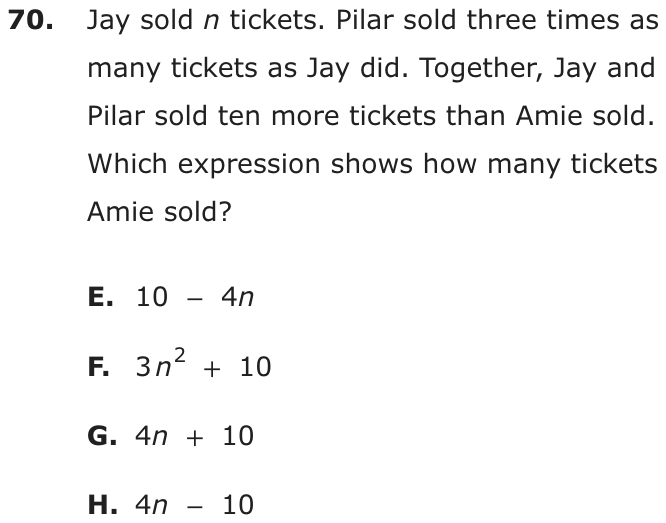
Jay sold n tickets. Pilar sold three times as many tickets as Jay did. Together, Jay and Pilar sold ten more tickets than Amie sold. Which expression shows how many tickets Amie sold?
- A
- B
- C
- D
Show the answer
Correct answer: D
Since Jay sold n tickets and Pilar sold 3 times the number of tickets Jay sold, Pilar sold tickets.
Then, since together Jay and Pilar sold 10 more tickets than Amie, subtract 10 from to get the expression that shows how many tickets Amie sold.
Then combine like terms.
Question analysis
Jay sells n tickets, Pilar sells three times as many, and together they sell ten more tickets than Amie. Students choose the expression in n for the number of tickets Amie sold. It tests writing and combining algebraic expressions from words, and the last sentence needs a careful reading, because it describes Amie only through the other two.
- NYS standards
- Grade level
- Grade 6 content, by NYS standard
- Compared with grade 7
- At grade 7 Writing an expression from words is grade 6 content, but this one links three people in a chain, and the last sentence compares the pair's total with Amie instead of describing Amie directly, which grade 7 students often misread.
- Estimated difficulty
- Moderate: several steps, or a close reading with one strong distractor.
- Thinking it demands
- Depth of knowledge 2, skills and concepts · mainly apply
- What makes it hard
- Turning words into math moderate
- Variables instead of numbers minor
- Solution
- 3 steps
- Reading level
- Question and choices: about grade 5, 37 words.
- Students, last 30 days
- Not enough answers yet to show (it takes 10).
Why it is hard, traps and wrong answers (shows the answer)
Why it is hard
Building the pair's total, n + 3n = 4n, is routine; the question is decided by which way the last comparison runs. Because the pair sold more than Amie, her expression must come out smaller than 4n, yet the most tempting choice adds the 10. Trying n = 5 settles it: the pair sold 20 tickets, so Amie sold 10, and only one expression gives 10.
Turning words into math moderate Understanding the question
“Together, Jay and Pilar sold ten more tickets than Amie sold” compares the pair's 4n with Amie, so her count is 10 less, though the word more suggests adding. (Hegarty, Mayer & Monk, 1995; Koedinger & Nathan, 2004)
Variables instead of numbers minor Understanding the question
Every count is written in terms of n, so no ticket total can be checked unless the student substitutes a value such as n = 5 into each expression. (Koedinger & Nathan, 2004; Enright, Morley & Sheehan, 2002)
Strategy: Write Pilar's tickets and the pair's total in terms of n, then test each choice with a small value such as n = 5 against the sentence comparing the pair with Amie.
Traps
- Follows a key word: Picks the operation from a single word rather than the situation: "removed" so subtract, "of" so multiply, "more" so add, when the situation needs something else.
- Negatives and direction: Arithmetic with negative numbers, the order of a subtraction, or direction on a number line. (Moving a term across the equals sign without changing its sign is a faulty procedure.)
- Wrong operation: Adds instead of multiplying, divides the wrong way round, turns a ratio or rate upside down, or undoes a step in the wrong direction (subtracts what should be added back).
The wrong answers, classified
A Negatives and direction (Brown & Burton, 1978)
Sees that 10 and the pair's 4n must be subtracted but writes them in the wrong order, 10 − 4n, which is negative once n is 3 or more.
B Wrong operation (Hegarty, Mayer & Monk, 1995; King et al., 2004)
Multiplies Jay's n by Pilar's 3n instead of adding them, getting 3n², and then adds the 10 as the word more suggests.
C Follows a key word (Hegarty, Mayer & Monk, 1995)
Follows the word more and adds 10 to the pair's 4n, though the pair sold 10 more than Amie, so Amie sold fewer.
Worked solution, step by step
Formulas used
- Combining like terms
- n is the unknown number. a and b are the numbers that multiply it. Like terms are terms with the same letter. Add the numbers in front: one n plus three n’s is four n’s, just as 1 apple plus 3 apples is 4 apples.
- Ten more than
- A and B are two amounts. If A is 10 more than B, A is the bigger one. To get the smaller amount, B, take 10 away from A. The words more than tell you which amount is bigger. They don’t always mean add.
Sort out the question
Jay sold n tickets. The letter n stands for a number you don’t know. Pilar sold three times as many as Jay. Jay and Pilar together sold ten more than Amie. You need an expression for Amie’s tickets. An expression is a math phrase with numbers and letters, like 2n + 1.
Write Pilar’s and the pair’s tickets
Three times as many as n is 3n. So Pilar sold 3n tickets. Together, Jay and Pilar sold n + 3n. Combine like terms:
So the pair sold 4n tickets.
Turn the last sentence into math
The pair sold ten more than Amie. So the pair has the bigger number. Amie’s tickets plus 10 make the pair’s 4n.
To find Amie’s tickets, take 10 away from 4n.
Watch out: the word more tempts you to add 10. That gives , choice C. But Amie sold fewer tickets than the pair, not more.
Rule out the other choices
Choice A, , subtracts in the wrong order. It is negative once n is 3 or more. Choice B, , multiplies n by 3n instead of adding them. So the answer is D, .
Check your answer
Try n = 5. Jay sold 5 and Pilar sold 15, so together they sold 20. Amie sold 10 fewer, which is 10. Choice D gives . That matches. Choice C gives 30, more than the pair sold.
More questions like this
The original DOE question