Question
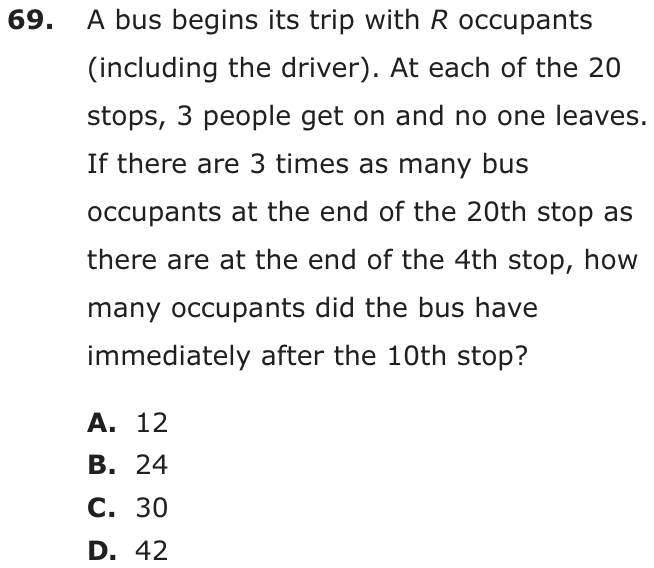
A bus begins its trip with R occupants (including the driver). At each of the 20 stops, 3 people get on and no one leaves. If there are 3 times as many bus occupants at the end of the 20th stop as there are at the end of the 4th stop, how many occupants did the bus have immediately after the 10th stop?
- A12
- B24
- C30
- D42
Show the answer
Correct answer: D
Write an expression to represent the number of occupants after 20 stops. Then, simplify the expression.
Write an expression to represent the number of occupants after 4 stops. Then, simplify the expression.
Write an equation that shows that the number of occupants after 20 stops is 3 times the number of occupants after 4 stops. Then, solve for R.
Write an expression to represent the number of occupants after 10 stops. Then, substitute 12 for R and evaluate.
Question analysis
A bus starts with an unknown number of riders, and 3 people board at each of 20 stops while no one gets off. After the 20th stop it holds three times as many as after the 4th. Students write and solve an equation for the starting number, then find how many were aboard after the 10th stop, a stop the condition never mentions.
- NYS standards
- Grade level
- Grade 8 content, by NYS standard
- Compared with grade 7
- Above grade 7 Grade 7 equations usually have the unknown on one side, as in px + q = r. Here students build two expressions from a story, set one equal to three times the other, solve with the unknown on both sides, then answer a third question.
- Estimated difficulty
- Hard: combines ideas, needs a plan, and has more than one tempting wrong answer.
- Thinking it demands
- Depth of knowledge 2, skills and concepts · mainly apply
- What makes it hard
- Turning words into math major
- Many steps moderate
- Much to keep track of minor
- Solution
- 5 steps
- Reading level
- Question and choices: about grade 8, 60 words.
- Students, last 30 days
- Not enough answers yet to show (it takes 10).
Why it is hard, traps and wrong answers (shows the answer)
Why it is hard
The question hides a linear equation in a story, and the comparison sentence is the hard part: the count that gets tripled is the one at the 4th stop, parentheses and all. Solving gives the starting count, but the question asks about a different moment, the end of the 10th stop, so one more step remains. Labeling each number with its stop, start, 4th, 10th or 20th, keeps the right count from being given for the wrong time.
Turning words into math major Understanding the question
“3 times as many bus occupants at the end of the 20th stop as there are at the end of the 4th stop” must become R + 60 = 3(R + 12), the 3 multiplying the whole smaller count. (Hegarty, Mayer & Monk, 1995; Koedinger & Nathan, 2004)
Many steps moderate Working it out
Two expressions, an equation solved for R = 12, and then a third count at the 10th stop: four stages, and the number asked for appears only at the last one. (Daniel & Embretson, 2010; Enright, Morley & Sheehan, 2002)
Much to keep track of minor Working it out
Three different stops matter, the 4th and the 20th for the equation and the 10th for the question, and each count has to keep the starting R. (Sweller, 1988; Carpenter, Just & Shell, 1990)
Strategy: Let R be the starting count, write the counts after the 4th and the 20th stops in terms of R, make the larger equal to 3 times the smaller and solve, then add the riders from 10 stops.
Traps
- Stops one step early: A choice is a number from partway through the solution.
- Answers a different question: A choice is right for another quantity: the other unknown, the rest instead of the part, the part instead of the whole.
The wrong answers, classified
A Stops one step early (King et al., 2004; Gierl et al., 2017)
Solves R + 60 = 3(R + 12) correctly and stops at R = 12, the occupants at the start, before adding the 30 riders from 10 stops.
B Answers a different question (King et al., 2004; Hegarty, Mayer & Monk, 1995)
Finds R = 12 but gives the count at the end of the 4th stop, 12 + 4 × 3 = 24, instead of the count after the 10th.
C Answers a different question (King et al., 2004; Hegarty, Mayer & Monk, 1995)
Counts only the riders who board at 10 stops, 10 × 3 = 30, leaving out the R occupants aboard from the start.
Worked solution, step by step
Formulas used
- People on the bus after some stops
- N is the number of people on the bus. R is the number at the start, driver included. s is the number of stops so far. 3 people get on at each stop and no one leaves, so each stop adds 3.
- Distributive property
- a is the number outside the parentheses. b and c are the terms inside. A term is a number, a letter, or a number times a letter. Multiply each term inside by a. Use it when a number multiplies a whole sum.
Sort out the question
Occupants are the people on the bus. R is how many there are at the start, counting the driver. At each stop, 3 people get on and nobody gets off. After the 20th stop, there are 3 times as many people as after the 4th stop. You need the number after the 10th stop. That is a third moment, so one more step waits at the end.
Write the counts for two stops
Keep R in each count. The people who started are still on the bus.
Write the equation
The count after stop 20 is 3 times the count after stop 4. The 3 multiplies the whole count after stop 4, so use parentheses.
Use the distributive property: 3 times R, plus 3 times 12.
Solve for R
Subtract R from both sides. Then subtract 36 from both sides. Then divide by 2.
So 12 people were on the bus at the start. Watch out: 12 is choice A, but it is the count at the start. The question asks about the 10th stop.
Count after the 10th stop
Watch out: 24 is the count after the 4th stop, choice B. 30 counts only the people who got on, choice C. It leaves out the 12 who started. So the answer is D, 42.
Check your answer
Test R = 12. After the 4th stop: people. After the 20th stop: people. And . That matches the question, so R = 12 is right, and so is 42.
More questions like this
The original DOE question