Question
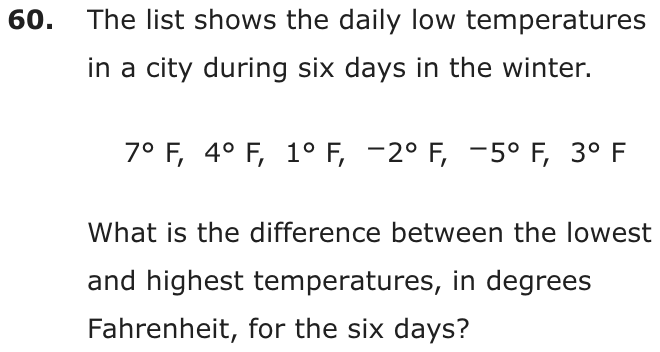
The list shows the daily low temperatures in a city during six days in the winter.
7° F, 4° F, 1° F, −2° F, −5° F, 3° F
What is the difference between the lowest and highest temperatures, in degrees Fahrenheit, for the six days?
Grid-in question: work out the answer and enter it as a number.
Show the answer
Correct answer: 12
Determine the greatest temperature listed for the six days:
Of 7, 4, 1, (−2), (−5), and 3, the greatest value is 7 because its location is farthest to the right on a number line.
Greatest temperature = 7° F
Determine the lowest temperature listed for the six days:
Of 7, 4, 1, (−2), (−5), and 3, the lowest value is (−5) because its location is farthest to the left on a number line.
Lowest temperature = (−5)° F
Determine the difference between the two temperatures:
Question analysis
A list gives a city's daily low temperatures over six winter days, some above zero and some below. This grid-in asks for the difference between the highest and the lowest of them, in degrees Fahrenheit. Students order positive and negative numbers and subtract integers; picking the right negative reading and handling the double minus sign are the tricky steps.
- Grade level
- Grade 7 content, by NYS standard
- Compared with grade 7
- At grade 7 Subtracting a negative number to find the distance between two temperatures is core grade 7 integer work. Picking the extremes from six one-digit readings is quick, so this is a typical, short grade 7 exercise.
- Estimated difficulty
- Straightforward: two steps or one careful reading.
- Thinking it demands
- Depth of knowledge 2, skills and concepts · mainly apply
- What makes it hard
- Error-prone arithmetic moderate
- An answer in an unexpected form minor
- Solution
- 2 steps
- Reading level
- Question and choices: about grade 7, 39 words.
- Students, last 30 days
- Not enough answers yet to show (it takes 10).
Why it is hard, traps and wrong answers (shows the answer)
Why it is hard
Six readings, two of them below zero, must be sorted before any subtraction, and −5 has to be seen as colder than −2 even though 5 is the bigger number. The subtraction is where most points go: the gap runs 5 degrees up to zero and 7 more above it. A quick sketch of a thermometer from −5 to 7 shows the full span and catches a sign dropped along the way.
Error-prone arithmetic moderate Working it out
The span is 7 − (−5), and subtracting a negative means adding 5, so the five degrees below zero are easy to drop, leaving only 2. (Brown & Burton, 1978; Junker & Sijtsma, 2001)
An answer in an unexpected form minor Choosing the answer
With no choices to compare, nothing flags an entry of 2 or −12; the student must see alone that the gap between the extremes is a positive count of degrees. (Enright, Morley & Sheehan, 2002)
Strategy: Picture the six readings on a number line: the lowest is the one farthest to the left. Subtract the lowest from the highest, remembering that subtracting a negative number means adding.
Traps
- Negatives and direction: Arithmetic with negative numbers, the order of a subtraction, or direction on a number line. (Moving a term across the equals sign without changing its sign is a faulty procedure.)
- Information you don't need: The question gives numbers or facts that play no part in the answer.
The wrong answers, classified
2 Negatives and direction (Brown & Burton, 1978)
Subtracts the sizes, 7 − 5 = 2, as if both readings were above zero, leaving out the 5 degrees between −5° F and zero.
9 Negatives and direction (Brown & Burton, 1978)
Takes −2° F as the lowest reading because 2 is less than 5, then subtracts 7 − (−2) = 9.
-12 Negatives and direction (Brown & Burton, 1978)
Subtracts in the reverse order, lowest minus highest, −5 − 7 = −12, and enters a negative difference.
Worked solution, step by step
Formulas used
- Difference between two values
- D is the difference. Subtract the lowest value from the highest, in that order, so D is not negative. It tells how far apart the two values are on a number line.
- Subtracting a negative number
- a and b are numbers, and −b is the negative of b. Taking away a negative is the same as adding its positive. On a number line, going from −b up to a passes b steps to zero, then a more.
Sort out the question
The list has six low temperatures, in degrees Fahrenheit (° F). Some are below zero. A minus sign means below zero. You need the highest and the lowest temperatures. Then find the difference between them. The difference tells how many degrees apart they are.
Find the highest and lowest
Picture a number line, or a thermometer. Numbers farther to the right are higher. The highest temperature is 7° F. The lowest is the one farthest to the left. That is −5° F. Watch out: −5 is colder than −2. The number 5 is bigger than 2, but 5 below zero is lower than 2 below. Using −2 as the lowest leads to 9.
Subtract the lowest from the highest
Subtracting a negative is the same as adding. The temperatures are 12 degrees apart. Watch out: leaves out the 5 degrees below zero. Also, a difference here is not negative, so don’t grid −12. So you would grid 12.
Check your answer
Count on a thermometer. From −5° F up to 0° F is 5 degrees. From 0° F up to 7° F is 7 more degrees. degrees. That matches.
More questions like this
The original DOE question