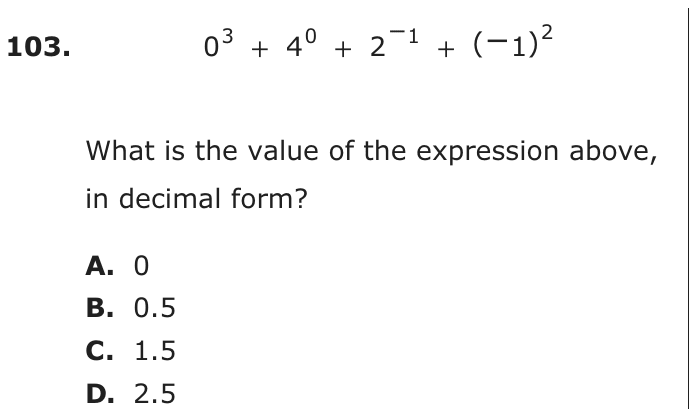
Question
What is the value of the expression above, in decimal form?
- A0
- B0.5
- C1.5
- D2.5
Show the answer
Correct answer: D
Question analysis
An exponents question: students find the decimal value of a sum of four powers, zero cubed, four to the zero power, two to the negative first power and negative one squared. Each of the four terms follows a different rule, and a slip on any one of them changes the total.
- Grade level
- Grade 8 content, by NYS standard
- Compared with grade 7
- Above grade 7 Grade 7 work uses whole-number exponents and signed numbers. Zero and negative exponents are grade 8 content, and this expression tests both alongside a negative base, each with its own common misconception.
- Estimated difficulty
- Hard: combines ideas, needs a plan, and has more than one tempting wrong answer.
- Thinking it demands
- Depth of knowledge 1, recall and reproduction · mainly apply
- What makes it hard
- Solution
- 4 steps
- Reading level
- Question and choices: about grade 6, 12 words.
- Students, last 30 days
- Not enough answers yet to show (it takes 10).
Why it is hard, traps and wrong answers (shows the answer)
Why it is hard
Every term tests a different exponent rule, and each wrong choice comes from breaking exactly one of them. The zero exponent is the most common casualty, since 4⁰ looks as if it should be 0 like 0³; a negative exponent read as a negative number is close behind. Writing each term’s value above it before adding, 0, 1, 1/2 and 1, keeps the four rules separate.
Something you must already know major Working it out
Three rules the test does not give decide the sum: any nonzero number to the 0 power is 1, 2 to the −1 power is 1/2, and (−1)² is positive 1. (Anderson & Krathwohl, 2001)
Error-prone arithmetic minor Working it out
The four terms carry a zero base, a zero exponent, a negative exponent and a negative base, so a sign or a stray 0 can slip in at each one. (Brown & Burton, 1978; Junker & Sijtsma, 2001)
Strategy: Evaluate each power on its own, using the rules for a zero exponent and a negative exponent and the sign of a squared negative number, then add the four values.
Traps
- A faulty procedure: A systematic but wrong procedure: adding fractions straight across, applying an exponent to each term of a sum, dropping a sign when moving a term.
- Order of operations: Working left to right, or distributing a minus sign wrongly, gives a choice.
The wrong answers, classified
A A faulty procedure (Brown & Burton, 1978; Tatsuoka, 1983)
Treats 2 to the power −1 as −2 instead of one half, so the four terms 0 + 1 − 2 + 1 add to 0.
B Order of operations (Brown & Burton, 1978)
Squares as if the minus sat outside the parentheses, taking (−1)² as −1, so the terms add to 0 + 1 + 0.5 − 1 = 0.5.
C A faulty procedure (Brown & Burton, 1978; Tatsuoka, 1983)
Takes 4 to the power 0 as 0 rather than 1, so the expression becomes 0 + 0 + 0.5 + 1 = 1.5.
Worked solution, step by step
Formulas used
- Zero exponent
- a is any number except 0. An exponent of 0 always gives 1. It works because each step down in the exponent divides by a. For example, 4 to the first power is 4, and 4 ÷ 4 = 1.
- Negative exponent
- a is the base, and n is a positive whole number. A negative exponent does not make the number negative. It means 1 divided by the base to the positive power. For example, 2 to the −1 power is one half.
Sort out the question
The expression adds four powers. A power is a base with an exponent, a small raised number. The exponent tells how many times to use the base as a factor, a number you multiply. Find each power, then add.
Find the first two powers
Zero times itself is still zero.
Next, use the zero exponent rule.
Watch out: is 1, not 0. Taking it as 0 gives choice C.
Find the negative power
Use the negative exponent rule.
Watch out: is not −2. That mistake gives choice A.
Find the last power
The base is −1, inside the parentheses. Multiply it by itself. A negative times a negative is positive.
Watch out: The answer is not −1. That mistake gives choice B.
Add the four values
Now add them. The question wants a decimal, so write one half as 0.5.
So the answer is D, 2.5.
Check your answer
See why with a pattern. and . Each step down divides by 4, so . In the same way, and .
More questions like this
The original DOE question