Question
FRUIT SOLD
AT STORE XYZ
| Fruit | Number Sold |
|---|---|
| Apples | 8 |
| Bananas | 6 |
| Cherries | 12 |
| Oranges | 6 |
| Peaches | ? |
| Total | 50 |
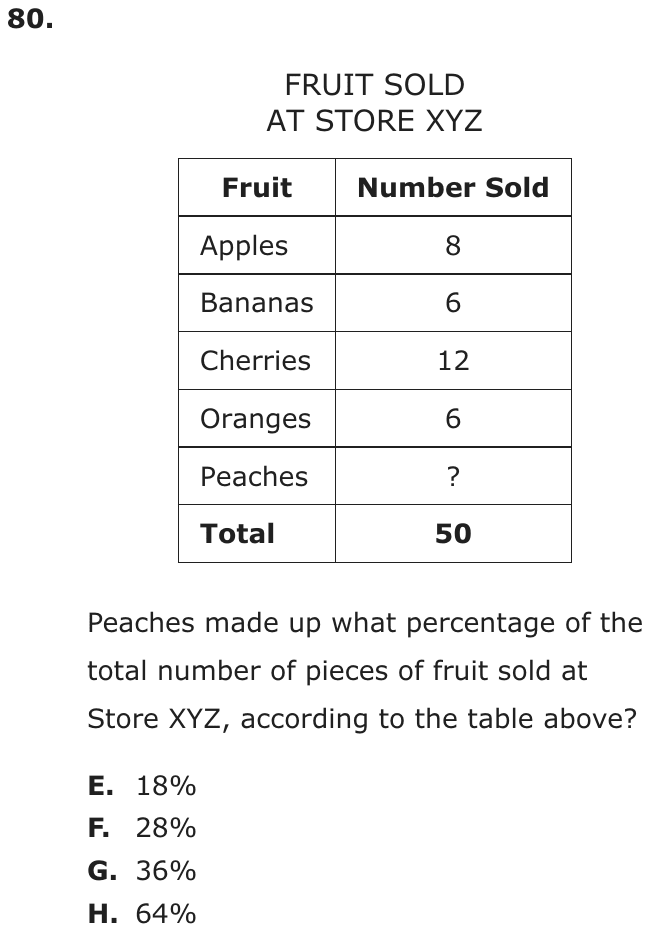
Peaches made up what percentage of the total number of pieces of fruit sold at Store XYZ, according to the table above?
- A18%
- B28%
- C36%
- D64%
Show the answer
Correct answer: C
First, find the number of peaches sold:
Then, find the percentage:
Question analysis
A table lists the fruit sold at Store XYZ, apples, bananas, cherries and oranges, with the number of peaches shown as a question mark and a total of 50. Students find what percentage of the fruit sold were peaches. They first work out the missing count, then turn it into a percent of the total.
- NYS standards
- 6.RP.3c percent as a rate per 100
- Grade level
- Grade 6 content, by NYS standard
- Compared with grade 7
- Below grade 7 Finding a missing value and writing a part as a percent of a whole are grade 6 skills. With a total of 50, the percent step is quick, so the task is lighter than typical grade 7 percent problems.
- Estimated difficulty
- Straightforward: two steps or one careful reading.
- Thinking it demands
- Depth of knowledge 2, skills and concepts · mainly apply
- What makes it hard
- Reading a figure, table or graph minor
- Many steps minor
- Solution
- 3 steps
- Reading level
- Question and choices: about grade 4, 34 words.
- Students, last 30 days
- Not enough answers yet to show (it takes 10).
Why it is hard, traps and wrong answers (shows the answer)
Why it is hard
The total of 50 makes the percent step easy, since each piece of fruit is 2 percent, but the question first hides the count it needs. Students who find the 18 peaches and stop, or who give the share of the four listed fruits, reach listed choices. Checking that the peaches’ percent and the other fruits’ percent add to 100 confirms the answer.
Reading a figure, table or graph minor Understanding the question
The table gives four counts, a question mark for peaches and a total of 50, so the missing count must be found by subtraction before any percent. (Lesh, Post & Behr, 1987; Kirsch & Mosenthal, 1990)
Many steps minor Working it out
Adding 8, 6, 12 and 6, subtracting from 50, and turning 18 out of 50 into a percent are three steps, and the count of 18 is itself a listed percent. (Daniel & Embretson, 2010; Enright, Morley & Sheehan, 2002)
Strategy: Add the four known counts, subtract from 50 to get the peaches, then double that count, since each piece out of 50 is 2 percent.
Traps
- Stops one step early: A choice is a number from partway through the solution.
- Answers a different question: A choice is right for another quantity: the other unknown, the rest instead of the part, the part instead of the whole.
The wrong answers, classified
A Stops one step early (King et al., 2004; Gierl et al., 2017)
Finds the 18 peaches but gives that count as the percent, forgetting to compare it with the total of 50 pieces.
B Little reason to choose it (Haladyna & Downing, 1993; Rodriguez, 2005)
No common working gives 28%, which would need 14 peaches; it takes a slip such as 36 for 8 + 6 + 12 + 6, so it mostly draws guesses.
D Answers a different question (King et al., 2004; Hegarty, Mayer & Monk, 1995)
Finds the share of the other four fruits, 32 of 50 or 64 percent, instead of the share of the peaches.
Worked solution, step by step
Formulas used
- Percent of a total
- The part is the amount you are asking about, here the peaches. The whole is the total, here all 50 pieces of fruit. Dividing gives the fraction of the whole. Multiplying by 100 turns it into a percent, which means out of 100.
Sort out the question
The table shows how many of each fruit Store XYZ sold. The number of peaches is missing, shown by a question mark. The total is 50 pieces of fruit. You need the percent of the total that were peaches.
Add the fruits you know
Apples, bananas, cherries and oranges add up to 32 pieces of fruit. That is every fruit except the peaches.
Find the number of peaches
The peaches are whatever is left of the 50.
So 18 peaches were sold. Watch out: 18 is a count, not a percent. Choosing 18% is choice A.
Turn the count into a percent
Peaches were 36% of the fruit sold. Watch out: 32 out of 50 is 64%, choice D. That is the other four fruits, not the peaches. So the answer is C, 36%.
Check your answer
Out of 50 pieces, each piece is 2% of the total, because . So 18 peaches are percent. Also, 36% for peaches plus 64% for the rest makes 100%.
More questions like this
The original DOE question