Question
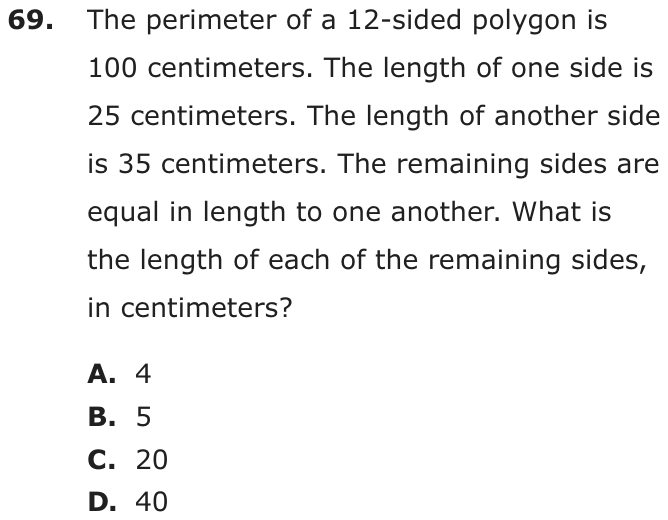
The perimeter of a 12-sided polygon is 100 centimeters. The length of one side is 25 centimeters. The length of another side is 35 centimeters. The remaining sides are equal in length to one another. What is the length of each of the remaining sides, in centimeters?
- A4
- B5
- C20
- D40
Show the answer
Correct answer: A
Let x represent the length of one of the 10 remaining sides:
Question analysis
A 12-sided polygon has a perimeter of 100 centimeters: one side is 25 cm long, another is 35 cm, and the rest are all equal to one another. Students find the length of each remaining side. This perimeter problem turns into a two-step equation, and the tricky part is counting the sides that are left.
- NYS standards
- 7.EE.4a two-step equations
- Grade level
- Grade 7 content, by NYS standard
- Compared with grade 7
- At grade 7 Writing and solving a two-step equation from a short description is standard grade 7 work. The perimeter setting is simple; the only extra care is counting the sides that remain after the two given ones.
- Estimated difficulty
- Straightforward: two steps or one careful reading.
- Thinking it demands
- Depth of knowledge 2, skills and concepts · mainly apply
- What makes it hard
- Turning words into math minor
- Many steps minor
- Solution
- 3 steps
- Reading level
- Question and choices: about grade 7, 44 words.
- Students, last 30 days
- Not enough answers yet to show (it takes 10).
Why it is hard, traps and wrong answers (shows the answer)
Why it is hard
The perimeter and the two named sides make the subtraction obvious, so the real decision comes after it: what to divide the leftover 40 centimeters by. Students who stop at the leftover length, or who lose track of how many sides remain, reach a listed choice. Writing 25 + 35 + 10x = 100 keeps the count of 10 in view.
Turning words into math minor Understanding the question
“The remaining sides are equal in length to one another” hides the count: 12 sides minus the two given ones leaves 10 equal sides to share the rest of the perimeter. (Hegarty, Mayer & Monk, 1995; Koedinger & Nathan, 2004)
Many steps minor Working it out
Subtracting 25 and 35 from 100, counting the sides left, and dividing are three steps, and the first result, 40, is itself a listed choice. (Daniel & Embretson, 2010; Enright, Morley & Sheehan, 2002)
Strategy: Subtract the two known sides from the perimeter, count how many sides are left, and share the remaining length equally among them.
Traps
- Stops one step early: A choice is a number from partway through the solution.
- Misreads the question: Misses or misreads a condition or a word in the question: "at least", "each", "remaining", "not".
The wrong answers, classified
B Little reason to choose it (Haladyna & Downing, 1993; Rodriguez, 2005)
No common working gives 5; sharing the 40 centimeters among 8 sides would, but nothing in the question suggests 8, so it mostly draws guesses.
C Misreads the question (Hegarty, Mayer & Monk, 1995)
Shares the leftover 40 centimeters between two sides, as if the figure were four-sided, overlooking that it has 12 sides.
D Stops one step early (King et al., 2004; Gierl et al., 2017)
Finds the total of the remaining sides, 100 − 25 − 35 = 40, and stops before sharing it among the 10 equal sides.
Worked solution, step by step
Formulas used
- Perimeter of a polygon
- P is the perimeter, the total distance around a shape. A polygon is a flat shape with straight sides. A sum is the answer to an addition. So add the lengths of every side to get P.
Sort out the question
The shape is a polygon with 12 sides. Its perimeter is 100 centimeters. One side is 25 centimeters, and another is 35 centimeters. The other sides all have the same length. You need that length.
Count the equal sides
Two of the 12 sides are already known. The rest are the equal sides.
So there are 10 equal sides. Call the length of each one x.
Write an equation for the perimeter
Use the perimeter formula. All 12 sides add up to 100. Ten sides of length x add up to 10x, which means 10 times x.
Solve for x
The 10 equal sides add up to 40 centimeters. Watch out: 40 is all ten sides together, not one side. Stopping here gives choice D. Now share the 40 among the 10 sides.
Give the answer
Each remaining side is 4 centimeters long. Watch out: sharing the 40 centimeters between only 2 sides gives 20, choice C. That treats the shape as if it had 4 sides, but it has 12. So the answer is A, 4.
Check your answer
Add all 12 sides: . That is the perimeter the question gives, so 4 centimeters is right.
More questions like this
The original DOE question