Question
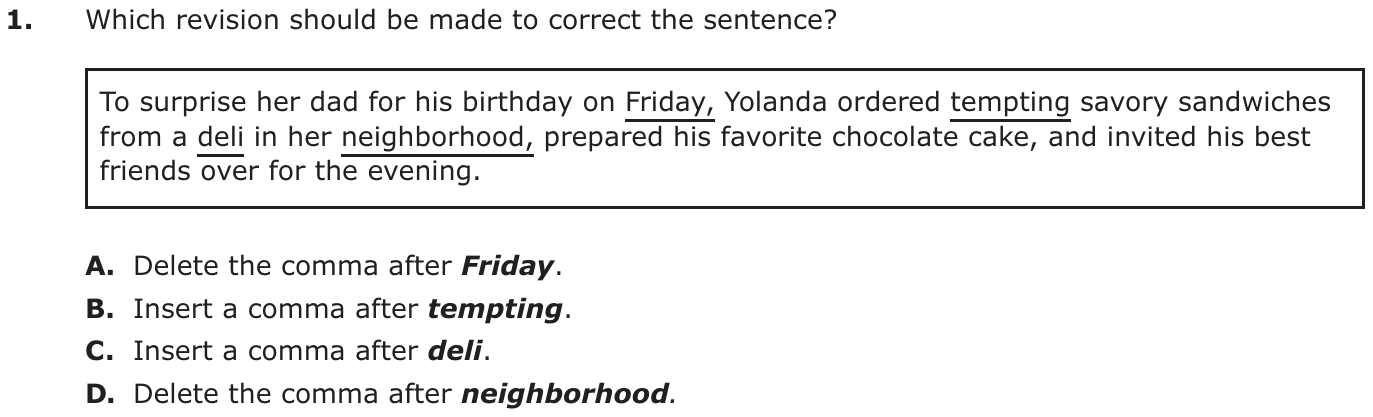
Which revision should be made to correct the sentence?
To surprise her dad for his birthday on Friday, Yolanda ordered tempting savory sandwiches from a deli in her neighborhood, prepared his favorite chocolate cake, and invited his best friends over for the evening.
- ADelete the comma after Friday.
- BInsert a comma after tempting.
- CInsert a comma after deli.
- DDelete the comma after neighborhood.
Show the answer
Correct answer: B
The question asks which edit should be made to correct the sentence.
A. Incorrect. A comma is needed to separate the introductory infinitive phrase “to surprise her dad for his birthday on Friday,” which modifies Yolanda’s action, from the remainder of the sentence.
B. CORRECT. A comma is needed between two adjectives of equal importance preceding a noun. In this case, the adjectives “tempting” and “savory” are of equal importance, modifying the noun “sandwiches.” Their equal importance can be determined by inserting the word “and” between them (“tempting and savory sandwiches”).
C. Incorrect. This edit would introduce an error into the sentence by needlessly breaking up the two prepositional phrases “from a deli” and “in her neighborhood” with a comma. No comma is needed when prepositional phrases are joined together in this way to indicate a singular idea. In this sentence, these two phrases work together to show where the sandwiches are from.
D. Incorrect. Deleting this comma would introduce an error into the sentence. A comma is needed to separate the first and second items in the series of three actions Yolanda undertook: “ordered tempting savory sandwiches from a deli in her neighborhood,” “prepared his favorite chocolate cake,” and “invited his best friends over for the evening.”
Question analysis
This punctuation question gives one long sentence about Yolanda’s birthday surprise for her dad, with sandwiches from a neighborhood deli, his favorite chocolate cake and his best friends invited over, and asks which comma revision corrects it. Two choices delete a comma and two insert one, so students must decide what each comma does, or would do, in the sentence.
- NYS standards
- 7L2 capitalization, punctuation, and spelling
- Grade level
- Grade 7 reading and task
- Compared with grade 7
- At grade 7 Comma rules are taught across grades 6 and 7, and one sentence with four marked spots is a typical grade 7 editing task. The sentence reads smoothly as printed, so the needed change has to be found by rule rather than by ear.
- Estimated difficulty
- Straightforward: two steps or one careful reading.
- Thinking it demands
- Depth of knowledge 1, recall and reproduction · mainly apply
- What makes it hard
- A rule that doesn't sound wrong moderate
- Complex sentences minor
- Evidence
- Answered from one sentence or line
- Reading level
- Question and choices: about grade 8, 63 words.
- Students, last 30 days
- Not enough answers yet to show (it takes 10).
Why it is hard, traps and wrong answers (shows the answer)
Why it is hard
Every marked spot but one already follows a rule, and the sentence reads smoothly as printed, so students who edit by ear go hunting for a pause to add or a comma to remove. The strongest pull inserts a comma between “from a deli” and “in her neighborhood,” two phrases that work as one, and another deletes the series comma because it sits right before a verb. Testing the two adjectives with “and” settles the question in seconds.
A rule that doesn't sound wrong moderate Working it out
“Tempting savory sandwiches” sounds complete without a comma, so the error is invisible to the ear; only putting “and” between the two adjectives, or swapping them, shows that they are coordinate and need one. (Connors & Lunsford, 1988)
Complex sentences minor Understanding the question
The 34-word sentence opens with a nine-word infinitive phrase and then lists three actions, the first running ten words to “neighborhood,” so each marked comma must be judged against where these parts begin and end. (Abedi & Lord, 2001; Freedle & Kostin, 1993; Messick, 1989)
Strategy: Take the four marked spots one at a time and name the comma rule that applies there; change only the spot where the sentence breaks a rule, not one that already follows it.
Traps
- Punctuation: A comma, semicolon, colon, dash or apostrophe used where it does not belong, or missing where it does.
The wrong answers, classified
A Punctuation (Connors & Lunsford, 1988)
Treats the comma after “Friday” as an interruption, though the nine-word opening phrase “To surprise her dad for his birthday on Friday” has to be set off from “Yolanda.”
C Punctuation (Connors & Lunsford, 1988)
Treats “in her neighborhood” as extra information to set off, but the phrase identifies the deli and works with “from a deli” as one unit, so no comma goes between them.
D Punctuation (Connors & Lunsford, 1988)
Stretches the rule against separating a subject from its verb to the comma before “prepared,” though that comma ends the first of Yolanda’s three actions in a series.
Working it out, step by step
Figure out what the question asks
This is a punctuation question. The sentence has four underlined spots. Two choices take a comma away, and two add one. Only one change fixes a real mistake. So go spot by spot. Ask what job a comma does there, or would do.
Learn the rule for paired describing words
An adjective is a describing word, like red or soft. Sometimes two adjectives describe the same noun (a naming word) equally. Then a comma goes between them. Here is a test: put and between the two words. If it still sounds right, use a comma.
Example: a long, boring movie. You could say a long and boring movie, so the comma belongs.
Find the spot that breaks the rule
Look at “tempting savory sandwiches.” Tempting means making you want it. Savory means salty or spicy, not sweet. Both words describe the sandwiches. Try the test: tempting and savory sandwiches. That sounds fine. You could even swap them: savory, tempting sandwiches. So a comma is missing. The sentence should say tempting, savory sandwiches.
Check each choice
- A is wrong. The sentence opens with a long phrase: “To surprise her dad for his birthday on Friday.” A comma must separate it from the main part, “Yolanda ordered.” So that comma stays.
- B is right. It adds the missing comma between the two adjectives.
- C is wrong. The words “in her neighborhood” tell which deli. They work as a team with “from a deli,” so no comma goes between them.
- D is wrong. Yolanda does three things: she ordered sandwiches, made a cake and invited friends. The comma after neighborhood ends the first item in that list. It must stay.
Watch out: C is tempting because a pause after deli may sound natural. But a pause is not a rule, and no rule puts a comma there.
Choose the answer
With the fix, Yolanda orders tempting, savory sandwiches, and every other comma stays as it is. So the answer is B: insert a comma after tempting.
Why this answer and not the closest wrong one
C is the closest wrong answer. It adds a comma too, but it splits two phrases that together tell where the deli is. B adds a comma where a rule needs one. The and test proves it: “tempting” and “savory” each describe the sandwiches in the same way.
More questions like this
The original DOE question