Question
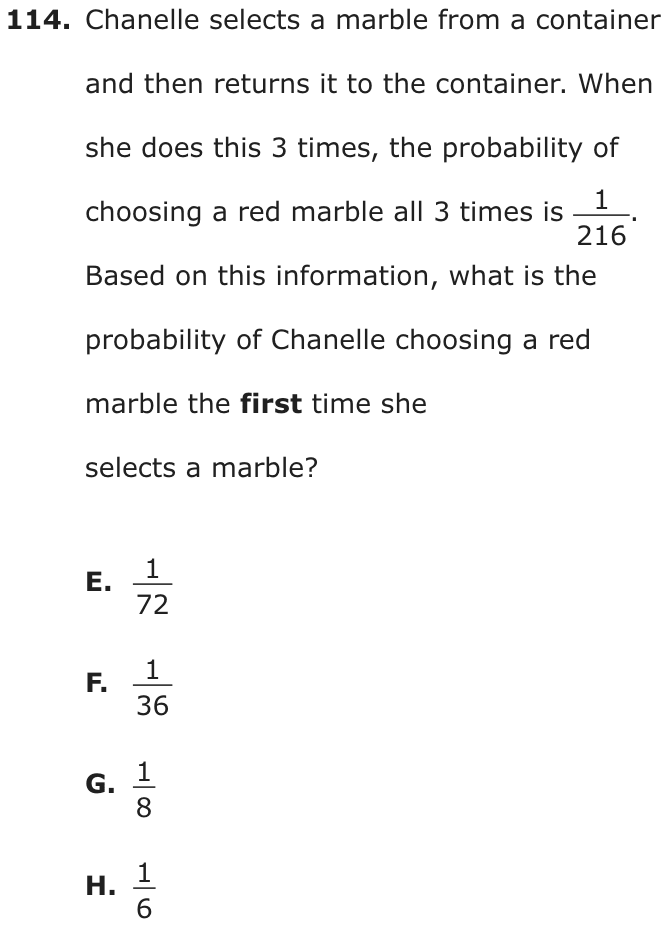
Chanelle selects a marble from a container and then returns it to the container. When she does this 3 times, the probability of choosing a red marble all 3 times is . Based on this information, what is the probability of Chanelle choosing a red marble the first time she selects a marble?
- A
- B
- C
- D
Show the answer
Correct answer: D
Let be the probability of Chanelle selecting a red marble the first time. The probability of selecting a red marble three times is , which is given as . Since , the value of x is 6, and the probability of Chanelle selecting a red marble the first time is .
Question analysis
This probability question says Chanelle draws a marble and puts it back, three times, and the chance of red all three times is 1/216. It asks for the chance of red on her first draw. Students reverse the multiplication rule for repeated independent draws, which means finding a cube root, and dividing by 3 is the tempting shortcut.
- Grade level
- Grade 8 content, by NYS standard
- Compared with grade 7
- Above grade 7 Multiplying probabilities for repeated draws with replacement is grade 7 compound probability. Running it backward, from three draws to one, needs a cube root, a grade 8 idea, though the numbers are friendly and the work is short once set up.
- Estimated difficulty
- Moderate: several steps, or a close reading with one strong distractor.
- Thinking it demands
- Depth of knowledge 2, skills and concepts · mainly apply
- What makes it hard
- Something you must already know moderate
- No obvious method minor
- Solution
- 2 steps
- Reading level
- Question and choices: about grade 7, 55 words.
- Students, last 30 days
- Not enough answers yet to show (it takes 10).
Why it is hard, traps and wrong answers (shows the answer)
Why it is hard
Once the three draws are seen as one chance cubed, the question is a cube root, and 216 is a perfect cube many students know. The risk lies in undoing the cube the wrong way: dividing by 3 because there are three draws, or stopping at 36 after one division by 6. A quick check, 1/6 × 1/6 × 1/6 = 1/216, confirms the answer.
Something you must already know moderate Working it out
Students must know that three draws with the marble returned each time multiply, p × p × p, and must recognize 216 as 6 × 6 × 6; the stem states neither. (Anderson & Krathwohl, 2001)
No obvious method minor Working it out
The usual direction runs from one draw to three; here the three-draw chance is given and the bold first asks for one draw, so students work backward and undo a cube. (Schoenfeld, 1985)
Strategy: Call the chance of red on one draw p, so three draws with replacement give p × p × p; then find the number whose cube equals the given probability.
Traps
- Wrong operation: Adds instead of multiplying, divides the wrong way round, turns a ratio or rate upside down, or undoes a step in the wrong direction (subtracts what should be added back).
- Stops one step early: A choice is a number from partway through the solution.
The wrong answers, classified
A Wrong operation (Hegarty, Mayer & Monk, 1995; King et al., 2004)
Divides 216 by 3 because there are three draws, instead of finding the number that multiplied by itself three times makes 216.
B Stops one step early (King et al., 2004; Gierl et al., 2017)
Divides 216 by 6 to get 36 and stops one division short, keeping 1/36, which is the chance of two reds in a row, not one.
C Little reason to choose it (Haladyna & Downing, 1993; Rodriguez, 2005)
No working with 1/216 gives 1/8, the chance of three heads in three coin tosses, so it mostly attracts guesses at a familiar fraction.
Worked solution, step by step
Formulas used
- Probability of repeated picks
- p is the chance of red on one pick. Chanelle puts the marble back each time, so every pick has the same chance p, and one pick doesn’t change the next. The chance of red on all three picks is the three chances multiplied.
Sort out the question
Chanelle picks a marble and puts it back, 3 times. The chance of red all 3 times is . You need the chance of red on just the first pick. Call that chance p.
Write the three picks as a product
She puts each marble back, so the container is the same every time. Each pick has the same chance, p.
Find the number that fits
You need a fraction that, multiplied by itself three times, makes . Its top is 1, since 1 × 1 × 1 = 1. For the bottom, find a number that times itself three times makes 216.
So the bottom is 6, and p is .
Avoid the tempting shortcuts
Watch out: dividing 216 by 3 gives 72, choice A. Three picks means multiplying three times, not dividing by 3. Also, is the chance of red twice in a row, choice B.
So the answer is D, .
Check your answer
Multiply it out: . That matches the question. Choice A fails fast: is already far smaller than .
More questions like this
The original DOE question