Question
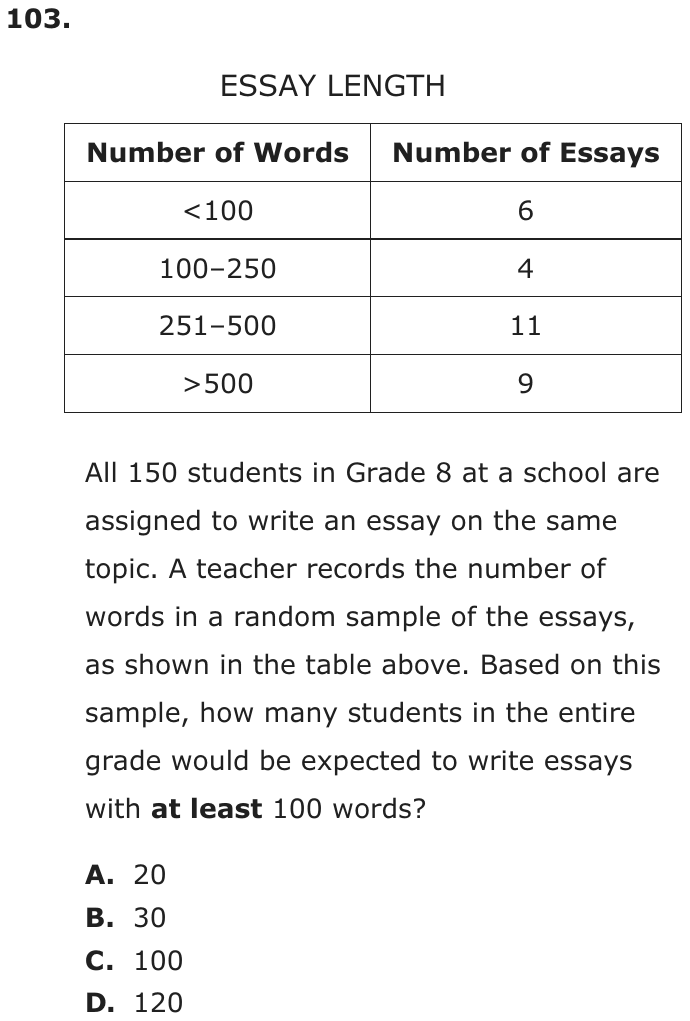
ESSAY LENGTH
| Number of Words | Number of Essays |
|---|---|
| <100 | 6 |
| 100–250 | 4 |
| 251–500 | 11 |
| >500 | 9 |
All 150 students in Grade 8 at a school are assigned to write an essay on the same topic. A teacher records the number of words in a random sample of the essays, as shown in the table above. Based on this sample, how many students in the entire grade would be expected to write essays with at least 100 words?
- A20
- B30
- C100
- D120
Show the answer
Correct answer: D
The number of students in the sample who wrote an essay with at least 100 words is 24 out of the 30 students. Write it as a fraction: . To predict the number of students in the entire grade who would write an essay with at least 100 words, find of 150, which is .
Question analysis
This statistics question gives a table of word counts for a random sample of Grade 8 essays and asks how many of all 150 students would be expected to write at least 100 words. Students find the sample size, the share meeting the condition, and scale it to the whole grade. Matching the words at least to the table's ranges is the tricky part.
- Grade level
- Grade 6 content, by NYS standard
- Compared with grade 7
- At grade 7 Using a random sample to predict a count for a whole population is typical grade 7 statistics and ratio work. Students total the sample from a table, read at least 100 against the table's ranges, and scale by a whole-number factor.
- Estimated difficulty
- Moderate: several steps, or a close reading with one strong distractor.
- Thinking it demands
- Depth of knowledge 2, skills and concepts · mainly apply
- What makes it hard
- Reading a figure, table or graph moderate
- Turning words into math minor
- Many steps minor
- Solution
- 3 steps
- Reading level
- Question and choices: about grade 6, 65 words.
- Students, last 30 days
- Not enough answers yet to show (it takes 10).
Why it is hard, traps and wrong answers (shows the answer)
Why it is hard
The proportion at the end is routine; the question is decided at the table. Students must turn “at least 100 words” into the right rows and also find the sample size, which is printed nowhere. Each listed wrong answer scales up a different group of rows, so a careless reading still produces a believable number. Noting that only 6 of 30 essays fall short, one fifth, gives a quick check.
Reading a figure, table or graph moderate Understanding the question
The table never prints the sample size; it has to be built by adding all four rows, 6 + 4 + 11 + 9 = 30, and the qualifying essays sit in three rows, not one. (Lesh, Post & Behr, 1987; Kirsch & Mosenthal, 1990)
Turning words into math minor Understanding the question
The bold “at least 100 words” must be matched to the rows 100–250, 251–500 and >500, keeping the row that begins at 100 and leaving out only the <100 row. (Hegarty, Mayer & Monk, 1995; Koedinger & Nathan, 2004)
Many steps minor Working it out
Four steps follow in order: the sample total, the qualifying count of 24, the fraction 24/30 = 4/5, and that fraction of all 150 students. (Daniel & Embretson, 2010; Enright, Morley & Sheehan, 2002)
Strategy: Add the table's counts to find the sample size, add the rows with 100 or more words, and scale that fraction of the sample up to all 150 students.
Traps
- Misreads the question: Misses or misreads a condition or a word in the question: "at least", "each", "remaining", "not".
- Answers a different question: A choice is right for another quantity: the other unknown, the rest instead of the part, the part instead of the whole.
The wrong answers, classified
A Misreads the question (Hegarty, Mayer & Monk, 1995)
Counts only the 100–250 row as at least 100 words, then scales its 4 essays up to the grade: 4/30 of 150 = 20.
B Answers a different question (King et al., 2004; Hegarty, Mayer & Monk, 1995)
Scales up the 6 essays with fewer than 100 words, 6/30 of 150 = 30, the very students the question leaves out.
C Misreads the question (Hegarty, Mayer & Monk, 1995)
Leaves out the 100–250 row, as if at least 100 meant more than 250, so it scales 11 + 9 = 20 essays up to 100.
Worked solution, step by step
Formulas used
- Predicting from a sample
- A sample is a smaller group picked at random from the whole group. The fraction of the sample with some feature is your best guess for the fraction of the whole group. So multiply that fraction by the size of the whole group.
Sort out the question
The table shows a random sample of the essays from a grade of 150 students. You need to predict how many of the 150 students wrote at least 100 words. At least 100 means 100 or more.
Find the sample size
The table doesn’t give the total, so add all four rows.
The sample has 30 essays.
Count the essays with enough words
Three rows count: 100–250, 251–500 and >500. Only the <100 row is left out.
Watch out: the 100–250 row counts, because 100 is at least 100. Leaving it out gives 100, choice C. Using the 6 short essays instead gives 30, choice B.
Scale up to the whole grade
About 4 out of every 5 students write at least 100 words. So the answer is D, 120 students.
Check your answer
The whole grade, 150, is 5 times the sample of 30. So multiply the sample count by 5: . The short essays scale to , and 120 + 30 = 150, the whole grade.
More questions like this
The original DOE question