Question
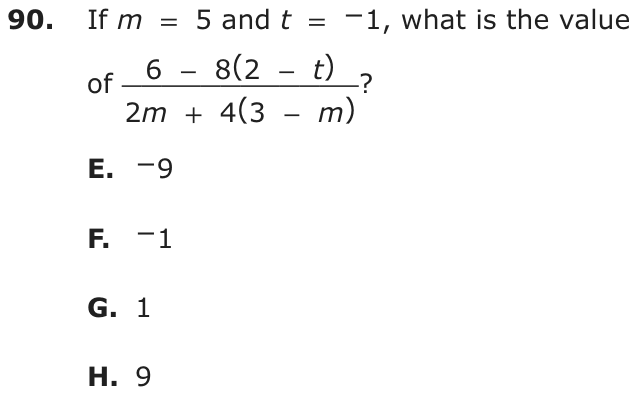
If and , what is the value of ?
- A−9
- B−1
- C1
- D9
Show the answer
Correct answer: A
Question analysis
This algebra question gives m = 5 and t = −1 and asks for the value of a fraction whose numerator and denominator both contain parentheses. Students substitute the values and follow the order of operations. Subtracting a negative number and multiplying by a negative difference make sign mistakes likely, and the four choices differ only in sign and size.
- NYS standards
- Grade level
- Grade 7 content, by NYS standard
- Compared with grade 7
- At grade 7 Substituting values into expressions with negative numbers is everyday grade 7 work. This fraction has a numerator and a denominator to evaluate separately, with a minus sign before a negative and a negative difference, so it is a longer version of a standard exercise.
- Estimated difficulty
- Moderate: several steps, or a close reading with one strong distractor.
- Thinking it demands
- Depth of knowledge 1, recall and reproduction · mainly apply
- What makes it hard
- Error-prone arithmetic moderate
- Many steps minor
- A very close wrong answer minor
- Solution
- 4 steps
- Reading level
- Question and choices: about grade 8, 10 words.
- Students, last 30 days
- Not enough answers yet to show (it takes 10).
Why it is hard, traps and wrong answers (shows the answer)
Why it is hard
This is a plain evaluation with no story, and every point is lost on signs. Subtracting the negative t, then handling the two negative intermediate results, each invite a dropped minus, and the four choices are built so that each such slip lands on a listed value. Writing −1 in parentheses when substituting, and finishing the top and the bottom before dividing, keeps the signs in view.
Error-prone arithmetic moderate Working it out
The value t = −1 sits inside 2 − t, so the numerator needs 2 − (−1) = 3, and the work then passes through two negatives, 6 − 24 = −18 and 3 − 5 = −2. (Brown & Burton, 1978; Junker & Sijtsma, 2001)
Many steps minor Working it out
The numerator and the denominator each take a substitution, a parenthesis, a product and a sum, worked separately before one final division, so a slip in either half changes the result. (Daniel & Embretson, 2010; Enright, Morley & Sheehan, 2002)
A very close wrong answer minor Choosing the answer
The choices pair each size with each sign, −9 with 9 and −1 with 1, so getting 18 and 2 right still leaves the sign to decide between two choices. (Embretson & Wetzel, 1987; Gorin & Embretson, 2006; Ascalon et al., 2007)
Strategy: Substitute with parentheses around −1, simplify the numerator and the denominator separately, innermost parentheses first, and divide only at the end, checking each sign as you go.
Traps
- Negatives and direction: Arithmetic with negative numbers, the order of a subtraction, or direction on a number line. (Moving a term across the equals sign without changing its sign is a faulty procedure.)
The wrong answers, classified
B Negatives and direction (Brown & Burton, 1978)
Treats 2 − (−1) as 1 instead of 3, so the numerator becomes 6 − 8 = −2 and the fraction −2 over 2 equals −1.
C Negatives and direction (Brown & Burton, 1978)
Takes 6 − 24 as 18 and 3 − 5 as 2, subtracting the smaller number from the larger both times, so the fraction is 18 over 10 + 8 = 18, which is 1.
D Negatives and direction (Brown & Burton, 1978)
Gets every step right except 6 − 24, which it writes as 18 instead of −18, so the quotient 18 ÷ 2 comes out positive.
Worked solution, step by step
Formulas used
- Subtracting a negative number
- a and b are numbers. Taking away a negative number is the same as adding the positive number. Think of a debt of 1 dollar being taken away: you are 1 dollar better off.
- Dividing a negative by a positive
- a and b are positive numbers. A negative number divided by a positive number gives a negative answer. The answer is positive only when both signs are the same.
Sort out the question
You know m = 5 and t = −1. You need the value of the big fraction. Work out the top, called the numerator, and the bottom, called the denominator, one at a time. Then divide the top by the bottom.
Put in the numbers
Put each number in parentheses, so the minus signs stay clear. Work inside the parentheses first, then multiply, then add or subtract.
Work out the top
The top is −18. It is negative because 24 is more than 6. Watch out: 2 − (−1) is 3, not 1. Using 1 makes the top −2 and the answer −1, choice B.
Work out the bottom
Here 3 − 5 = −2, because 5 is more than 3. Then 4 times −2 is −8. The bottom is 2.
Divide the top by the bottom
Watch out: if you lost the minus sign in 6 − 24, you would get 9, choice D. So the answer is A, −9.
Check your answer
Check the sign first. The top, 6 − 24, is clearly negative. The bottom, 10 − 8, is positive. Negative over positive is negative, so only −1 or −9 can work. Without the signs, the top is 18 and the bottom is 2, and 18 ÷ 2 = 9. So −9 fits.
More questions like this
The original DOE question