Question
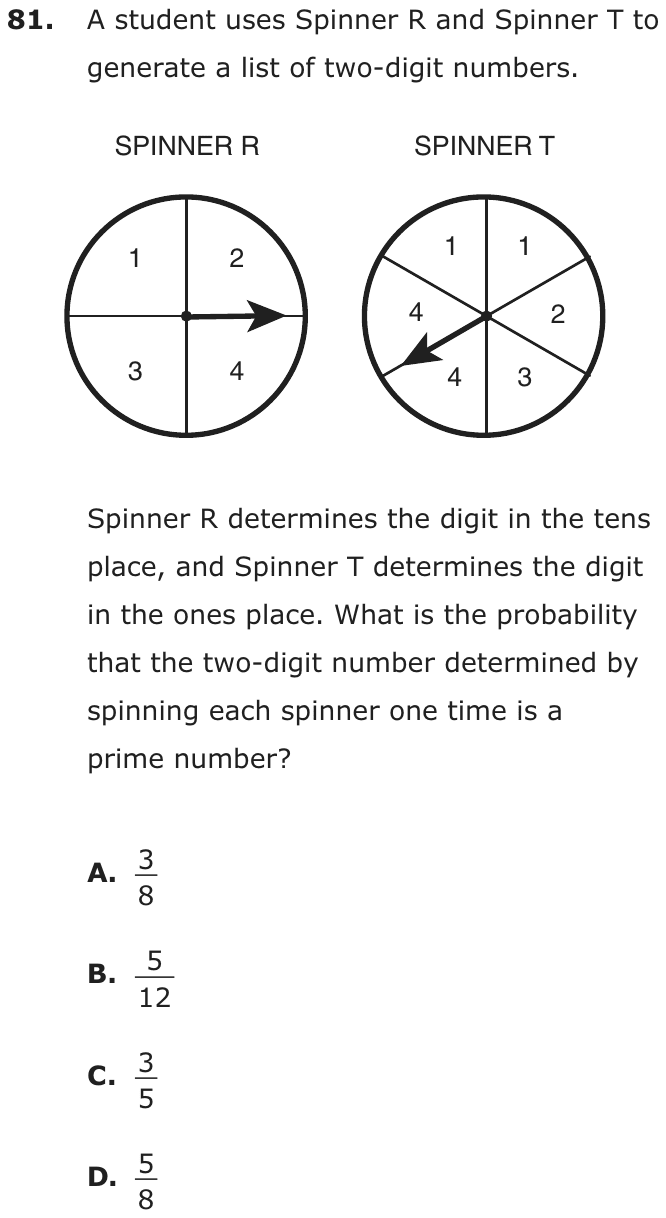
A student uses Spinner R and Spinner T to generate a list of two-digit numbers.
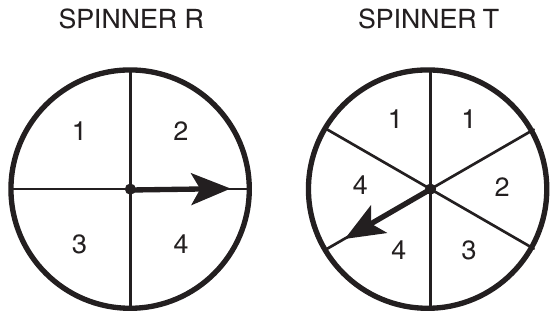
Spinner R determines the digit in the tens place, and Spinner T determines the digit in the ones place. What is the probability that the two-digit number determined by spinning each spinner one time is a prime number?
- A
- B
- C
- D
Show the answer
Correct answer: A
Spinner R has 4 equal sections and Spinner T has 6 equal sections, so the number of possible two-digit numbers that can be created is found by multiplying 4 and 6, which is 24. List the possible outcomes:
| 11 | 11 | 12 | 13 | 14 | 14 |
| 21 | 21 | 22 | 23 | 24 | 24 |
| 31 | 31 | 32 | 33 | 34 | 34 |
| 41 | 41 | 42 | 43 | 44 | 44 |
There are 9 prime numbers out of 24 possible outcomes: 11, 11, 13, 23, 31, 31, 41, 41, and 43.
So the probability that the two-digit number created is a prime number is , which is equivalent to .
Question analysis
Spinner R, with four equal sections, gives the tens digit and Spinner T, with six equal sections and some labels repeated, gives the ones digit of a two-digit number. Students find the probability that the number is prime. Building the full table of outcomes, counting repeated sections separately, and checking whether each number is prime all take care.
- NYS standards
- Grade level
- Grade 7 content, by NYS standard
- Compared with grade 7
- Above grade 7 Listing a sample space for two spinners is grade 7 work, usually with distinct labels and a simple event. Here one spinner repeats two numbers, the space has 24 outcomes, and each two-digit result must be tested for being prime.
- Estimated difficulty
- Hard: combines ideas, needs a plan, and has more than one tempting wrong answer.
- Thinking it demands
- Depth of knowledge 2, skills and concepts · mainly apply
- What makes it hard
- Reading a figure, table or graph moderate
- Much to keep track of moderate
- Something you must already know minor
- Solution
- 4 steps
- Reading level
- Question and choices: about grade 7, 57 words.
- Students, last 30 days
- Not enough answers yet to show (it takes 10).
Why it is hard, traps and wrong answers (shows the answer)
Why it is hard
The question combines a compound sample space with a test for primes, and its figure adds a twist: two labels repeat on Spinner T. Counting the 24 section pairs rather than the 16 different numbers is the careful route, though here both happen to give the same fraction. The points are lost in the prime test, where 33 is easy to count as prime, and in writing the count as a share of all 24 outcomes.
Reading a figure, table or graph moderate Understanding the question
Spinner T has six equal sections but only four labels, with 1 and 4 each appearing twice, so the 24 equally likely outcomes include repeats such as 11 and 11. (Lesh, Post & Behr, 1987; Kirsch & Mosenthal, 1990)
Much to keep track of moderate Working it out
Twenty-four two-digit numbers have to be built and each tested for primality while the repeated sections are kept track of; a 4-by-6 table is the reliable way to hold them. (Sweller, 1988; Carpenter, Just & Shell, 1990)
Something you must already know minor Working it out
Which two-digit numbers are prime is not given; students must test 21, 33, 43 and the rest themselves, and 21 = 3 × 7 and 33 = 3 × 11 look prime at a glance. (Anderson & Krathwohl, 2001)
Strategy: Make a 4-by-6 table with Spinner R's digits as tens and Spinner T's six sections as ones, mark each prime, and count every section, including repeated labels.
Traps
- An arithmetic slip: The right method with a plausible arithmetic error: a digit, a place value or a times-table fact.
- Misunderstands the concept: A wrong belief about a concept: that percents can be added, that area grows like length, that averages can be averaged, that a bigger denominator means a bigger fraction.
- Answers a different question: A choice is right for another quantity: the other unknown, the rest instead of the part, the part instead of the whole.
The wrong answers, classified
B An arithmetic slip (Junker & Sijtsma, 2001)
Counts 33 as prime, missing that 33 = 3 × 11, so 10 of the 24 outcomes look prime and 10/24 reduces to 5/12.
C Misunderstands the concept (Smith, diSessa & Roschelle, 1993; De Bock et al., 1998; Ni & Zhou, 2005)
Finds the 9 prime outcomes but compares them with the 15 that are not prime, a part-to-part ratio, 9/15 = 3/5, instead of dividing by all 24.
D Answers a different question (King et al., 2004; Hegarty, Mayer & Monk, 1995)
Counts the 15 outcomes that are not prime and gives 15/24 = 5/8, the probability of the opposite event.
Worked solution, step by step
Formulas used
- Counting outcomes
- a is the number of equal sections on the first spinner, and b is the number on the second. Each section of the first can go with each section of the second. So the number of pairs is a times b.
- Probability
- P is the probability, the chance that something happens. Possible results are all the results that are equally likely. Wanted results are the ones you are looking for. The chance is the fraction of all the results that you want.
Sort out the question
Spinner R gives the tens digit. Spinner T gives the ones digit. Together they make a two-digit number, like 23. You need the chance that the number is prime. A prime number has exactly two factors, 1 and itself. For example, 13 is prime, but 21 = 3 × 7 is not.
Count all the outcomes
Spinner R has 4 equal sections. Spinner T has 6 equal sections. Look closely: T has two 1s and two 4s. Each section counts as its own outcome.
There are 24 outcomes, all equally likely.
Make a table of the numbers
Each row is a tens digit from R. Each column is a section of T. Prime numbers are in bold.
R 1 1 2 3 4 4 1 11 11 12 13 14 14 2 21 21 22 23 24 24 3 31 31 32 33 34 34 4 41 41 42 43 44 44 Count the prime numbers
Numbers ending in 2 or 4 are even, so 2 divides them. They are not prime. Check the rest. 11, 13, 23, 31, 41 and 43 are prime. But 21 = 3 × 7 and 33 = 3 × 11 are not. Count every section, so 11, 31 and 41 each count twice. That makes 3 + 1 + 2 + 3 = 9 primes. Watch out: counting 33 as prime gives , choice B.
Find the probability
Watch out: divide by all 24 outcomes. Comparing the 9 primes with the 15 others gives , choice C. So the answer is A, .
Check your answer
There are numbers that are not prime. Their chance is . And , as it should be. Notice that , choice D, is the chance of not prime.
More questions like this
The original DOE question