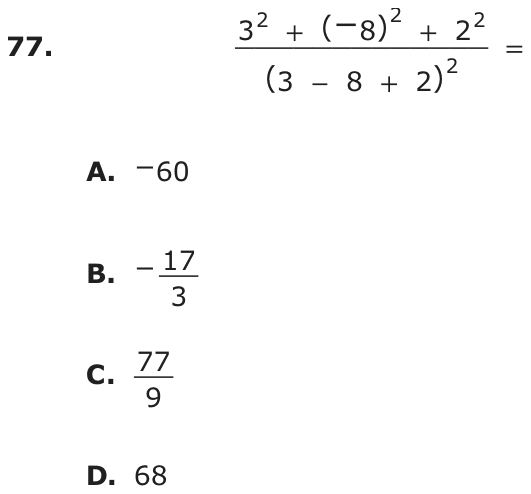
Question
- A−60
- B
- C
- D68
Show the answer
Correct answer: C
Question analysis
This arithmetic question asks for the value of a fraction whose numerator is the sum of the squares of 3, −8 and 2, and whose denominator is the square of 3 − 8 + 2. Students apply the order of operations with negative numbers. Squaring a negative number and adding inside parentheses before squaring are the points to watch.
- NYS standards
- Grade level
- Grade 7 content, by NYS standard
- Compared with grade 7
- At grade 7 Squaring negative numbers and simplifying with the order of operations is standard grade 7 practice. Here the fraction bar groups a numerator and a denominator that each involve a negative sign, but the work stays short.
- Estimated difficulty
- Straightforward: two steps or one careful reading.
- Thinking it demands
- Depth of knowledge 1, recall and reproduction · mainly apply
- What makes it hard
- Error-prone arithmetic moderate
- Many steps minor
- Solution
- 3 steps
- Reading level
- Question and choices: about grade 16+, 3 words.
- Students, last 30 days
- Not enough answers yet to show (it takes 10).
Why it is hard, traps and wrong answers (shows the answer)
Why it is hard
The expression is built so that signs decide everything: the top's 3², (−8)² and 2² are all positive, and so is the square of the bottom's −3. Students who keep a negative after squaring, or who cancel the 9 on top against the 9 below, reach the other choices. The result, 77/9, does not reduce, which can make careful students doubt a correct answer.
Error-prone arithmetic moderate Working it out
Two negatives sit inside squares: (−8)² must be +64, and the denominator's 3 − 8 + 2 = −3 must be squared to +9, so every term ends up positive. (Brown & Burton, 1978; Junker & Sijtsma, 2001)
Many steps minor Working it out
The numerator needs three squares and a sum, the denominator a sum and then a square, and the fraction bar groups each side, so neither part can be split or cancelled. (Daniel & Embretson, 2010; Enright, Morley & Sheehan, 2002)
Strategy: Simplify the top and the bottom separately: square each number in the numerator, add inside the parentheses before squaring in the denominator, then write the fraction in lowest terms.
Traps
- Order of operations: Working left to right, or distributing a minus sign wrongly, gives a choice.
- A faulty procedure: A systematic but wrong procedure: adding fractions straight across, applying an exponent to each term of a sum, dropping a sign when moving a term.
The wrong answers, classified
A Order of operations (Brown & Burton, 1978)
Squares as if the minus sat outside the parentheses, (−8)² as −64, and also cancels the 9 on top against the 9 below, leaving −64 + 4 = −60.
B Order of operations (Brown & Burton, 1978)
Squares as if the minus sat outside the parentheses, taking (−8)² as −64, so the top is 9 − 64 + 4 = −51 and −51/9 = −17/3.
D A faulty procedure (Brown & Burton, 1978; Tatsuoka, 1983)
Cancels the 9 in the numerator, 9 + 64 + 4, against the denominator's 9, leaving 64 + 4 = 68, though only a factor of the whole top can cancel.
Worked solution, step by step
Formulas used
- Square of a negative
- a is any number. To square means to multiply a number by itself. A negative times a negative is positive. So the square of a negative number is always positive.
- The fraction bar groups
- A fraction bar means divide. It also groups: work out the whole top and the whole bottom first, then divide. You can only cancel a number that multiplies the whole top, not one part of a sum.
Sort out the expression
The top, the numerator, is three squares added together. The bottom, the denominator, is a sum in parentheses that is then squared. To square means to multiply a number by itself. Work out the top and the bottom on their own. Then divide.
Work out the top
Square each number first. Then add.
Watch out: (−8)² is +64, not −64. The minus sign is inside the parentheses, so it is squared too. Using −64 makes the top −51 and gives , choice B.
Work out the bottom
Work inside the parentheses first. Add and subtract before you square.
The bottom is 9.
Divide and simplify
77 is 7 × 11 and 9 is 3 × 3. They share no factor, so the fraction is in lowest terms. Watch out: don’t cancel the 9 on top with the 9 below. That 9 is only one part of a sum. Canceling it leaves 64 + 4 = 68, choice D. So the answer is C, .
Check your answer
Every square is positive or zero. So the top and the bottom are both positive, and the answer must be positive. That rules out −60 and . Also, is about 8.6, which is far from 68.
More questions like this
The original DOE question