Question
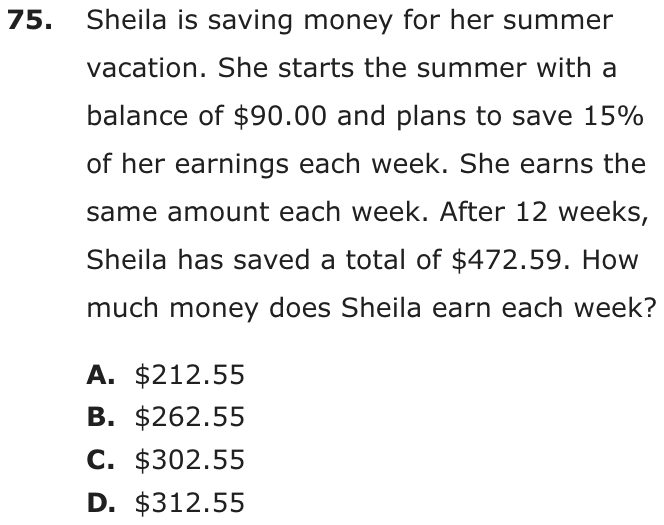
Sheila is saving money for her summer vacation. She starts the summer with a balance of $90.00 and plans to save 15% of her earnings each week. She earns the same amount each week. After 12 weeks, Sheila has saved a total of $472.59. How much money does Sheila earn each week?
- A$212.55
- B$262.55
- C$302.55
- D$312.55
Show the answer
Correct answer: A
Let x be the amount that Sheila needs to earn each week.
First, subtract 90 from both sides:
Last, divide both sides by 1.8:
Question analysis
Sheila starts the summer with $90 and saves 15% of what she earns each week, earning the same amount every week, and after 12 weeks she has $472.59. Students find her weekly earnings. They must write an equation that separates the starting balance from the savings and then work with a percent and long decimals.
- Grade level
- Grade 7 content, by NYS standard
- Compared with grade 7
- At grade 7 Writing and solving an equation of the form px + q = r from a word problem is core grade 7 work. Here the coefficient combines a percent with 12 weeks, and the decimals are long, which adds steps but no new idea.
- Estimated difficulty
- Moderate: several steps, or a close reading with one strong distractor.
- Thinking it demands
- Depth of knowledge 2, skills and concepts · mainly apply
- What makes it hard
- Turning words into math moderate
- Error-prone arithmetic moderate
- Many steps minor
- Solution
- 3 steps
- Reading level
- Question and choices: about grade 4, 48 words.
- Students, last 30 days
- Not enough answers yet to show (it takes 10).
Why it is hard, traps and wrong answers (shows the answer)
Why it is hard
The story has three layers, a starting balance, a weekly saving rate and a 12-week total, and the unknown sits under the percent. Students lose the point by forgetting the $90 was already there, or by moving it the wrong way. Testing a choice is a dependable alternative: 15% of $212.55 is about $31.88, and 12 of those plus $90 gives $472.59.
Turning words into math moderate Understanding the question
The total of $472.59 includes the $90.00 she started with, and only 15% of each week's pay is saved, so the equation is 90 + 12 × 0.15x = 472.59. (Hegarty, Mayer & Monk, 1995; Koedinger & Nathan, 2004)
Error-prone arithmetic moderate Working it out
Dividing $382.59 by 1.8 by hand means shifting the decimal point to get 3,825.9 ÷ 18, which comes out to exactly $212.55 only if every digit is placed correctly. (Brown & Burton, 1978; Junker & Sijtsma, 2001)
Many steps minor Working it out
Subtract the $90, then divide by 12 weeks and by 0.15, or by their product 1.8; doing the division before the subtraction gives a listed choice. (Daniel & Embretson, 2010; Enright, Morley & Sheehan, 2002)
Strategy: Subtract the starting $90 from the final total, then divide by 12 weeks and by 0.15, or test each choice by taking 15% of it, multiplying by 12 and adding $90.
Traps
- Misreads the question: Misses or misreads a condition or a word in the question: "at least", "each", "remaining", "not".
- Wrong operation: Adds instead of multiplying, divides the wrong way round, turns a ratio or rate upside down, or undoes a step in the wrong direction (subtracts what should be added back).
The wrong answers, classified
B Misreads the question (Hegarty, Mayer & Monk, 1995)
Overlooks the $90 she started with, treating the whole $472.59 as savings from earnings, and divides it by 1.8 to get $262.55.
C Little reason to choose it (Haladyna & Downing, 1993; Rodriguez, 2005)
No setup of the savings gives $302.55, the right weekly pay plus the $90 starting balance, a sum with no meaning here, so it mostly catches guesses.
D Wrong operation (Hegarty, Mayer & Monk, 1995; King et al., 2004)
Adds the $90 to $472.59 instead of subtracting it, so the savings from earnings look like $562.59, and dividing by 1.8 gives $312.55.
Worked solution, step by step
Formulas used
- Percent of a number
- p is the percent. The whole is the amount you take the percent of. The part is the result. Percent means out of 100. So 15% is 15 out of every 100, or 0.15.
- Savings over time
- The start is the money she had at the beginning. Weekly savings is what she adds each week. Weeks is how many weeks pass. Each week adds the same amount, so multiply. Then add what she started with.
Sort out the question
Sheila starts with $90.00. Each week she earns the same amount and saves 15% of it. After 12 weeks she has $472.59 in all. That total includes the $90 she started with. You need how much she earns each week, not how much she saves.
Write an equation
Call her weekly earnings x. She saves 15% of x each week. That is .
Take away the starting $90
Only the money added during the 12 weeks came from her pay. Subtract 90 from both sides.
She saved $382.59 from her pay. Watch out: subtract the $90, don’t add it. Adding leads to $312.55, choice D. Forgetting the $90 leads to $262.55, choice B.
Combine the numbers next to x
Each week she saves 0.15 of one week’s pay. Over 12 weeks, that adds up to 1.8 times one week’s pay.
Divide by 1.8
Divide both sides by 1.8. First move the decimal point one place right in both numbers. Then you divide by the whole number 18.
Sheila earns $212.55 each week. So the answer is A, $212.55.
Check your answer
Work forward. 12 weeks of saving 15% is 1.8 weeks of pay: . Add the $90 she started with: . That is the total in the question.
More questions like this
The original DOE question