Question
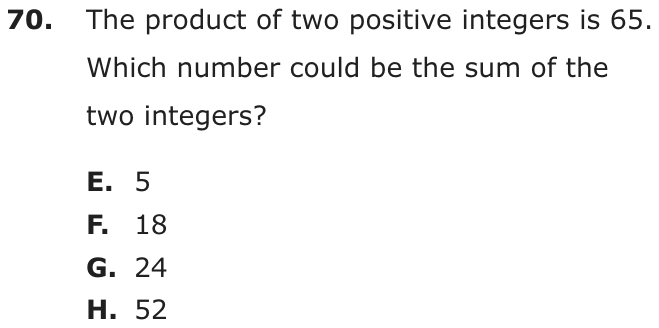
The product of two positive integers is 65. Which number could be the sum of the two integers?
- A5
- B18
- C24
- D52
Show the answer
Correct answer: B
First, find the pairs of positive integers that multiply to 65: and .
The sums of the pairs are 66 and 18. 18 is the option that is provided in the answer choices.
Question analysis
Two positive integers multiply to 65, and this question asks which number in the choices could be their sum. Students list the factor pairs of 65 and add each pair. The words could be signal that more than one pair exists, and only one of the sums appears among the choices.
- NYS standards
- 6.NS.4 common factors and multiples
- Grade level
- Grade 6 content, by NYS standard
- Compared with grade 7
- Below grade 7 Finding factor pairs of a two-digit number is review by grade 7. The question takes two quick steps, listing the pairs and adding each, with nothing to compute beyond small products and sums.
- Estimated difficulty
- Routine: one familiar step, little to misread.
- Thinking it demands
- Depth of knowledge 1, recall and reproduction · mainly apply
- What makes it hard
- Solution
- 2 steps
- Reading level
- Question and choices: about grade 5, 17 words.
- Students, last 30 days
- Not enough answers yet to show (it takes 10).
Why it is hard, traps and wrong answers (shows the answer)
Why it is hard
With only two factor pairs, 1 × 65 and 5 × 13, the work is a short list and two additions. The word could matters: the sum depends on which pair is chosen, and only one of the two sums appears among the choices. The main slip is answering with a factor rather than with the sum the question asks for.
Something you must already know minor Working it out
The pairs come from factoring 65 as 5 × 13, a fact the stem leaves to the student; the pair 1 and 65 also counts, but its sum, 66, is not offered. (Anderson & Krathwohl, 2001)
Strategy: List every pair of positive integers whose product is 65, starting from 1, and add the two numbers in each pair.
Traps
- Answers a different question: A choice is right for another quantity: the other unknown, the rest instead of the part, the part instead of the whole.
The wrong answers, classified
A Answers a different question (King et al., 2004; Hegarty, Mayer & Monk, 1995)
Finds the factor pair 5 and 13 and answers with the factor 5, one of the two integers, instead of their sum.
C Little reason to choose it (Haladyna & Downing, 1993; Rodriguez, 2005)
No pair of positive integers with product 65 adds to 24; reaching it needs a wrong pair such as 3 and 21, whose product is 63, so it mostly catches guesses.
D Little reason to choose it (Haladyna & Downing, 1993; Rodriguez, 2005)
No factor pair of 65 adds to 52, which is 65 − 13 or 4 × 13, and no common working combines them that way, so it mostly draws guesses.
Worked solution, step by step
Formulas used
- Factor pair
- a and b are positive whole numbers that multiply to make 65. Such a pair is called a factor pair of 65. To find them all, try 1, 2, 3 and so on. Stop when the factors start to repeat.
- Dividing by 5
- A whole number splits into groups of 5, with none left over, when its last digit is 0 or 5. So 65 divides by 5, but 64 does not.
Sort out the question
Two positive integers multiply to make 65. Positive integers are the counting numbers 1, 2, 3 and so on. The product is the answer to a multiplication. You need a number that could be their sum, the answer when you add them.
List the factor pairs of 65
Try each small number. See if it divides 65 with nothing left over.
- 1 works: .
- 2 and 4 don’t work, because 65 is odd. 3 doesn’t work either: , with 2 left over.
- 5 works, since 65 ends in 5: .
- 6 and 8 are even, so they don’t work. 7 doesn’t either: .
Since , any factor bigger than 8 pairs with one smaller than 8. You already tried those. So the pairs are 1 and 65, and 5 and 13.
Add each pair
The possible sums are 66 and 18. Only 18 is a choice. Watch out: the question asks for the sum, not one of the numbers. Picking the factor 5 is choice A. So the answer is B, 18.
Check your answer
Work back from 18. Look for two numbers that add to 18 and multiply to 65. and . Both match. For 24 or 52, no pair of whole numbers that multiplies to 65 adds up to them.
More questions like this
The original DOE question