Question
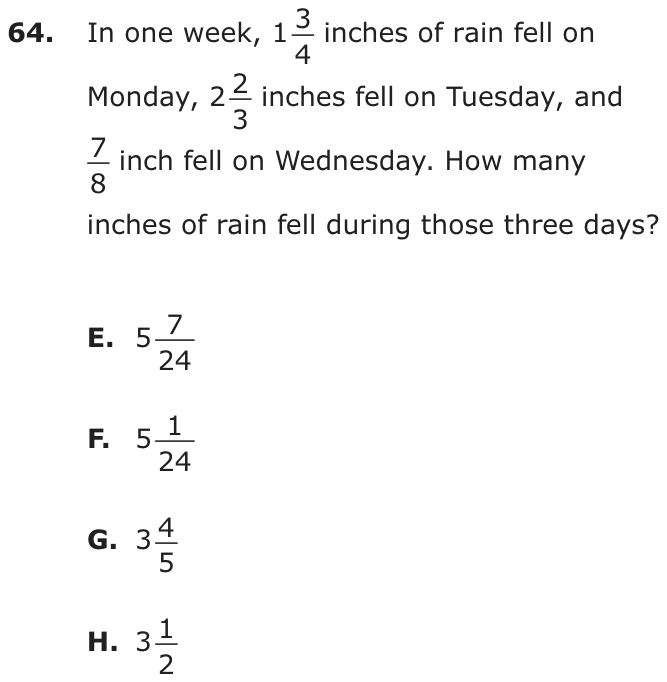
In one week, inches of rain fell on Monday, inches fell on Tuesday, and inch fell on Wednesday. How many inches of rain fell during those three days?
- A
- B
- C
- D
Show the answer
Correct answer: A
To solve, add the three given fractions:
The common denominator is 24:
Question analysis
A rainfall word problem gives the inches of rain on Monday, Tuesday and Wednesday as two mixed numbers and a fraction, and asks for the total over the three days. Students add fractions with unlike denominators. Finding a common denominator for fourths, thirds and eighths, and regrouping the fractional part into wholes, is where errors come in.
- NYS standards
- Grade level
- Grade 7 content, by NYS standard
- Compared with grade 7
- Below grade 7 Adding fractions and mixed numbers with unlike denominators is taught before grade 7, and this is a direct word problem. It takes more care than a typical exercise only because three different denominators must be rewritten over a common one.
- Estimated difficulty
- Straightforward: two steps or one careful reading.
- Thinking it demands
- Depth of knowledge 2, skills and concepts · mainly apply
- What makes it hard
- Error-prone arithmetic moderate
- Many steps minor
- Solution
- 3 steps
- Reading level
- Question and choices: about grade 5, 35 words.
- Students, last 30 days
- Not enough answers yet to show (it takes 10).
Why it is hard, traps and wrong answers (shows the answer)
Why it is hard
The setup is plain addition, so the difficulty is all in the fractions. Students who know to rename over a common denominator rarely miss it, while those who add the fraction parts straight across, or put the numerators over 24 without scaling them, reach choices with a whole part of 3. Since 1 3/4 + 2 2/3 alone is more than 4, any total below 4 can be ruled out at a glance.
Error-prone arithmetic moderate Working it out
The fractional parts have denominators 4, 3 and 8, so they must be renamed as 18, 16 and 21 twenty-fourths, and their sum, 55/24, regrouped as 2 7/24 before the wholes are added. (Brown & Burton, 1978; Junker & Sijtsma, 2001)
Many steps minor Working it out
Renaming, adding the numerators, regrouping the improper fraction and adding the whole numbers are four separate moves, and losing the 2 carried from 55/24 drops the total by two inches. (Daniel & Embretson, 2010; Enright, Morley & Sheehan, 2002)
Strategy: Rewrite the three fractional parts over a common denominator of 24, add the whole numbers and the fractions separately, and regroup any extra twenty-fourths as a whole.
Traps
- A faulty procedure: A systematic but wrong procedure: adding fractions straight across, applying an exponent to each term of a sum, dropping a sign when moving a term.
The wrong answers, classified
B Little reason to choose it (Haladyna & Downing, 1993; Rodriguez, 2005)
No single renaming mistake gives 49 twenty-fourths; this choice sits exactly 1/4 below the right total, so it mostly catches guesses near it.
C A faulty procedure (Brown & Burton, 1978; Tatsuoka, 1983)
Adds the whole numbers to get 3, then adds the fractions straight across, (3 + 2 + 7)/(4 + 3 + 8) = 12/15 = 4/5.
D A faulty procedure (Brown & Burton, 1978; Tatsuoka, 1983)
Finds the common denominator 24 but adds the numerators without renaming them, (3 + 2 + 7)/24 = 1/2, and adds that to the wholes, 3.
Worked solution, step by step
Formulas used
- Equivalent fractions
- a over b is a fraction, and k is any whole number except 0. Multiplying the top and the bottom by the same number gives an equal fraction. You cut each piece into k smaller pieces. So you have k times as many pieces, each k times smaller.
- Adding fractions with the same bottom
- d is the denominator, the bottom number. It tells the size of the pieces. a, b and c are the numerators, the top numbers. They count the pieces. When the pieces are the same size, add the counts. The bottom stays the same.
- Fraction to mixed number
- a over b is a fraction whose top is bigger than its bottom. q is the quotient, how many whole times b fits into a. r is the remainder, what is left over. The leftover stays over the same bottom number.
Sort out the question
Rain fell on three days: inches, inches and inch. You need the total rain, in inches. So add the three amounts. Add the whole numbers and the fractions separately. The whole numbers are 1 and 2, so they add to 3 inches.
Find a common denominator
The fractions have denominators, or bottom numbers, 4, 3 and 8. You can only add pieces of the same size. So find the smallest number that 4, 3 and 8 all divide into. Count by 8s: 8, 16, 24. 24 works, since 24 = 4 × 6 and 24 = 3 × 8. So use 24ths.
Rename each fraction in 24ths
Multiply the top and the bottom by the same number.
Watch out: change the tops too. Keeping 3, 2 and 7 over 24 gives and a total of , choice D.
Add the fractions
Now the pieces are the same size, so add the tops.
That is more than 1 whole. 24 goes into 55 twice, with 7 left over.
Watch out: never add the bottoms. Adding straight across gives and a total of , choice C.
Put the parts together
Add the 3 whole inches from before.
So the answer is A, inches.
Check your answer
Use decimals. is 1.75, is about 2.67, and is 0.875. They add to about 5.29. And is about 0.29. So fits, and is too small.
More questions like this
The original DOE question