Question
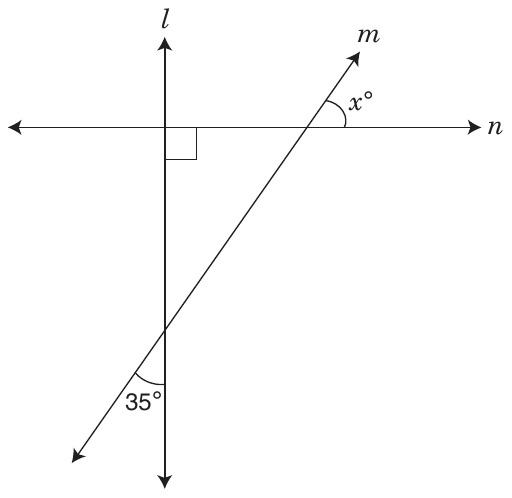
In the figure above, line l is perpendicular to line n. What is the value of x?
Grid-in question: work out the answer and enter it as a number.
Show the answer
Correct answer: 55
Since vertical angles are congruent, the right triangle in the figure has acute angles with measures of 35° and x°. The interior angles of a triangle sum to 180°, so set up an equation to solve for x:
Question analysis
Three lines cross in a figure: line l is perpendicular to line n, and a slanted line m meets them at a marked 35° angle and an unknown angle x. This geometry grid-in asks for the value of x. Students must see the right triangle the lines form and carry the marked angles into it using vertical angles.
- NYS standards
- Grade level
- Grade 8 content, by NYS standard
- Compared with grade 7
- Above grade 7 Grade 7 angle problems use vertical, supplementary and complementary angles. This one also needs the angle sum of a triangle, which New York places in grade 8, and the triangle is not drawn as a separate shape, so students must spot it.
- Estimated difficulty
- Moderate: several steps, or a close reading with one strong distractor.
- Thinking it demands
- Depth of knowledge 2, skills and concepts · mainly apply
- What makes it hard
- Reading a figure, table or graph moderate
- Something you must already know moderate
- An answer in an unexpected form minor
- Solution
- 3 steps
- Reading level
- Question and choices: about grade 4, 17 words.
- Students, last 30 days
- Not enough answers yet to show (it takes 10).
Why it is hard, traps and wrong answers (shows the answer)
Why it is hard
The figure hides a small right triangle between the three lines, and the question is easy once students see it. Its angles are the right angle, the vertical partner of the 35° angle and the vertical partner of x, so x is what the right angle and 35° leave of 180°. Students who never spot the triangle tend to guess a direct relationship between the two marked angles, which no angle fact supports.
Reading a figure, table or graph moderate Understanding the question
Neither marked angle is inside the right triangle that lines l, m and n form: the 35° opens below the point where m crosses l, and x opens above line n, so each must be carried in as a vertical angle. (Lesh, Post & Behr, 1987; Kirsch & Mosenthal, 1990)
Something you must already know moderate Working it out
The stem states only that l is perpendicular to n; students must supply that vertical angles are equal and that the three angles of a triangle add to 180°. (Anderson & Krathwohl, 2001)
An answer in an unexpected form minor Choosing the answer
As a grid-in it offers no choices, so 125, the right angle plus the 35° angle, can be gridded with nothing to signal the missing subtraction. (Enright, Morley & Sheehan, 2002)
Strategy: Find the triangle formed by the three lines, use vertical angles to move the 35° and x° angles inside it, and apply the triangle's angle sum with the right angle.
Traps
- Stops one step early: A choice is a number from partway through the solution.
- A formula you must know: Needs a formula the test does not give: area, circumference, volume, probability rules.
The wrong answers, classified
125 Stops one step early (King et al., 2004; Gierl et al., 2017)
Adds the right angle and the 35° angle, 90 + 35 = 125, and grids that sum without subtracting it from the triangle's 180°.
35 Misunderstands the concept (Smith, diSessa & Roschelle, 1993; De Bock et al., 1998; Ni & Zhou, 2005)
Assumes line m crosses l and n at equal angles, as it would cross two parallel lines, though l and n are perpendicular.
Worked solution, step by step
Formulas used
- Vertical angles
- When two lines cross, they make an X. The angles straight across from each other in the X are called vertical angles. a and b are one such pair. They are always equal, because each one plus the angle between them makes a straight line.
- Angles of a triangle
- A, B and C are the three angles inside any triangle, in degrees. They always add up to 180°. Use it when you know two of the angles and need the third.
Sort out the figure
Line l is perpendicular to line n. Perpendicular means they meet at a right angle, 90°. The small square in the figure marks it. Line m crosses both lines. The three lines make a triangle with a right angle. You need x, the angle marked x° where m crosses n.
Move the 35° angle into the triangle
The 35° angle is below the point where m crosses l. So it is outside the triangle. Lines l and m make an X there. The triangle’s angle is straight across from the 35° angle. They are vertical angles, so they are equal. The triangle’s angle at that corner is 35°.
Move the x° angle into the triangle
The x° angle is above line n, so it is outside the triangle too. Lines m and n make another X. The triangle’s angle at that crossing is straight across from x°. So the third angle of the triangle is also x°. Watch out: line m does not cross l and n at the same angle. Lines l and n are not parallel, so x is not 35.
Use the triangle’s angle sum
The triangle’s three angles are 90°, 35° and x°.
Watch out: 125 is only the two known angles added together. You still subtract it from 180. Gridding 125 is wrong. So you would grid 55.
Check your answer
In a right triangle, the two smaller angles add up to 90°. That is because the right angle uses 90° of the 180°. Check: . Also, in the figure the x° angle looks a bit bigger than the 35° angle, and 55 is.
More questions like this
The original DOE question