Question
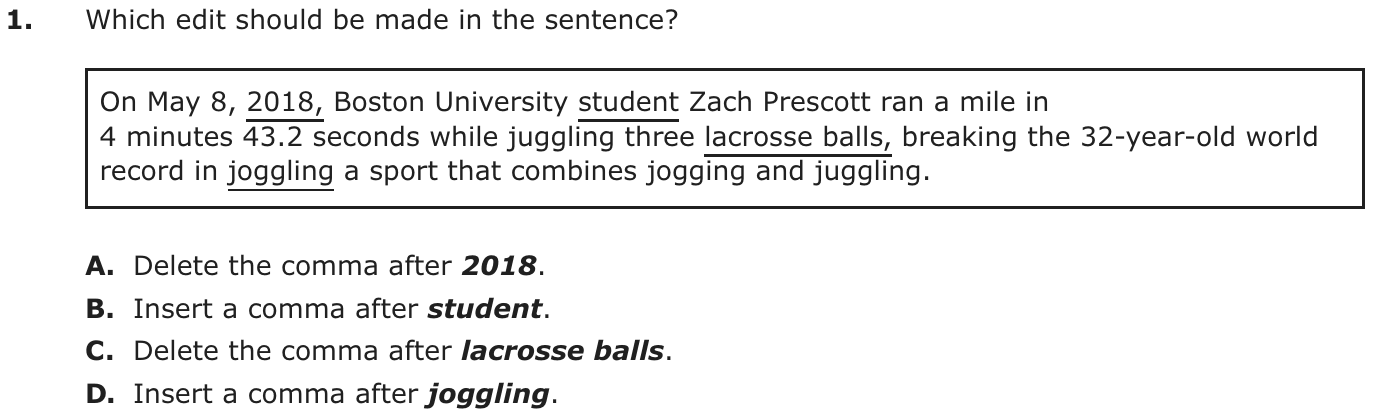
Which edit should be made in the sentence?
On May 8, 2018, Boston University student Zach Prescott ran a mile in 4 minutes 43.2 seconds while juggling three lacrosse balls, breaking the 32-year-old world record in joggling a sport that combines jogging and juggling.
- ADelete the comma after 2018.
- BInsert a comma after student.
- CDelete the comma after lacrosse balls.
- DInsert a comma after joggling.
Show the answer
Correct answer: D
The question asks which edit should be made to correct the sentence.
A. Incorrect. This edit incorrectly deletes the comma that is necessary to set off the year in a date from the remainder of the sentence.
B. Incorrect. This edit introduces an unnecessary comma into the sentence by needlessly separating the adjective phrase “Boston University student” from the noun it modifies, “Zach Prescott.”
C. Incorrect. This edit would delete the comma needed to separate the participle phrase “breaking the 32-year-old world record in joggling” and its companion appositive “a sport that combines jogging and juggling” from the rest of the sentence. This complete element is nonessential, which means it requires separation from the rest of the sentence with a comma because its removal would not fundamentally change the meaning of the sentence.
D. CORRECT. The appositive “a sport that combines jogging and juggling” further describes the word “joggling.” An appositive requires separation with a comma because it is nonessential, meaning that its removal would not change the overall meaning of the sentence.
Question analysis
This punctuation question gives one long sentence about a Boston University student who ran a mile while juggling and broke a world record, and asks which comma edit it needs. Students weigh four marked spots, at a date, between a title and a name, and at two places near the end, deciding at each whether a comma belongs.
- NYS standards
- 7L2 capitalization, punctuation, and spelling
- Grade level
- Grade 6 reading and task
- Compared with grade 7
- Below grade 7 Commas with dates and with extra information added to a sentence are grade 6 punctuation rules. This item tests them in a single 36-word sentence with one edit to choose, lighter than grade 7 work on phrases, clauses and modifiers.
- Estimated difficulty
- Straightforward: two steps or one careful reading.
- Thinking it demands
- Depth of knowledge 1, recall and reproduction · mainly apply
- What makes it hard
- A rule that doesn't sound wrong moderate
- Hard words minor
- Complex sentences minor
- Evidence
- Answered from one sentence or line
- Reading level
- Question and choices: about grade 7, 60 words.
- Students, last 30 days
- Not enough answers yet to show (it takes 10).
Why it is hard, traps and wrong answers (shows the answer)
Why it is hard
The one missing comma sits at the end of a long sentence, right after an unfamiliar word, and the sentence still sounds acceptable without it. The strongest pull applies the appositive rule one spot too early, between a descriptive title and the name it introduces, while the other two wrong edits remove commas that the date and the added phrase about the record both need. Bracketing each piece of added information, from where it starts to where it ends, exposes the gap after the sport’s name.
A rule that doesn't sound wrong moderate Working it out
Two quiet rules decide the question: the closing appositive “a sport that combines jogging and juggling” must be set off from “joggling,” while a title placed straight before a name, as in “Boston University student Zach Prescott,” takes no comma. (Connors & Lunsford, 1988)
Hard words minor Understanding the question
“Joggling” is a word few students have met, and without the comma “in joggling a sport” can read like a verb and its object rather than the name of a sport followed by its definition. (Perfetti, 2007; Freedle & Kostin, 1993)
Complex sentences minor Understanding the question
The 36-word sentence strings together a date, a title and name, a “while” phrase, the phrase “breaking the 32-year-old world record” and a closing appositive, so every comma has to be judged against where these parts begin and end. (Abedi & Lord, 2001; Freedle & Kostin, 1993; Messick, 1989)
Strategy: Find the main subject and verb, then take the four underlined spots in order and ask what the words on each side are doing and whether a comma belongs between them.
Traps
- Punctuation: A comma, semicolon, colon, dash or apostrophe used where it does not belong, or missing where it does.
The wrong answers, classified
A Punctuation (Connors & Lunsford, 1988)
Treats the comma after “2018” as extra, not knowing that a full date takes a comma after the year as well as between the day and the year.
B Punctuation (Connors & Lunsford, 1988)
Applies the appositive rule to “student Zach Prescott,” but a title placed directly before a name is not set off, and a lone comma there would cut the title off from the name.
C Punctuation (Connors & Lunsford, 1988)
Deletes the comma before “breaking the 32-year-old world record” as if the phrase belonged to the juggling, though without it the lacrosse balls seem to break the record instead of Prescott.
Working it out, step by step
Figure out what the question asks
This is a punctuation question. Punctuation means marks like commas and periods. The sentence has four underlined spots. Each choice adds or takes away one comma. Only one edit fixes the sentence. To find it, ask what each group of words is doing.
Learn the rule for renaming words
Sometimes a sentence names a thing and then tells you what it is. The words that rename it are called an appositive. An appositive gets a comma to set it off from the rest of the sentence.
Example: My uncle plays the tuba, a big brass horn. The words a big brass horn tell you what a tuba is, so a comma comes before them.
Find where a comma is missing
Look at the end of the sentence: “breaking the 32-year-old world record in joggling a sport that combines jogging and juggling.” Joggling is the name of a sport. The words “a sport that combines jogging and juggling” tell you what joggling is. So they are an appositive. But nothing sets them off from “joggling.” A comma belongs right after “joggling.”
Check each choice
- A is wrong. When more of the sentence follows a full date, the year needs a comma after it too. Example: On June 2, 2020, we moved.
- B is wrong. A title that comes right before a name takes no comma. You write Coach Rivera with no comma. In the same way, “Boston University student” is a title for Zach Prescott.
- C is wrong. The comma before “breaking” sets off the part about the record. Without it, the lacrosse balls seem to break the record, not Zach.
- D is right. It adds the comma that sets off the appositive.
Watch out: B is tempting, because “student” does describe Zach. But a title placed right before a name stays joined to it.
Choose the answer
With the new comma, the end reads: breaking the 32-year-old world record in joggling, a sport that combines jogging and juggling. So the answer is D: insert a comma after joggling.
Why this answer and not the closest wrong one
B is the closest wrong answer. It puts one comma between a title and a name. That comma would cut “Boston University student” off from “Zach Prescott.” D fixes a real gap. It puts a comma before “a sport that combines jogging and juggling,” the words that tell what joggling is.
More questions like this
The original DOE question