Says it twice
Question 1 of 3
2026 Practice Test A English, question 43Passage The Benefits of Indoor Plants
The Benefits of Indoor Plants
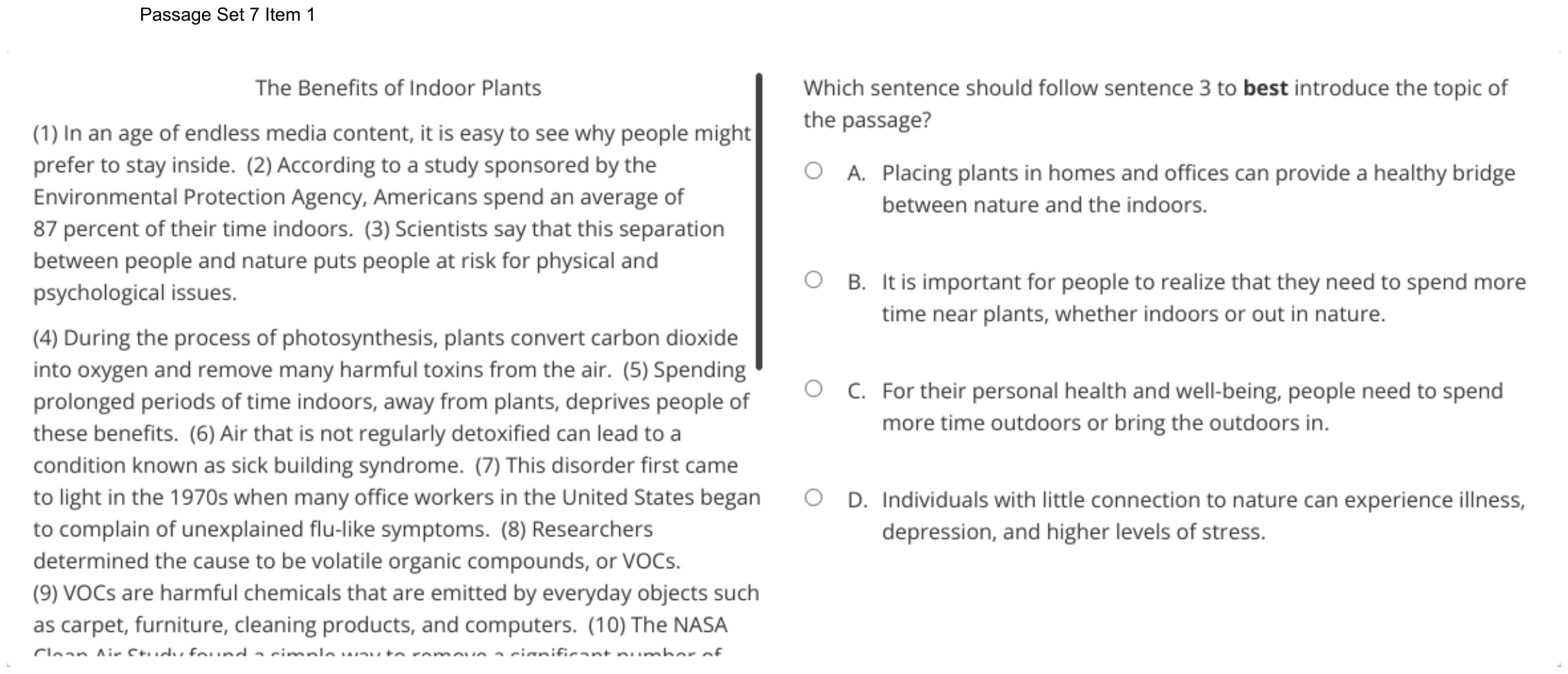
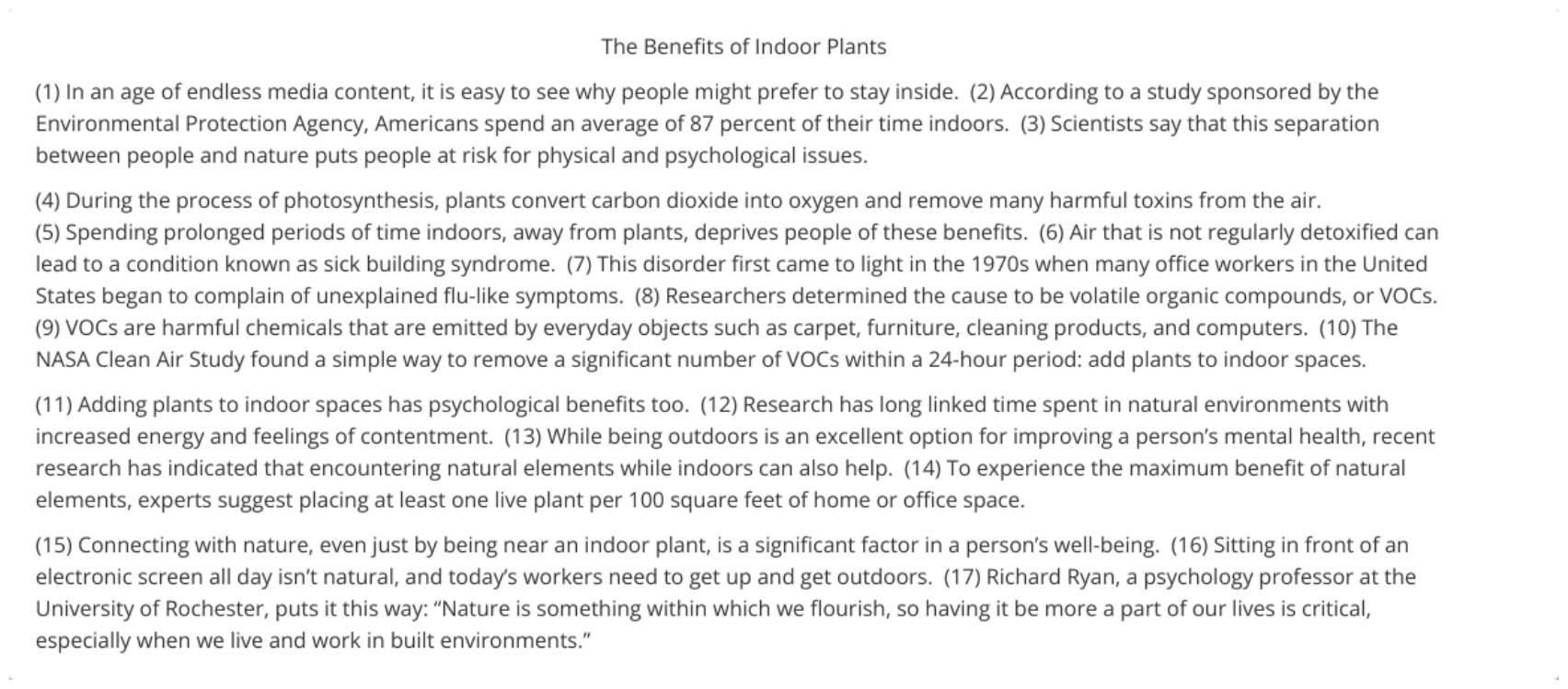
(1) In an age of endless media content, it is easy to see why people might prefer to stay inside. (2) According to a study sponsored by the Environmental Protection Agency, Americans spend an average of 87 percent of their time indoors. (3) Scientists say that this separation between people and nature puts people at risk for physical and psychological issues.
(4) During the process of photosynthesis, plants convert carbon dioxide into oxygen and remove many harmful toxins from the air. (5) Spending prolonged periods of time indoors, away from plants, deprives people of these benefits. (6) Air that is not regularly detoxified can lead to a condition known as sick building syndrome. (7) This disorder first came to light in the 1970s when many office workers in the United States began to complain of unexplained flu-like symptoms. (8) Researchers determined the cause to be volatile organic compounds, or VOCs. (9) VOCs are harmful chemicals that are emitted by everyday objects such as carpet, furniture, cleaning products, and computers. (10) The NASA Clean Air Study found a simple way to remove a significant number of VOCs within a 24-hour period: add plants to indoor spaces.
(11) Adding plants to indoor spaces has psychological benefits too. (12) Research has long linked time spent in natural environments with increased energy and feelings of contentment. (13) While being outdoors is an excellent option for improving a person’s mental health, recent research has indicated that encountering natural elements while indoors can also help. (14) To experience the maximum benefit of natural elements, experts suggest placing at least one live plant per 100 square feet of home or office space.
(15) Connecting with nature, even just by being near an indoor plant, is a significant factor in a person’s well-being. (16) Sitting in front of an electronic screen all day isn’t natural, and today’s workers need to get up and get outdoors. (17) Richard Ryan, a psychology professor at the University of Rochester, puts it this way: “Nature is something within which we flourish, so having it be more a part of our lives is critical, especially when we live and work in built environments.”
Question
Which sentence should follow sentence 3 to best introduce the topic of the passage?
- APlacing plants in homes and offices can provide a healthy bridge between nature and the indoors.
- BIt is important for people to realize that they need to spend more time near plants, whether indoors or out in nature.
- CFor their personal health and well-being, people need to spend more time outdoors or bring the outdoors in.
- DIndividuals with little connection to nature can experience illness, depression, and higher levels of stress.
Show the answer
Correct answer: A
The question asks which sentence should follow sentence 3 to best introduce the topic of the passage.
A. CORRECT. The sentence introduces the overall topic by previewing the main ideas in the passage. It introduces the connection between natural elements and well-being (“a healthy bridge”) and sets up the main argument of the passage (“Placing plants in homes and offices” can increase people’s well-being).
B. Incorrect. Although sentence 3 mentions the connection between “people and nature,” this sentence references the importance of spending time near plants while both indoors and outdoors. However, the passage focuses specifically on the benefits of having indoor plants.
C. Incorrect: Though the sentence describes a reason why indoor plants are important (“For [people’s] personal health and well-being”), the topic of the passage is related to the need for indoor plants, not the need for people to spend more time outdoors.
D. Incorrect. While the sentence refers to how time away from nature can affect health and well-being, the vague wording (“little connection to nature”) makes this sentence too broad to introduce the topic of the passage, and thus, it should not follow sentence 3.
Question analysis
This revising question works with the four-paragraph passage “The Benefits of Indoor Plants” and asks which sentence should follow sentence 3 to introduce the passage's topic. The opening paragraph ends on the health risks of time spent away from nature, and every choice continues that thought in some way, so students must judge which one prepares a reader for what the passage goes on to cover.
- NYS standards
- 7W2a introducing and organizing a topic
- Grade level
- Grade 7 reading and task
- Compared with grade 7
- At grade 7 Introducing a topic so that it previews what follows is a grade 7 writing standard, practised often in class. The passage is short and plainly worded, and the choices differ in focus rather than in grammar, typical grade 7 revision.
- Estimated difficulty
- Moderate: several steps, or a close reading with one strong distractor.
- Thinking it demands
- Depth of knowledge 2, skills and concepts · mainly evaluate
- What makes it hard
- A very close wrong answer moderate
- Evidence in several places moderate
- How sentences fit together minor
- Evidence
- Answered from the whole text
- Reading level
- Passage: about grade 12, 346 words; question and choices: about grade 9, 84 words.
- Students, last 30 days
- Not enough answers yet to show (it takes 10).
Why it is hard, traps and wrong answers (shows the answer)
Why it is hard
The first paragraph ends on a problem, and all four choices continue it plausibly, so the decision is about scope. The passage is about plants indoors, and the near miss offers outdoor time as an equal remedy, while another widens the subject to plants anywhere and a third simply restates the danger. Students who skim the topic sentences of the later paragraphs before choosing see that only an indoor solution introduces what follows.
A very close wrong answer moderate Choosing the answer
The choice ending “or bring the outdoors in” sounds like the key's “bridge between nature and the indoors,” but it adds spending more time outdoors, a remedy the passage does not develop. (Embretson & Wetzel, 1987; Gorin & Embretson, 2006; Ascalon et al., 2007)
Evidence in several places moderate Working it out
The topic only emerges from the later paragraphs: plants cleaning indoor air in sentences 4–10, their psychological benefits in 11–14, and nature brought indoors in 15–17. (Kirsch & Mosenthal, 1990; Gorin & Embretson, 2006)
How sentences fit together minor Working it out
The new sentence must follow sentence 3's warning about “separation between people and nature” and lead into sentence 4's photosynthesis, so it has to name plants as the remedy. (Halliday & Hasan, 1976)
Strategy: Skim the first sentence of each later paragraph to see what the passage actually covers, then test each choice: would it set up those paragraphs without promising something they never discuss?
Traps
- Half right: One half of a two-part choice is right and the other is not.
- Too broad or too strong: A choice overstates, generalizes, or uses absolute words the text does not support.
- Says it twice: Repeats an idea that the sentence or passage already states.
The wrong answers, classified
B Too broad or too strong (King et al., 2004)
Accepts a sentence about needing plants, but “whether indoors or out in nature” widens the subject to plants anywhere, while the passage discusses only plants inside.
C Half right (King et al., 2004; Thissen, Steinberg & Fitzpatrick, 1989)
Is drawn by “bring the outdoors in” and “health and well-being,” but the other half, spending more time outdoors, is a remedy the passage never goes on to develop.
D Says it twice (Connors & Lunsford, 1988)
Follows sentence 3 smoothly by naming illness, depression and stress, but that only restates its “physical and psychological issues” and never introduces plants, the passage's subject.
Working it out, step by step
Figure out what the question asks
This revising question asks you to add a sentence that introduces the topic. Such a sentence tells the reader what the passage will be about. For example, an essay about why dogs make good pets might start: Dogs make loyal, loving pets. The new sentence goes after sentence 3, so it must also follow from it.
Find the passage’s topic
Skim the rest of the passage. Sentences 4–10 tell how plants clean indoor air. Sentences 11–14 say plants indoors help the mind. Sentences 15–17 say even an indoor plant connects you with nature. So the topic is plants inside homes and offices. The title says it too: “The Benefits of Indoor Plants.”
Connect it to sentence 3
Sentence 3 names a problem: “this separation between people and nature puts people at risk for physical and psychological issues.” Psychological means having to do with the mind and feelings. The best next sentence should name the fix the passage talks about: bringing plants indoors.
Check each choice
- A is right. It names plants “in homes and offices” as “a healthy bridge between nature and the indoors.” A bridge connects two things, so plants bring nature inside. That sets up every later paragraph.
- B is wrong. “Whether indoors or out in nature” widens the topic to plants anywhere. The passage only discusses plants inside.
- C is wrong. It offers two fixes: more time outdoors, or bringing the outdoors in. The passage develops only the second. C never even mentions plants.
- D is wrong. It just repeats sentence 3’s problem in new words. It never brings up plants, the subject of the passage.
Look closely at choice C
Watch out: C sounds close because of “bring the outdoors in.” But the passage gives no tips for spending more time outside. Sentence 13 mentions being outdoors only on its way to the indoor point. So half of C promises something the passage never delivers.
Choose the answer
Only one choice moves from sentence 3’s problem to the passage’s answer, plants inside. So the answer is A.
Why this answer and not the closest wrong one
C is the closest wrong answer, because “bring the outdoors in” sounds like A. But C gives equal weight to spending more time outdoors, and the passage never develops that idea. A points only to plants indoors, which is exactly what the rest of the passage is about.
More questions like this
The original DOE question
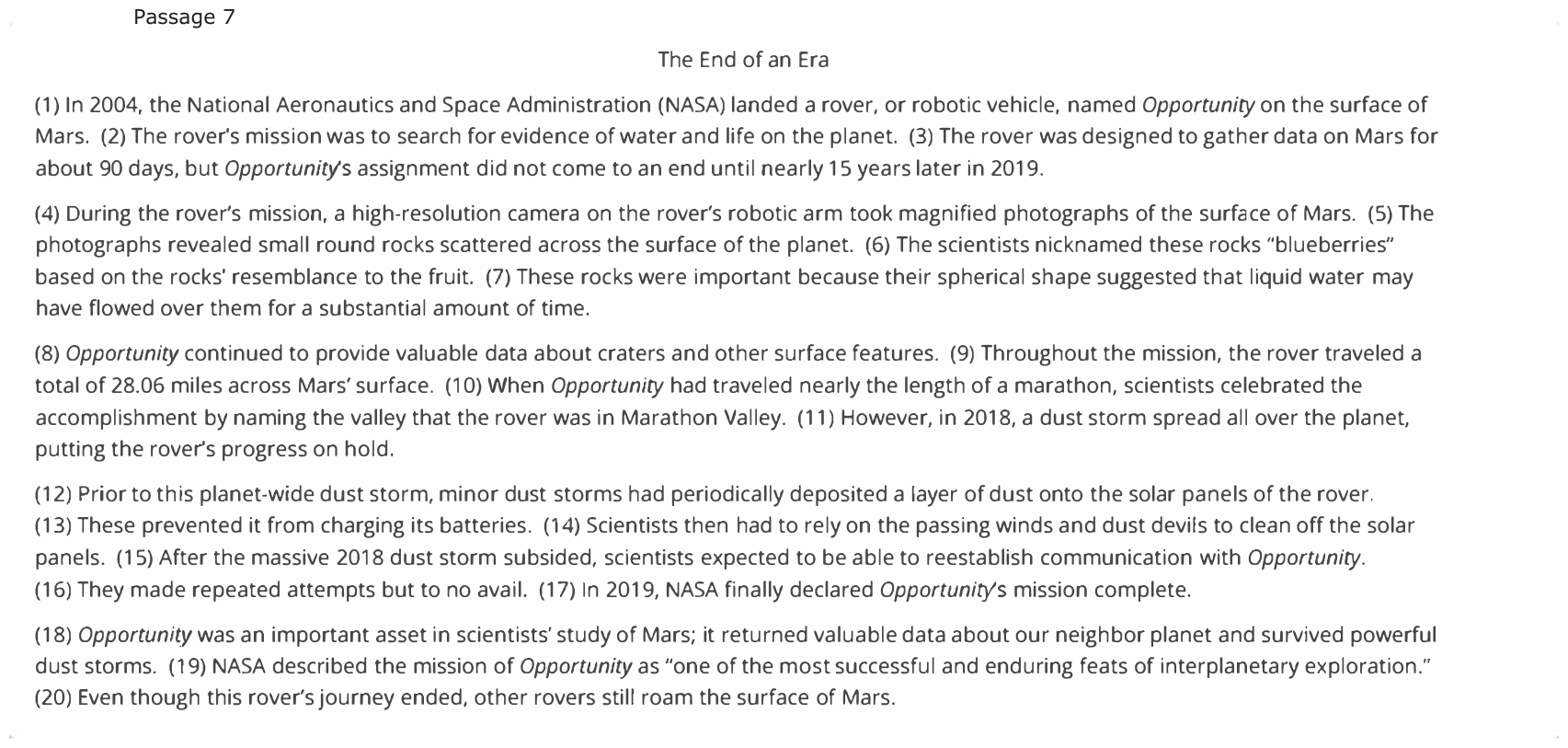
The passage “The Benefits of Indoor Plants” as printed (page 60)
Question 2 of 3
2026 Practice Test B English, question 43Passage The End of an Era
The End of an Era
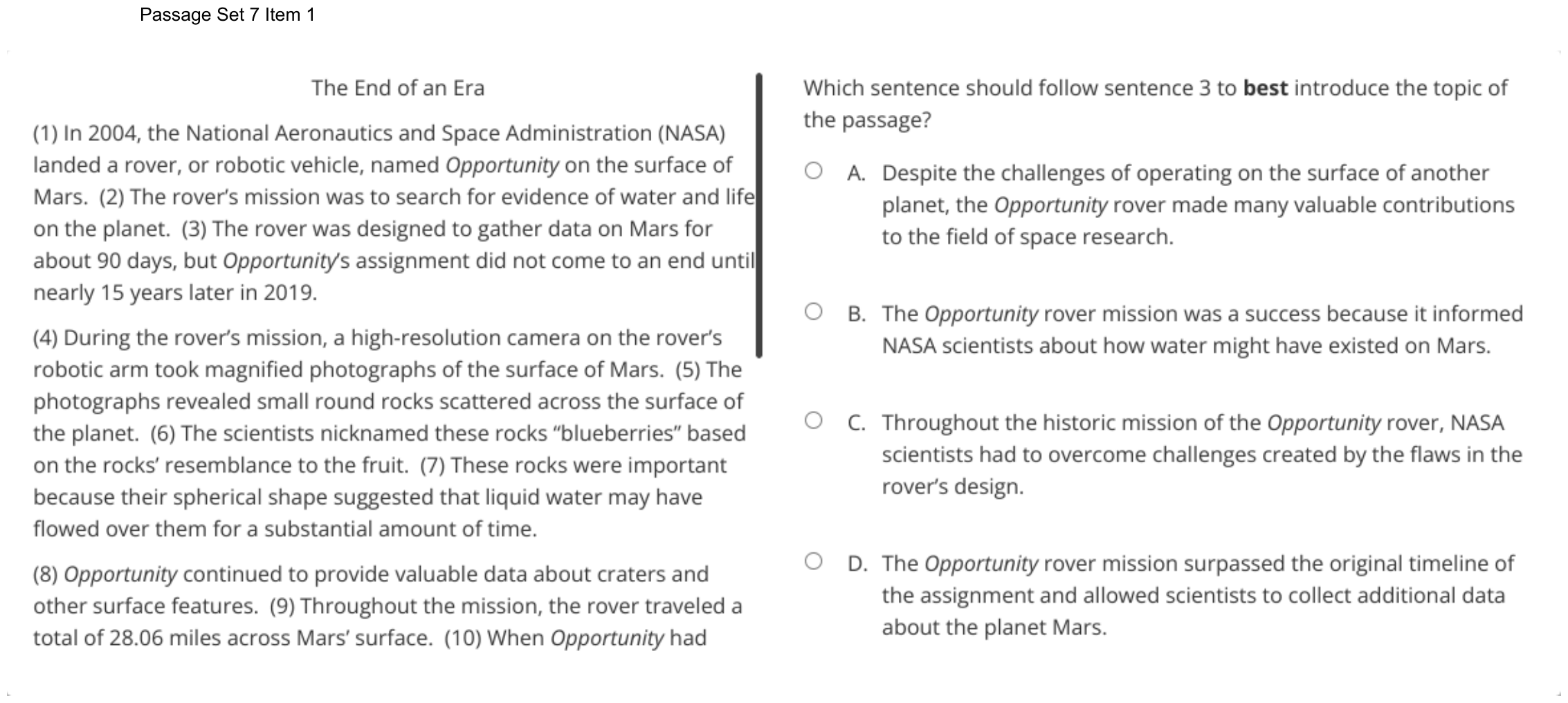
(1) In 2004, the National Aeronautics and Space Administration (NASA) landed a rover, or robotic vehicle, named Opportunity on the surface of Mars. (2) The rover’s mission was to search for evidence of water and life on the planet. (3) The rover was designed to gather data on Mars for about 90 days, but Opportunity’s assignment did not come to an end until nearly 15 years later in 2019.
(4) During the rover’s mission, a high-resolution camera on the rover’s robotic arm took magnified photographs of the surface of Mars. (5) The photographs revealed small round rocks scattered across the surface of the planet. (6) The scientists nicknamed these rocks “blueberries” based on the rocks’ resemblance to the fruit. (7) These rocks were important because their spherical shape suggested that liquid water may have flowed over them for a substantial amount of time.
(8) Opportunity continued to provide valuable data about craters and other surface features. (9) Throughout the mission, the rover traveled a total of 28.06 miles across Mars’ surface. (10) When Opportunity had traveled nearly the length of a marathon, scientists celebrated the accomplishment by naming the valley that the rover was in Marathon Valley. (11) However, in 2018, a dust storm spread all over the planet, putting the rover’s progress on hold.
(12) Prior to this planet-wide dust storm, minor dust storms had periodically deposited a layer of dust onto the solar panels of the rover. (13) These prevented it from charging its batteries. (14) Scientists then had to rely on the passing winds and dust devils to clean off the solar panels. (15) After the massive 2018 dust storm subsided, scientists expected to be able to reestablish communication with Opportunity. (16) They made repeated attempts but to no avail. (17) In 2019, NASA finally declared Opportunity’s mission complete.
(18) Opportunity was an important asset in scientists’ study of Mars; it returned valuable data about our neighbor planet and survived powerful dust storms. (19) NASA described the mission of Opportunity as “one of the most successful and enduring feats of interplanetary exploration.” (20) Even though this rover’s journey ended, other rovers still roam the surface of Mars.
Question
Which sentence should follow sentence 3 to best introduce the topic of the passage?
- ADespite the challenges of operating on the surface of another planet, the Opportunity rover made many valuable contributions to the field of space research.
- BThe Opportunity rover mission was a success because it informed NASA scientists about how water might have existed on Mars.
- CThroughout the historic mission of the Opportunity rover, NASA scientists had to overcome challenges created by the flaws in the rover’s design.
- DThe Opportunity rover mission surpassed the original timeline of the assignment and allowed scientists to collect additional data about the planet Mars.
Show the answer
Correct answer: A
The question asks for the sentence that should follow sentence 3 to best introduce the topic of the passage.
A. CORRECT. This sentence best introduces the passage’s topic: the Opportunity rover had many accomplishments on its mission, despite numerous challenges. Some of those accomplishments include providing high-resolution photographs (paragraph 2), traveling long distances (paragraph 3), and providing data about craters and other surface features (paragraph 3).
B. Incorrect. Although paragraph 2 discusses how photographs taken by the rover showed rocks that may have been shaped by water, this idea alone is not the topic of the entire passage.
C. Incorrect. While this sentence incorporates ideas about difficulties the scientists encountered because of the Opportunity rover’s design (paragraph 4), the main topic of the passage is not the design flaws and obstacles scientists encountered throughout the mission. The passage primarily focuses on the achievements of the mission.
D. Incorrect. While it is true that the Opportunity rover mission lasted much longer than planned (sentence 3), this fact is a supporting detail of the passage, not the main topic of the passage; surpassing the original timeline is only one of the rover’s many achievements mentioned in the passage.
Question analysis
This revising question works with “The End of an Era,” a passage about NASA's Opportunity rover on Mars, and asks which sentence should follow sentence 3 to best introduce the topic. Students must keep the whole passage in view, from the rover's photographs and travels to the dust storms that ended its mission, and judge which choice previews it best.
- NYS standards
- 7W2a introducing and organizing a topic
- Grade level
- Grade 7 reading and task
- Compared with grade 7
- At grade 7 Choosing a sentence that introduces a passage's topic is a standard grade 7 writing task. The passage is twenty plain sentences about one rover mission, and every choice draws on that mission, so it calls for a typical careful comparison.
- Estimated difficulty
- Moderate: several steps, or a close reading with one strong distractor.
- Thinking it demands
- Depth of knowledge 2, skills and concepts · mainly evaluate
- What makes it hard
- Evidence in several places moderate
- How sentences fit together minor
- Evidence
- Answered from the whole text
- Reading level
- Passage: about grade 11, 337 words; question and choices: about grade 14, 101 words.
- Students, last 30 days
- Not enough answers yet to show (it takes 10).
Why it is hard, traps and wrong answers (shows the answer)
Why it is hard
Sentence 3 already tells a striking story, a 90-day mission that lasted nearly fifteen years, and the most tempting continuation simply repeats it in new words. The other near misses each pick one part of the passage, the water evidence or the dust problems, and make it the whole. The question rewards skimming every paragraph first and choosing the sentence that covers both the achievements and the hardships, the pairing the final paragraph makes.
Evidence in several places moderate Working it out
The topic only emerges from the later paragraphs: the “blueberries” of sentences 4–7, the 28.06 miles of paragraph 3, the dust storms of paragraph 4 and NASA’s praise in sentence 19. (Kirsch & Mosenthal, 1990; Gorin & Embretson, 2006)
How sentences fit together minor Working it out
The new sentence follows sentence 3’s surprise that a 90-day mission lasted nearly 15 years, so it must turn from that fact to what the mission achieved. (Halliday & Hasan, 1976)
Strategy: Skim the opening sentence of each later paragraph to see what the passage covers, then ask which choice would prepare a reader for all of it.
Traps
- Too narrow: A single detail offered as the central idea or a summary, or a summary that keeps minor details and leaves out an essential part.
- Says it twice: Repeats an idea that the sentence or passage already states.
- Off the point: Adds or keeps something that does not support the paragraph's or the passage's focus, or an introduction or conclusion that misses the main point.
The wrong answers, classified
B Too narrow (King et al., 2004)
Picks the water finding of paragraph 2, a real result, but it covers one paragraph and leaves out the rover’s travels, its endurance and the dust storms.
C Off the point (Halliday & Hasan, 1976)
Builds on the dust that blocked the solar panels in paragraph 4, but the passage never blames flaws in the rover’s design and dwells on its achievements.
D Says it twice (Connors & Lunsford, 1988)
Follows sentence 3 smoothly, but saying the mission “surpassed the original timeline” only restates the 90 days that became 15 years instead of introducing what comes next.
Working it out, step by step
Figure out what the question asks
This revising question asks for a sentence to add after sentence 3. It should introduce the topic of the whole passage. A good introduction gives a preview, a quick look at everything coming. It doesn’t repeat one fact or zoom in on one part. For example, a report on a soccer season might begin: The team lost two stars but still won the title. That previews both the struggles and the wins.
Skim each paragraph
- Paragraph 2 (sentences 4–7): The rover’s camera found small round rocks that hinted at water.
- Paragraph 3 (sentences 8–11): It sent data and traveled 28.06 miles. Then a huge dust storm stopped it.
- Paragraph 4 (sentences 12–17): Dust had covered its solar panels before. After the 2018 storm, NASA could not reach it.
- Paragraph 5 (sentences 18–20): It “returned valuable data about our neighbor planet and survived powerful dust storms.”
Name the topic
So the passage covers two things. One is what the rover achieved: photos, data and miles. The other is its challenges, mainly the dust storms. Challenges are hard problems. Sentence 18 puts both together. The new sentence should preview both.
Check each choice
- A is right. It names the challenges and the “many valuable contributions.” That covers the whole passage.
- B is wrong. Water is only paragraph 2. It leaves out the travel and the dust storms.
- C is wrong. The passage never blames flaws in the rover’s design. It mostly praises the rover.
- D is wrong. Sentence 3 already says the mission lasted far past 90 days. D repeats it instead of looking ahead.
Watch out: D follows sentence 3 smoothly, so it sounds right. But it only restates sentence 3 in new words.
Choose the answer
So the answer is A: “Despite the challenges of operating on the surface of another planet, the Opportunity rover made many valuable contributions to the field of space research.”
Why this answer and not the closest wrong one
D is the closest wrong answer, because it flows right after sentence 3. But it only repeats that the mission lasted longer than planned. A previews both halves of the passage: the rover’s achievements and the challenges it survived. Sentence 18 sums up the same two ideas.
More questions like this
The original DOE question
The passage “The End of an Era” as printed (page 60)
Question 3 of 3
2026 Practice Test B English, question 46Uses the passage above: “The End of an Era”.
Question
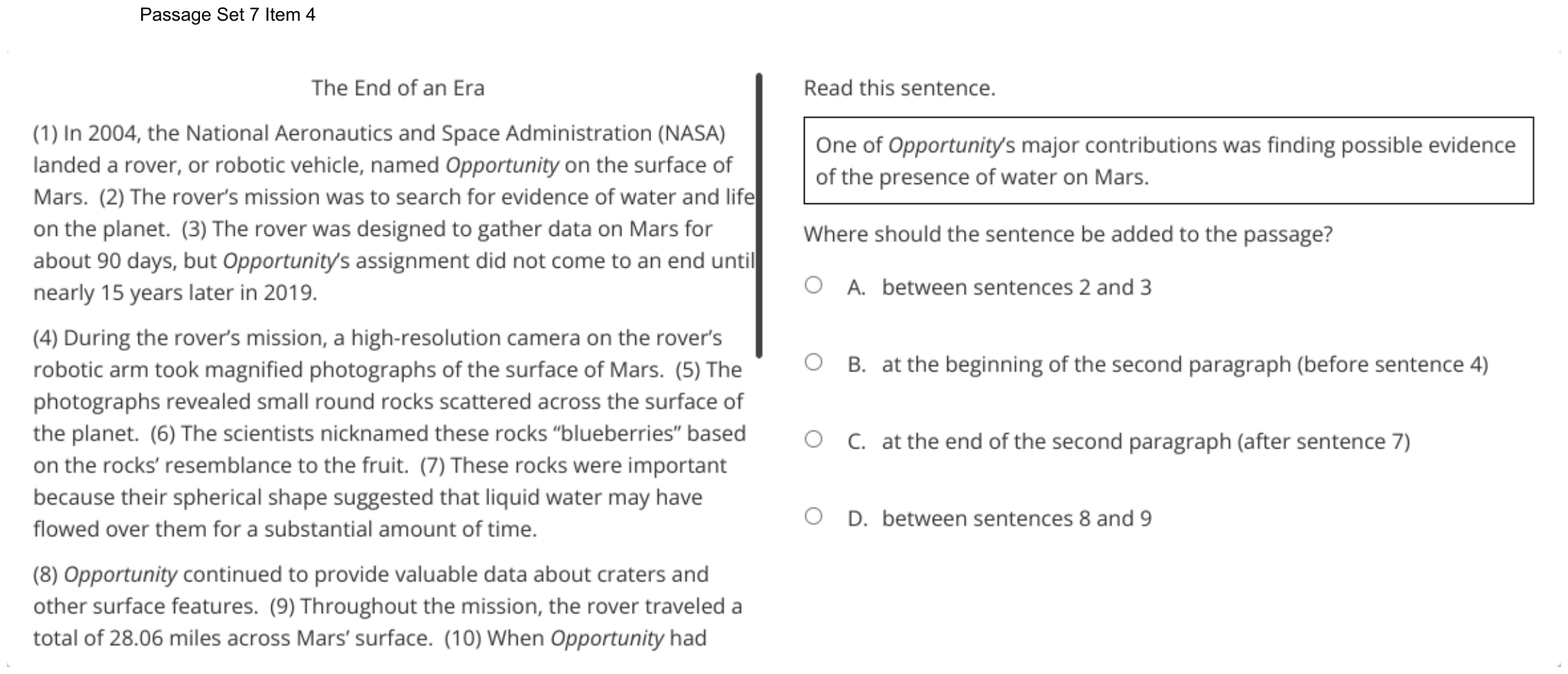
Read this sentence.
One of Opportunity’s major contributions was finding possible evidence of the presence of water on Mars.
Where should the sentence be added to the passage?
- Abetween sentences 2 and 3
- Bat the beginning of the second paragraph (before sentence 4)
- Cat the end of the second paragraph (after sentence 7)
- Dbetween sentences 8 and 9
Show the answer
Correct answer: B
The question asks where the sentence should be added to the passage.
A. Incorrect. While sentence 2 refers to Opportunity’s mission to search for evidence of water, sentence 3 mentions the rover lasting much longer than anticipated. Placing the sentence between these two ideas, rather than at the start of the second paragraph, where it introduces the topic of the paragraph, would create a disjointed and confusing experience for the reader.
B. CORRECT. The sentence introduces the idea of finding possible evidence of water on Mars, which is the main topic of the second paragraph.
C. Incorrect. The sentence sets up the main idea of paragraph 2, which is the possibility of water on Mars. As a concluding sentence, it would be repetitive and confusing.
D. Incorrect. The sentence introduces the possibility of water on Mars, while sentences 8 and 9 discuss other surface features and the distance traveled by the rover. Adding the sentence here would create a disorganized paragraph.
Question analysis
This organization question gives a new sentence about Opportunity's possible discovery of evidence of water on Mars and asks where it should be added to the rover passage. Students must follow the order of ideas across the first three paragraphs, because the sentence echoes ideas that appear in several places and could seem to fit more than one of them.
- NYS standards
- 7W2a introducing and organizing a topic
- Grade level
- Grade 7 reading and task
- Compared with grade 7
- At grade 7 Deciding where a sentence belongs is typical grade 7 revision work. The four positions span three paragraphs of a plain passage, and the sentence's wording connects to more than one of them, so the order of ideas must be checked.
- Estimated difficulty
- Moderate: several steps, or a close reading with one strong distractor.
- Thinking it demands
- Depth of knowledge 2, skills and concepts · mainly analyze
- What makes it hard
- How sentences fit together moderate
- A very close wrong answer moderate
- Evidence
- Answered from several paragraphs or stanzas
- Reading level
- Passage: about grade 11, 337 words; question and choices: about grade 7, 52 words.
- Students, last 30 days
- Not enough answers yet to show (it takes 10).
Why it is hard, traps and wrong answers (shows the answer)
Why it is hard
The new sentence reads well in more than one place, because water comes up in sentence 2, in sentence 7 and near the “valuable data” of sentence 8. Its wording settles the matter: “One of Opportunity’s major contributions” announces a topic, so it belongs ahead of the evidence. The strongest pull places it as a closing line after sentence 7, where it restates the point the blueberries have just made.
How sentences fit together moderate Working it out
The new sentence names a contribution in general terms, so it belongs before sentence 4, where the camera and the “blueberries” supply the details, not after them. (Halliday & Hasan, 1976)
A very close wrong answer moderate Choosing the answer
The two positions in paragraph 2, before sentence 4 and after sentence 7, both keep the sentence beside the water evidence; they differ only in whether it introduces the details or sums them up. (Embretson & Wetzel, 1987; Gorin & Embretson, 2006; Ascalon et al., 2007)
Strategy: Find what the new sentence is about and where the passage discusses that, then read the sentence in each offered position and check whether it introduces, interrupts or repeats the ideas around it.
Traps
- Sentence in the wrong place: Puts a sentence where it breaks the order of ideas or separates it from what it refers to.
- Says it twice: Repeats an idea that the sentence or passage already states.
The wrong answers, classified
A Sentence in the wrong place (Halliday & Hasan, 1976)
Matches the sentence to sentence 2’s search for water, but there it announces the finding before the photographs are described and cuts into the account of the mission’s length.
C Says it twice (Connors & Lunsford, 1988)
Uses it as a wrap-up after the blueberries, a common paragraph shape, but there it only repeats sentence 7’s point about water instead of introducing the paragraph’s topic.
D Sentence in the wrong place (Halliday & Hasan, 1976)
Links “major contributions” to the “valuable data” of sentence 8, though paragraph 3 covers craters, distance traveled and the dust storm, not water.
Working it out, step by step
Figure out what the question asks
This question asks where a new sentence belongs. First find what the sentence is about. Then find where the passage talks about that. Last, decide whether the sentence should start that part, interrupt it or end it.
Read the new sentence
It says that one of Opportunity’s major contributions was “finding possible evidence of the presence of water on Mars.” It names a big idea in general terms. A sentence like that is a topic sentence. A topic sentence tells what a paragraph will be about. It usually comes first. For example, Dogs help people in many ways. comes before the details about guiding, herding and comforting.
Find where water comes up
Paragraph 2 (sentences 4–7) gives the details. The camera took close-up photos. They showed small round rocks, nicknamed “blueberries.” Sentence 7 says the rocks’ round shape “suggested that liquid water may have flowed over them.” So the new sentence should come right before these details, at the start of paragraph 2.
Check each choice
- A is wrong. Between sentences 2 and 3, it would announce the finding before the photos are described. It would also break up the facts about the mission’s length.
- B is right. Before sentence 4, it introduces the paragraph about the round rocks and water.
- C is wrong. After sentence 7, it would only repeat the point sentence 7 just made.
- D is wrong. Paragraph 3 is about craters, miles and the dust storm, not water.
Watch out: C is tempting because some paragraphs end with a summary. But sentence 7 already makes the point about water.
Choose the answer
So the answer is B: “at the beginning of the second paragraph (before sentence 4).”
Why this answer and not the closest wrong one
C is the closest wrong answer, because it keeps the sentence in the paragraph about water. But the sentence names a topic, so it works best before the details. After sentence 7, it would repeat what the blueberries just showed. Before sentence 4, it tells readers what is coming.
More questions like this
The original DOE question