6.SP.8b probability models from observed frequencies
Question 1 of 2
2026 Practice Test D Math, question 34Question
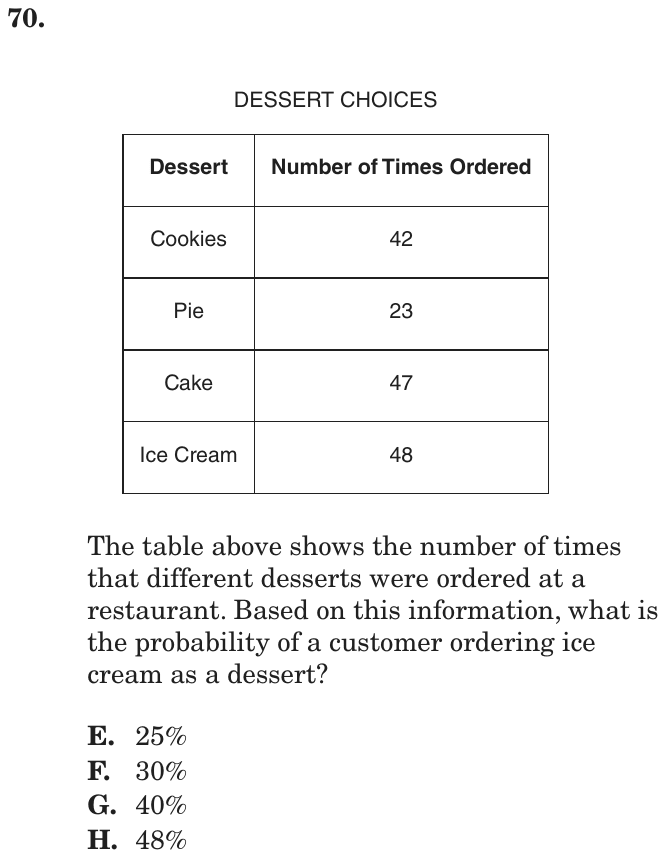
Last week, Emily rode the bus to school on 3 of the 5 mornings and rode the bus home on 4 of the 5 afternoons. Based on last week’s events, what is the probability that Emily will ride the bus in the morning and the afternoon next Monday?
- A
- B
- C
- D
Show the answer
Correct answer: C
Using the joint probability formula, find the product of the two independent events. The probability that Emily will ride the bus to school on any given morning is . The probability that Emily will ride the bus home on any given afternoon is . Therefore, the probability that Emily will ride the bus in the morning and the afternoon is .
Question analysis
Last week Emily rode the bus to school on 3 of 5 mornings and home on 4 of 5 afternoons. This probability question asks how likely she is to ride the bus both ways next Monday, based on those frequencies. Students turn each count into a probability and combine the two, deciding how chances join when both events must happen.
- NYS standards
- Grade level
- Grade 7 content, by NYS standard
- Compared with grade 7
- At grade 7 Compound probability is grade 7 work, often done with a table of outcomes. Each chance here comes from one week's frequencies, and joining the morning and afternoon events in one step is about the usual grade 7 demand.
- Estimated difficulty
- Moderate: several steps, or a close reading with one strong distractor.
- Thinking it demands
- Depth of knowledge 2, skills and concepts · mainly apply
- What makes it hard
- Something you must already know moderate
- Turning words into math minor
- Solution
- 3 steps
- Reading level
- Question and choices: about grade 5, 48 words.
- Corrected from the DOE handbook
- An inaccurate detail in the explanation was corrected.
- Students, last 30 days
- Not enough answers yet to show (it takes 10).
Why it is hard, traps and wrong answers (shows the answer)
Why it is hard
Once the two chances are written, the question is how they combine. Pooling the week into 7 bus rides out of 10 trips, or adding fractions in some way, gives listed choices that look reasonable, since each lies between 0 and 1. Picturing the 25 pairings of a morning with an afternoon, 3 × 4 = 12 of which have both rides, shows why the chances multiply.
Something you must already know moderate Working it out
The rule that two independent events both happen with the product of their chances, 3/5 times 4/5, is not given, and “the morning and the afternoon” is the only signal for it. (Anderson & Krathwohl, 2001)
Turning words into math minor Understanding the question
The counts “3 of the 5 mornings” and “4 of the 5 afternoons” have to become two separate probabilities based on last week, not one pool of 10 trips. (Hegarty, Mayer & Monk, 1995; Koedinger & Nathan, 2004)
Strategy: Turn each count into a probability, then multiply them, since both rides must happen; picturing a table of 5 mornings by 5 afternoons shows why multiplying works.
Traps
- Misunderstands the concept: A wrong belief about a concept: that percents can be added, that area grows like length, that averages can be averaged, that a bigger denominator means a bigger fraction.
- A faulty procedure: A systematic but wrong procedure: adding fractions straight across, applying an exponent to each term of a sum, dropping a sign when moving a term.
- Wrong operation: Adds instead of multiplying, divides the wrong way round, turns a ratio or rate upside down, or undoes a step in the wrong direction (subtracts what should be added back).
The wrong answers, classified
A Wrong operation (Hegarty, Mayer & Monk, 1995; King et al., 2004)
Subtracts the morning chance from the afternoon chance, 4/5 − 3/5 = 1/5, an operation with no meaning for two rides that must both happen.
B A faulty procedure (Brown & Burton, 1978; Tatsuoka, 1983)
Adds the numerators, 3 + 4, but multiplies the denominators, 5 × 5, mixing the rule for adding fractions with the rule for multiplying them.
D Misunderstands the concept (Smith, diSessa & Roschelle, 1993; De Bock et al., 1998; Ni & Zhou, 2005)
Pools the week’s trips into 7 bus rides out of 10, a rate for a single trip, as if riding both ways next Monday were just as likely.
What was corrected from the DOE handbook, and why
- Explanation: The DOE’s explanation says “The probability that Emily will ride the bus to school on any given afternoon is 4/5.” The question says she rode the bus home on 4 of the 5 afternoons; her rides to school are the morning ones. The site now says “ride the bus home on any given afternoon”.
Worked solution, step by step
Formulas used
- Probability from past results
- P is the probability, the chance something happens. You use what happened before to predict the chance it happens again. Emily rode in 3 of 5 mornings, so the chance for one morning is 3/5.
- Both of two independent events
- A and B are two events. Independent means one does not change the chance of the other. To find the chance that both happen, multiply their chances. The result is smaller than either one, since both must happen.
Sort out the question
Last week Emily:
- rode the bus to school on 3 of the 5 mornings;
- rode the bus home on 4 of the 5 afternoons.
You need the chance that she rides the bus in the morning and in the afternoon next Monday. The word and means both rides must happen.
Write each chance
Use last week to find each chance:
- Bus to school on a morning:
- Bus home on an afternoon:
Keep them apart. The morning rides go to school, and the afternoon rides go home.
Multiply the two chances
Both rides must happen, so multiply:
Why multiply? Pair each of the 5 mornings with each of the 5 afternoons. That makes 25 pairs. In of them, she rides both times. So the chance is 12 out of 25.
Avoid the tempting wrong choices
Watch out: pooling the week gives 7 rides out of 10 trips, or 7/10, choice D. That is the chance for one trip, not for two trips on one day.
Adding the tops but multiplying the bottoms gives 7/25, choice B. Subtracting the chances gives 1/5, choice A.
So the answer is C, .
Check your answer
The chance of both rides must be less than the chance of each ride alone. As decimals, 12/25 = 0.48. That is less than 3/5 = 0.6 and 4/5 = 0.8. Choice D, 7/10 = 0.7, is more than 3/5, so it cannot be right.
More questions like this
The original DOE question
Question 2 of 2
2018 Test B Math, question 13Question
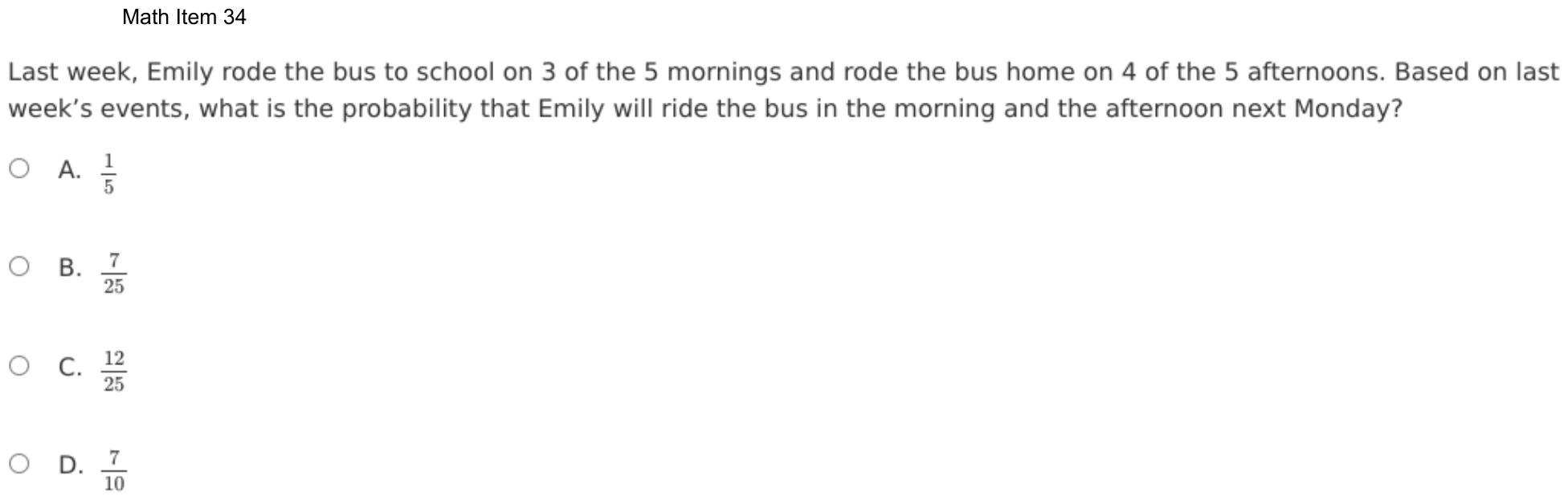
DESSERT CHOICES
| Dessert | Number of Times Ordered |
| Cookies | 42 |
| Pie | 23 |
| Cake | 47 |
| Ice Cream | 48 |
The table above shows the number of times that different desserts were ordered at a restaurant. Based on this information, what is the probability of a customer ordering ice cream as a dessert?
- A25%
- B30%
- C40%
- D48%
Show the answer
Correct answer: B
The total number of desserts ordered is
42 + 23 + 47 + 48 = 160
The probability that ice cream was chosen is
.
Question analysis
This probability question gives a table of how many times four desserts were ordered at a restaurant and asks how likely a customer is to order ice cream, as a percent. Students total the orders and divide. The trap is using a raw count, or the wrong total, in place of the full number of desserts ordered.
- Grade level
- Grade 6 content, by NYS standard
- Compared with grade 7
- Below grade 7 Finding a probability from observed frequencies is grade 6 content in New York. Here it takes one sum, one division and a conversion to a percent with friendly numbers, lighter than typical grade 7 work.
- Estimated difficulty
- Routine: one familiar step, little to misread.
- Thinking it demands
- Depth of knowledge 1, recall and reproduction · mainly apply
- What makes it hard
- Solution
- 3 steps
- Reading level
- Question and choices: about grade 5, 45 words.
- Students, last 30 days
- Not enough answers yet to show (it takes 10).
Why it is hard, traps and wrong answers (shows the answer)
Why it is hard
This is a direct relative-frequency question with friendly numbers, and most students finish it quickly. The risk is using a number from the table as if it were already a percent, or treating the four desserts as equally likely. Remembering that a probability compares one count with the total of all counts prevents both mistakes.
Reading a figure, table or graph minor Understanding the question
The four counts sit in a table, and the probability needs all of them: the ice cream row gives the numerator and the sum of the column gives the denominator. (Lesh, Post & Behr, 1987; Kirsch & Mosenthal, 1990)
Error-prone arithmetic minor Working it out
Adding 42 + 23 + 47 + 48 by hand and then simplifying 48/160 to 3/10 are small steps where a careless total spoils the percent. (Brown & Burton, 1978; Junker & Sijtsma, 2001)
Strategy: Add the four counts in the table to get all the orders, divide the ice cream count by that total, and convert the fraction to a percent.
Traps
- Answers a different question: A choice is right for another quantity: the other unknown, the rest instead of the part, the part instead of the whole.
The wrong answers, classified
A Misunderstands the concept (Smith, diSessa & Roschelle, 1993; De Bock et al., 1998; Ni & Zhou, 2005)
Treats the four desserts as equally likely, one chance in four, ignoring how often each was actually ordered.
C Answers a different question (King et al., 2004; Hegarty, Mayer & Monk, 1995)
Divides 48 by the 112 orders of the other desserts instead of all 160, getting about 43%, and takes the nearest choice.
D Numbers taken from the question (Hegarty, Mayer & Monk, 1995)
Reads the 48 ice cream orders as 48 percent without dividing by the total number of desserts ordered.
Worked solution, step by step
Formulas used
- Probability
- P is the probability, the chance that something happens. The top counts the outcomes you want, here ice cream orders. The bottom counts every outcome, here all dessert orders. It works because each order counts the same.
- Fraction to percent
- Percent means out of 100. Multiply a fraction or a decimal by 100 to write it as a percent. For example, 3/10 times 100 is 30, so 3/10 is 30%.
Sort out the table
The table shows how many times each dessert was ordered. Ice cream was ordered 48 times.
You need the chance that a customer orders ice cream. The orders in the table show how often each dessert is picked.
Find the total orders
Add all four rows of the table.
There were 160 dessert orders in all. This is the bottom of the fraction, because it counts every order.
Write the probability
Put the counts into the probability formula. The top is the 48 ice cream orders. The bottom is all 160 orders.
Simplify the fraction. Both numbers can be divided by 16.
Change to a percent
The probability is 30%.
Watch out: 48 orders is not 48%, choice D. You must divide by the total. Also, the four desserts are not equally popular. So the chance is not 1 out of 4, or 25%, choice A.
So the answer is B, 30%.
Check your answer
Work backward: . That matches the ice cream row. Also, 48 is a bit less than a third of 160, and 30% is a bit less than a third.
More questions like this
The original DOE question