6.RP.3a tables of equivalent ratios
Question 1 of 4
2026 Practice Test A Math, question 37Question
When a student buys 4 notebooks, the total cost is $12. Each notebook costs the same amount. Select each point on the graph that best represents y, the total cost of x notebooks.
Select all the correct answers.
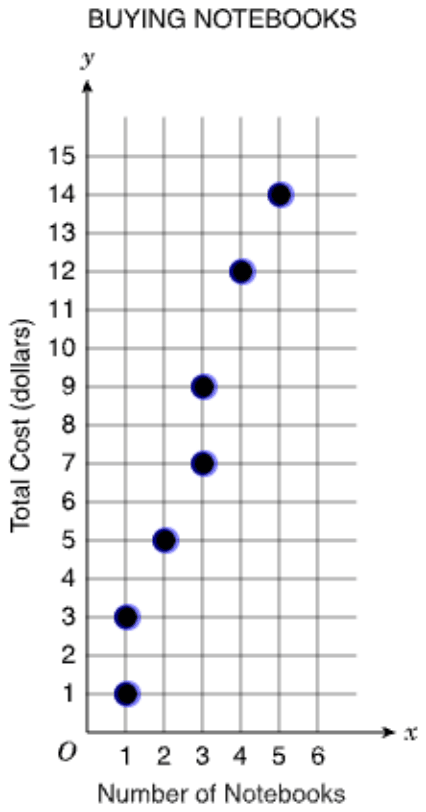
On the test you click the points in the figure; here, choose them below. The DOE has not published how answers with several parts are scored; this site counts one right only when every part is right.
- A(1, 1)
- B(1, 3)
- C(2, 5)
- D(3, 7)
- E(3, 9)
- F(4, 12)
- G(5, 14)
Show the answer
Correct answer: B, E, and F
Solution:
There are three correct points: (1, 3), (3, 9), and (4, 12).
Find the cost per notebook: .
The equation of the line is , where y is the total cost of x notebooks.
Check each point by plugging the x-value into the equation . If the y-value from the equation matches the y-value of the point, then the point is on the line .
Check all seven points:
(1, 1) y-values do not match; incorrect point
(1, 3) y-values match; CORRECT point
(2, 5) y-values do not match; incorrect point
(3, 7) y-values do not match; incorrect point
(3, 9) y-values match; CORRECT point
(4, 12) y-values match; CORRECT point
(5, 14) y-values do not match; incorrect point
Question analysis
A graph titled Buying Notebooks shows seven points, and students select every point that fits the total cost of buying notebooks, given the cost of a few notebooks and that each costs the same. It tests finding a unit rate and recognizing points of a proportional relationship. Some points line up in tempting patterns, and the item does not say how many to select.
- NYS standards
- Grade level
- Grade 7 content, by NYS standard
- Compared with grade 7
- At grade 7 Finding a unit rate and deciding which points fit a proportional relationship are grade 7 skills, and the arithmetic here is easy. What adds demand is testing all seven points with no count given, since one miss or extra pick loses the item.
- Estimated difficulty
- Straightforward: two steps or one careful reading.
- Thinking it demands
- Depth of knowledge 2, skills and concepts · mainly apply
- What makes it hard
- Solution
- 2 steps
- Reading level
- Question and choices: about grade 5, 36 words.
- Students, last 30 days
- Not enough answers yet to show (it takes 10).
Why it is hard, traps and wrong answers (shows the answer)
Why it is hard
Finding the price is one division, 12 ÷ 4 = 3, so the question is really about checking: each chosen dot must fit y = 3x exactly, and the item does not say how many do. The graph punishes judging by eye, since a straight row of dots climbs from (1, 3) at $2 a notebook and two dots sit a single gridline off the true line. Multiplying each x by 3 and reading each y from the axis, not from the pattern, settles all seven.
Every choice must be checked moderate Choosing the answer
Seven dots must each be tested against $3 a notebook, and the item never says how many fit; one missed point or one extra loses the whole item, so no dot can be skipped. (Embretson & Wetzel, 1987)
Reading a figure, table or graph minor Understanding the question
The graph stacks two dots above 1 notebook and two above 3, and each total cost has to be read off a grid ruled at every dollar up to 15. (Lesh, Post & Behr, 1987; Kirsch & Mosenthal, 1990)
A very close wrong answer minor Choosing the answer
(5, 14) sits one gridline below (5, 15), where 5 notebooks at $3 would be, and (2, 5) sits one below (2, 6), so judging by the line's direction cannot rule either out. (Embretson & Wetzel, 1987; Gorin & Embretson, 2006; Ascalon et al., 2007)
Strategy: Work out the cost of one notebook from the total given in the question, then multiply each point's x-coordinate by that price and keep only the points whose y-coordinate matches exactly.
Traps
- Misunderstands the concept: A wrong belief about a concept: that percents can be added, that area grows like length, that averages can be averaged, that a bigger denominator means a bigger fraction.
- Misreads the figure: Reads a value, label or tick spacing in a figure, table or graph wrongly.
The wrong answers, classified
A Little reason to choose it (Haladyna & Downing, 1993; Rodriguez, 2005)
No working from 4 notebooks for $12 makes one notebook cost $1, so this lowest dot mostly catches guesses, such as taking the dot nearest the origin as a start.
C Misunderstands the concept (Smith, diSessa & Roschelle, 1993; De Bock et al., 1998; Ni & Zhou, 2005)
Takes the straight row (1, 3), (2, 5), (3, 7) as the graph because its dots line up, though it climbs $2 a notebook and would meet the y-axis at $1, not the origin.
D Misunderstands the concept (Smith, diSessa & Roschelle, 1993; De Bock et al., 1998; Ni & Zhou, 2005)
Prefers the lower of the two dots above 3 notebooks because it continues the evenly spaced row from (1, 3) and (2, 5), instead of checking that 3 notebooks cost $9.
G Misreads the figure (Lesh, Post & Behr, 1987; Kirsch & Mosenthal, 1990)
Finds that 5 notebooks cost 5 × $3 = $15, then reads the dot above 5 as sitting on the top gridline, 15, when it is one line lower, at 14.
Worked solution, step by step
Formulas used
- Unit price
- The unit price is what one item costs. Divide the total cost by the number of items bought. This works because every notebook costs the same, so the total splits into equal parts.
- A proportional relationship
- y is the total cost in dollars, and x is the number of notebooks. k is the price of one notebook, the number you always multiply by. A point fits only if its y is exactly k times its x. The graph is a straight line through (0, 0).
Sort out the question
Four notebooks cost $12, and each one costs the same. On the graph, x is the number of notebooks, and y is the total cost in dollars. The graph shows seven points. You must select every point that fits. The question does not say how many fit, so test all seven.
Find the price of one notebook
Split the $12 equally among the 4 notebooks:
Each notebook costs $3. So the total cost is 3 times the number of notebooks:
Test each point
For each point, multiply its x by 3. Keep the point only if the result equals its y.
Choice Point 3 × x Fits? A (1, 1) 3 No B (1, 3) 3 Yes C (2, 5) 6 No D (3, 7) 9 No E (3, 9) 9 Yes F (4, 12) 12 Yes G (5, 14) 15 No Watch for look-alike points
Watch out: the dots (1, 3), (2, 5) and (3, 7) sit in a neat straight row. But that row climbs $2 per notebook, not $3. Lining up is not enough: (2, 5) and (3, 7), choices C and D, do not fit.
Watch out: 5 notebooks cost dollars. The dot above 5 sits one gridline lower, at 14. Read the y-axis carefully, and you will skip choice G.
Name the points
Three points fit: (1, 3), (3, 9) and (4, 12). On the test, you click each of these dots on the graph. On this site, you check their boxes. So the answers are B, E and F.
Check your answer
All three points fit : , and . They also line up with (0, 0), since 0 notebooks cost $0. And (4, 12) is the fact the question gave you.
More questions like this
The original DOE question
Question 2 of 4
2024 Test A Math, question 55Question
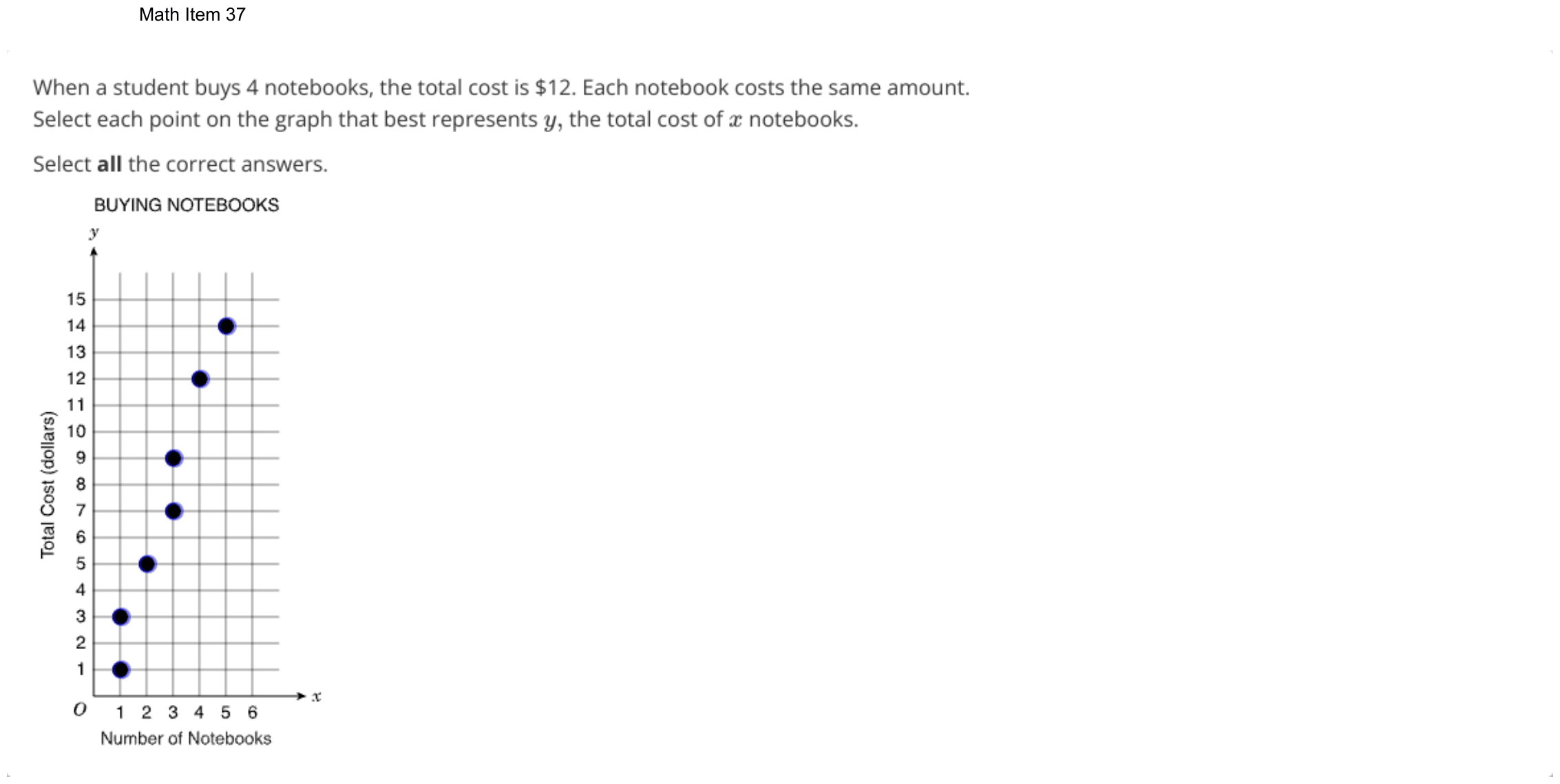
The table below shows the number of cups of red paint and blue paint used to make a purple paint mixture.
PURPLE PAINT
| Cups of Red Paint | Cups of Blue Paint |
|---|---|
| 1 | 1.5 |
| 4 | 6 |
| 11 | y |
Based on the relationship between the number of cups of red paint and the number of cups of blue paint, what is the value of y?
- A10.5
- B13
- C16.5
- D24
Show the answer
Correct answer: C
Divide the number of cups of blue paint by the number of cups of red paint to find the constant of proportionality.
Multiply to find the value of y.
Question analysis
A table gives cups of red and blue paint for a purple mixture: 1 and 1.5, 4 and 6, and 11 and an unknown y. This ratio table question asks for y based on the relationship between the two colors. The tricky part is noticing whether the relationship works by multiplying or by adding.
- Grade level
- Grade 7 content, by NYS standard
- Compared with grade 7
- Below grade 7 Finding a constant of proportionality from a table is grade 7 work, but here one row already pairs 1 cup of red with its cups of blue, so a single multiplication finishes it, lighter than typical grade 7 tasks.
- Estimated difficulty
- Routine: one familiar step, little to misread.
- Thinking it demands
- Depth of knowledge 2, skills and concepts · mainly apply
- What makes it hard
- Solution
- 2 steps
- Reading level
- Question and choices: about grade 4, 57 words.
- Students, last 30 days
- Not enough answers yet to show (it takes 10).
Why it is hard, traps and wrong answers (shows the answer)
Why it is hard
The relationship is multiplicative, 1.5 cups of blue for every cup of red, and one multiplication finishes the question. The trap is additive thinking: red grows by 7 cups from the second row to the third, and adding the same 7 to the blue column gives a listed answer. Testing a rule on every row exposes the additive one, since blue is 0.5 more than red in the first row but 2 more in the second.
Reading a figure, table or graph minor Understanding the question
The table's first row, 1 cup of red to 1.5 cups of blue, hands over the constant of proportionality; the other two rows only confirm it. (Lesh, Post & Behr, 1987; Kirsch & Mosenthal, 1990)
Strategy: Use the row with 1 cup of red paint to read the cups of blue per cup of red, multiply that rate by 11, and check the rate against the row with 4 cups.
Traps
- Misunderstands the concept: A wrong belief about a concept: that percents can be added, that area grows like length, that averages can be averaged, that a bigger denominator means a bigger fraction.
- Stops one step early: A choice is a number from partway through the solution.
The wrong answers, classified
A Stops one step early (King et al., 2004; Gierl et al., 2017)
Scales only the jump from 4 to 11 cups of red, 7 × 1.5 = 10.5, and forgets to add the 6 cups of blue already there.
B Misunderstands the concept (Smith, diSessa & Roschelle, 1993; De Bock et al., 1998; Ni & Zhou, 2005)
Thinks additively: red goes up 7 cups from 4 to 11, so adds the same 7 to the 6 cups of blue, getting 13.
D Numbers taken from the question (Hegarty, Mayer & Monk, 1995)
Multiplies the two numbers in the second row, 4 × 6 = 24, without finding how the two columns are related.
Worked solution, step by step
Formulas used
- Constant of proportionality
- x and y are two amounts that change together. k is the constant of proportionality: how much y goes with 1 of x. In a proportional relationship, y divided by x gives the same k every time.
- Proportional relationship
- x is the cups of red paint, and y is the cups of blue paint. k is the cups of blue for each cup of red. In a proportional relationship, y is always k times x. Use it to find y for any amount of red.
Sort out the table
The table shows cups of red and blue paint for the same purple. 1 cup of red goes with 1.5 cups of blue. 4 cups of red go with 6 cups of blue. You need y, the cups of blue for 11 cups of red. The same color means the paints mix at the same rate in every row.
Find the blue for each cup of red
Both rows give 1.5. So there are always 1.5 cups of blue for each cup of red. This number is the constant of proportionality.
Use the rate for 11 cups
Think of it as 11 cups plus half of 11 cups: . So y is 16.5 cups of blue.
Avoid the traps and answer
Watch out: red goes up 7 cups from 4 to 11. Adding the same 7 cups to the 6 cups of blue gives 13, choice B. Paint mixes by multiplying, not by adding. Watch out: , choice A, is only the extra blue for the 7 extra cups of red.So the answer is C, 16.5.
Check your answer
Divide to check: . That matches the other rows. Also, every row has more blue than red, so y must be more than 11. That rules out 10.5.
More questions like this
The original DOE question
Question 3 of 4
2024 Test B Math, question 30Question
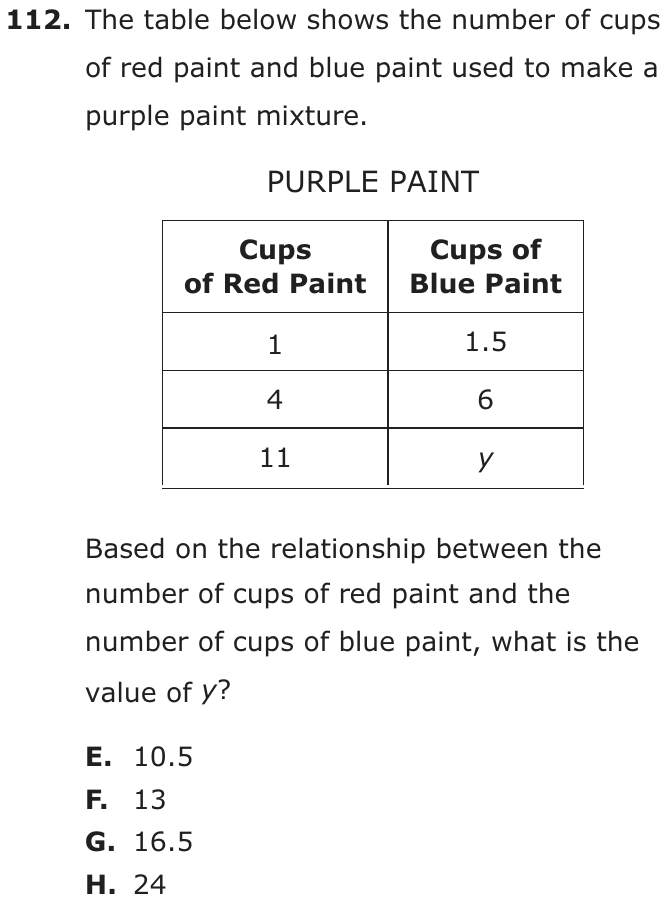
GIA’S MIX
| Snack | Number in Bag |
|---|---|
| Pretzels | 12 |
| Raisins | 9 |
Gia and her friends counted the numbers of pretzels and raisins in their snack mix. The table above shows the numbers in Gia’s mix. Which other mix has a ratio of pretzels to raisins in the same proportional relationship as Gia’s mix?
- A
ADELE’S MIX
Snack Number in Bag Pretzels 6 Raisins 18 - B
CARL’S MIX
Snack Number in Bag Pretzels 15 Raisins 12 - C
ISABEL’S MIX
Snack Number in Bag Pretzels 18 Raisins 15 - D
TREVON’S MIX
Snack Number in Bag Pretzels 16 Raisins 12
Show the answer
Correct answer: D
The ratio of pretzels to raisins in Gia’s bag of snack mix, , is equivalent to the ratio of pretzels to raisins in Trevon’s bag, .
Question analysis
Gia's snack mix table lists how many pretzels and raisins are in her bag, and four friends' tables list theirs. Students pick the mix whose ratio of pretzels to raisins matches Gia's. It tests equivalent ratios and proportional relationships, and some mixes look close at a glance, so each ratio has to be tested exactly.
- Grade level
- Grade 7 content, by NYS standard
- Compared with grade 7
- At grade 7 Testing whether two ratios are equivalent is core grade 7 proportional reasoning. The numbers are small whole numbers in four short tables, so the work is routine, though every table has to be checked against Gia's.
- Estimated difficulty
- Straightforward: two steps or one careful reading.
- Thinking it demands
- Depth of knowledge 2, skills and concepts · mainly apply
- What makes it hard
- Solution
- 2 steps
- Reading level
- Question and choices: about grade 4, 77 words.
- Students, last 30 days
- Not enough answers yet to show (it takes 10).
Why it is hard, traps and wrong answers (shows the answer)
Why it is hard
A short ratio check made harder only by an additive pull: Carl's and Isabel's mixes keep the gap of 3 between pretzels and raisins that Gia's mix has, so students who compare differences instead of ratios see two matches. Reducing every table to lowest terms, Gia's 12:9 to 4:3, shows that exactly one mix keeps the ratio.
Every choice must be checked minor Choosing the answer
Each of the four tables has to be reduced in turn, to 1:3, 5:4, 6:5 and 4:3, because none of them can be ruled out at a glance. (Embretson & Wetzel, 1987)
Reading a figure, table or graph minor Understanding the question
The counts sit in five separate tables, and pretzels must stay first in every ratio, in the same order as Gia's 12 pretzels to 9 raisins. (Lesh, Post & Behr, 1987; Kirsch & Mosenthal, 1990)
Strategy: Simplify the pretzels-to-raisins ratio in Gia's table to lowest terms, then simplify each other mix's ratio in the same order and compare.
Traps
- Misunderstands the concept: A wrong belief about a concept: that percents can be added, that area grows like length, that averages can be averaged, that a bigger denominator means a bigger fraction.
The wrong answers, classified
A Misunderstands the concept (Smith, diSessa & Roschelle, 1993; De Bock et al., 1998; Ni & Zhou, 2005)
Halves Gia's 12 pretzels and doubles her 9 raisins, which keeps the product 108 the same but changes the ratio from 4:3 to 1:3.
B Misunderstands the concept (Smith, diSessa & Roschelle, 1993; De Bock et al., 1998; Ni & Zhou, 2005)
Adds 3 to both of Gia's counts, 12 + 3 and 9 + 3, keeping the difference of 3 instead of the ratio; 15:12 reduces to 5:4.
C Misunderstands the concept (Smith, diSessa & Roschelle, 1993; De Bock et al., 1998; Ni & Zhou, 2005)
Adds 6 to both counts, giving 18 and 15, so pretzels still outnumber raisins by 3, but 18:15 reduces to 6:5, not 4:3.
Worked solution, step by step
Formulas used
- Equivalent ratios
- a and b are the two amounts being compared, in order. k is any number that divides both evenly. Dividing both amounts by the same number keeps the ratio the same. When no number but 1 divides both, the ratio is in simplest form.
Sort out the question
A ratio compares two amounts. Gia’s mix has 12 pretzels and 9 raisins. So her ratio of pretzels to raisins is 12 : 9.
The “same proportional relationship” means the ratios are equal once you simplify them. For example, 2 : 1 and 6 : 3 are equal. Always keep pretzels first and raisins second.
Simplify Gia’s ratio
Both 12 and 9 can be divided by 3. So divide both by 3.
Gia’s mix has 4 pretzels for every 3 raisins.
Simplify each other mix
Do the same for each choice. Divide both numbers by the biggest number that goes into both.
Choice Pretzels : raisins Divide by Simplest form A, Adele 6 : 18 6 1 : 3 B, Carl 15 : 12 3 5 : 4 C, Isabel 18 : 15 3 6 : 5 D, Trevon 16 : 12 4 4 : 3 Pick the matching mix
Only Trevon’s mix simplifies to 4 : 3, the same as Gia’s.
Watch out: Carl’s and Isabel’s mixes each have 3 more pretzels than raisins, just like Gia’s. But adding the same number to both amounts changes the ratio. Equal ratios come from multiplying or dividing. That trap leads to choice B or C.
So the answer is D, Trevon’s mix.
Check your answer
Go the other way. Multiply both parts of 4 : 3 by 4. You get 16 : 12, which are Trevon’s exact numbers. You can also divide pretzels by raisins. Both and equal .
More questions like this
The original DOE question
Question 4 of 4
2018 Test A Math, question 2Question
The owner of a tree farm plants pine trees and oak trees in a ratio of . How many oak trees are planted if 264 pine trees are planted?
Grid-in question: work out the answer and enter it as a number.
Show the answer
Correct answer: 99
Let be the number of oak trees when 264 pine trees are planted. Set up a proportion and solve for :
Question analysis
A ratio word problem about a tree farm that plants pine and oak trees in a fixed ratio of 8 to 3. Given how many pine trees are planted, students find the matching number of oak trees and grid it in. The main risk is pairing each number with the wrong kind of tree.
- Grade level
- Grade 6 content, by NYS standard
- Compared with grade 7
- Below grade 7 This is a one-ratio proportion with whole numbers, the kind of problem grade 6 students solve with equivalent ratios. A typical grade 7 task adds rates with fractions or a multistep percent; this has neither.
- Estimated difficulty
- Routine: one familiar step, little to misread.
- Thinking it demands
- Depth of knowledge 2, skills and concepts · mainly apply
- What makes it hard
- Solution
- 2 steps
- Reading level
- Question and choices: about grade 4, 28 words.
- Corrected from the DOE handbook
- An arithmetic slip in the explanation was corrected.
- Students, last 30 days
- Not enough answers yet to show (it takes 10).
Why it is hard, traps and wrong answers (shows the answer)
Why it is hard
This is a one-ratio scaling problem with friendly numbers: 264 splits into 8 equal parts of 33. The only real risk is matching 264 to the wrong term of 8:3, and a quick sense check catches it, since oak trees are the smaller group and must number fewer than 264. Students who grid the one-part value or the total of both kinds of tree have answered a question that was not asked.
Turning words into math minor Understanding the question
The ratio 8:3 lists pine first, so the 264 pine trees match the 8 and the oak count matches the 3; reading the terms in the other order flips the setup. (Hegarty, Mayer & Monk, 1995; Koedinger & Nathan, 2004)
An answer in an unexpected form minor Choosing the answer
As a grid-in it offers no choices, so an upside-down proportion that gives 704 oak trees, far more than the 264 pines, has to be caught by the student's own check. (Enright, Morley & Sheehan, 2002)
Strategy: Divide the number of pine trees by the pine part of the ratio to get the size of one part, then multiply by the oak part.
Traps
- Answers a different question: A choice is right for another quantity: the other unknown, the rest instead of the part, the part instead of the whole.
- Stops one step early: A choice is a number from partway through the solution.
The wrong answers, classified
704 Wrong operation (Hegarty, Mayer & Monk, 1995; King et al., 2004)
Turns the ratio upside down, treating the 264 pines as 3 parts: 264 ÷ 3 = 88, then 88 × 8 = 704.
33 Stops one step early (King et al., 2004; Gierl et al., 2017)
Divides 264 by 8 to get the size of one part, 33 trees, and stops before multiplying by the 3 parts that are oak.
363 Answers a different question (King et al., 2004; Hegarty, Mayer & Monk, 1995)
Finds the 99 oak trees correctly and then adds the 264 pines, gridding the total number of trees planted.
What was corrected from the DOE handbook, and why
- Explanation: The handbook goes from x/264 = 3/8 to “8x = 762”. Cross-multiplying gives 8x = 3 × 264 = 792, so that line now reads 8x = 792. The handbook’s final answer, x = 99, was already right (792 ÷ 8 = 99).
Worked solution, step by step
Formulas used
- Equal ratios
- a and b are the two numbers in a ratio, written as a fraction. n is any number you choose, except zero. Multiplying both numbers by the same n gives an equal ratio. This is how you scale a small ratio up to real counts.
Sort out the ratio
A ratio compares two amounts. Here the ratio of pine trees to oak trees is 8:3. Pine comes first, so pine goes with the 8. Oak goes with the 3. So for every 8 pine trees, there are 3 oak trees.
The farm planted 264 pine trees. You need the number of oak trees.
Find the size of one part
Think of the trees in equal groups, called parts. Pine trees fill 8 parts, and oak trees fill 3 parts. The 264 pine trees are the 8 parts, so divide by 8.
Each part is 33 trees. Watch out: 33 is one part, not the number of oak trees. Don’t stop here.
Find the number of oak trees
Oak trees fill 3 parts. Multiply the part size by 3.
You can see the same thing with equal ratios. Multiply both numbers of 8:3 by 33.
So 264 pine trees go with 99 oak trees.
Avoid the traps and answer
Watch out: if you match 264 to the 3 instead of the 8, you flip the ratio. That gives 704 oak trees. Watch out: the question asks only for oak trees. Adding the 264 pines gives 363. So you would grid 99.
Check your answer
The ratio 8:3 says there are fewer oak trees than pine trees. 99 is less than 264, so that fits. Also, divide both counts by 33: and . That gives back 8:3.
More questions like this
The original DOE question
