7W1d transitions in arguments
Question 1 of 3
2022 Test A English, question 6Passage Cracking the Code
Cracking the Code
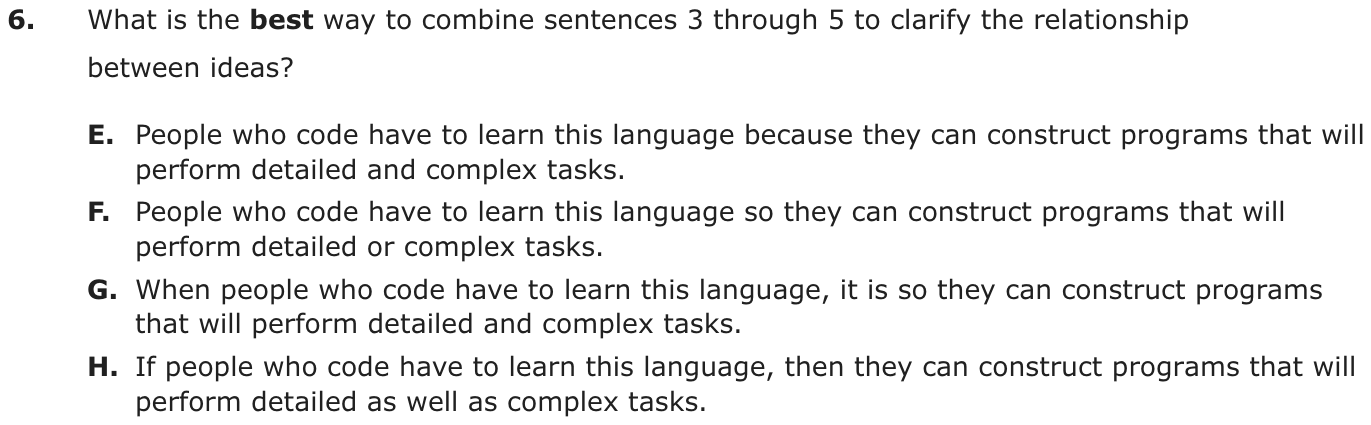
(1) Computer code is part of every electronic interaction, from video games to home thermostats to vehicle GPS systems. (2) Code is a language that computers can interpret, and programmers use it to instruct computers to perform different tasks, such as finding, sorting, or calculating data. (3) People who code have to learn this language. (4) They can construct programs that will perform detailed tasks. (5) The programs can also perform complex tasks.
(6) A coding language uses letters, numbers, and symbols that are arranged in a way that makes sense to a computer. (7) The code that makes up a program tells a computer how to process information. (8) Studying a coding language involves learning the rules for combining phrases and instructions so that they are recognizable to the computer. (9) Once a person understands coding rules, the possibilities for applying them are infinite.
(10) Coding skills are becoming important in many occupational fields. (11) For example, code can be used to create programs to track, analyze, and predict changes in the stock market. (12) Code can also be designed to help doctors track and monitor a patient’s health. (13) Jobs that require coding skills are typically higher paying, offering salaries that are up to as much as $22,000 a year more than jobs that do not require coding knowledge.
(14) People have a variety of opportunities to learn how to code. (15) In some schools, young people can study computer science and coding just as they study foreign languages. (16) Computer science teachers can use websites and apps that employ games designed to help everyone understand how code works. (17) Even high school students who do not take computer science can learn coding by attending coding workshops and online classes or by watching tutorials online. (18) After studying the basics of coding, some students may become interested in learning how to create programs, such as games and apps.
(19) The late Steve Jobs, a pioneer in computer technology, once said, “Everybody in this country should learn how to program a computer . . . because it teaches you how to think.” (20) Learning to code can seem challenging, but one does not need to become an expert programmer to reap the benefits of understanding this language.
Question
What is the best way to combine sentences 3 through 5 to clarify the relationship between ideas?
- APeople who code have to learn this language because they can construct programs that will perform detailed and complex tasks.
- BPeople who code have to learn this language so they can construct programs that will perform detailed or complex tasks.
- CWhen people who code have to learn this language, it is so they can construct programs that will perform detailed and complex tasks.
- DIf people who code have to learn this language, then they can construct programs that will perform detailed as well as complex tasks.
Show the answer
Correct answer: B
The question asks for the best way to combine sentences 3 through 5 to clarify the relationship between ideas.
A. Incorrect. While this sentence shows a relationship between the ideas, it does not clarify the relationship accurately. Learning the language of code does not depend on people’s previous ability to construct programs that will perform detailed and complex tasks. The word “because” incorrectly indicates that people can already construct complex programs prior to learning the coding language that would allow them to do so.
B. CORRECT. This sentence accurately shows the relationship between the ideas of the sentences. Before people can construct programs that will perform detailed and complex tasks, they have to learn a coding language. Knowing that language will, in turn, allow them to build programs that can perform detailed and complex tasks.
C. Incorrect. This sentence does not accurately express the relationship between ideas because the sentence implies that some people who code do not have to learn the language to perform their job functions. The passage clearly states that “computer code is part of every electronic interaction” (sentence 1) and that “programmers use it to instruct computers to perform different tasks” (sentence 2).
D. Incorrect. The conditional (If . . . then) construction of the sentence in Option D does not convey the intended relationship of the ideas in the sentences. The “then” statement (“they can construct programs that will perform detailed as well as complex tasks”) does not follow the condition of the “if” statement (“people who code have to learn this language”).
Question analysis
This sentence-combining question uses the first paragraph of “Cracking the Code,” a passage about computer coding, and asks for the best way to join sentences 3 through 5: coders must learn the language, they can build programs for detailed tasks, and those programs can also handle complex ones. Each version links the ideas with a different word, so students must judge which states the relationship accurately.
- Grade level
- Grade 7 reading and task
- Compared with grade 7
- At grade 7 Joining short sentences with a word that shows how their ideas relate is typical grade 7 work. Here three sentences become one and every version is grammatical, so the choice rests on whether the joining words state the logic accurately.
- Estimated difficulty
- Moderate: several steps, or a close reading with one strong distractor.
- Thinking it demands
- Depth of knowledge 2, skills and concepts · mainly evaluate
- What makes it hard
- A very close wrong answer moderate
- How sentences fit together moderate
- Every choice must be checked minor
- Evidence
- Answered from one paragraph or stanza
- Reading level
- Passage: about grade 10, 357 words; question and choices: about grade 9, 101 words.
- Students, last 30 days
- Not enough answers yet to show (it takes 10).
Why it is hard, traps and wrong answers (shows the answer)
Why it is hard
Every version is a correct sentence carrying the same facts, so the question tests logic rather than grammar: what does learning the language make possible? The look-alike joined by “because” is the main danger, since it seems to give a reason for learning. Careful readers may also pause over the key’s “detailed or complex tasks,” looser than sentence 5’s “also,” but the joining word, not that slip, is what separates the best sentence from the rest.
A very close wrong answer moderate Choosing the answer
The version joined by “because” matches the key word for word except for its linking word and “and” in place of “or,” so the decision rests on which way the link between learning and building runs. (Embretson & Wetzel, 1987; Gorin & Embretson, 2006; Ascalon et al., 2007)
How sentences fit together moderate Working it out
Sentence 3 states a requirement and sentences 4 and 5 state what meeting it allows, so the combined sentence must present learning the language as the means and building programs as the purpose. (Halliday & Hasan, 1976)
Every choice must be checked minor Choosing the answer
All four versions are grammatical and keep the same facts; only the opening or joining words change, “because,” “so,” “When … it is so” and “If … then,” and each must be weighed. (Embretson & Wetzel, 1987)
Strategy: Before reading the choices, decide in your own words how sentence 3 relates to sentences 4 and 5, then check whether each version’s opening or joining word signals that same relationship.
Traps
- Wrong transition: A connecting word or phrase that signals the wrong relationship, such as contrast where the idea continues.
- Wordy, vague or informal: A revision is grammatical but wordy, imprecise or too casual for the passage.
The wrong answers, classified
A Wrong transition (Halliday & Hasan, 1976)
Hears “because” as giving the reason to learn the language, but it treats the ability to build detailed and complex programs as already there, when that ability comes from learning.
C Wordy, vague or informal (Connors & Lunsford, 1988)
Is drawn by the formal ring of “When … it is so,” which buries the purpose in a clumsy frame and suggests coders must learn the language only on some occasions.
D Wrong transition (Halliday & Hasan, 1976)
Keeps learning before building but frames it with “If … then,” turning a stated requirement into a mere possibility, though having to learn a language does not by itself let anyone build programs.
Working it out, step by step
Figure out what the question asks
This asks you to join three short sentences into one. The new sentence must show how the ideas connect. All four choices are correct sentences with the same facts. What changes is the joining word. So first decide how the ideas connect. Then find the joining word that says so.
Read sentences 3 through 5
Sentence 3 says “People who code have to learn this language.” Sentence 4 says “They can construct programs that will perform detailed tasks.” Sentence 5 adds “The programs can also perform complex tasks.” To construct is to build. Detailed tasks have many small parts. Complex tasks are complicated and hard to do.
Name the link between the ideas
Why do coders have to learn the language? So that they can build programs. Learning comes first. Building programs is the goal it makes possible. A word that shows a goal, or purpose, is “so” (short for “so that”). Example: I practice piano so I can play in the concert. The practice comes first, and the concert is the goal.
Check each choice
- A does not fit. “Because” gives a reason that is already true. It says coders learn the language because they can already build programs. That gets the order backward.
- B fits. “So” shows that building programs is the goal of learning the language. It says “detailed or complex tasks” where sentence 5 means both, a small slip. But its joining word is right.
- C does not fit. “When” suggests coders only sometimes have to learn the language. And “it is so” is wordy.
- D does not fit. “If” makes learning sound like a maybe. The passage says coders “have to learn” it. That is a must.
Choose the answer
Watch out: A is the most tempting. It matches B almost word for word, and “because” sounds like a reason to learn. But it points the wrong way. B shows that learning leads to building. So the answer is B.
Why this answer and not the closest wrong one
A is the closest wrong answer. It uses the same words as B except for the joining word. “Because” makes building programs the reason coders learn the language, as if they could already do it. “So” makes building programs the goal that learning leads to. Learning comes first, so B shows the link correctly.
More questions like this
The original DOE question
The passage “Cracking the Code” as printed (page 40)
Question 2 of 3
2022 Test A English, question 8Uses the passage above: “Cracking the Code”.
Question
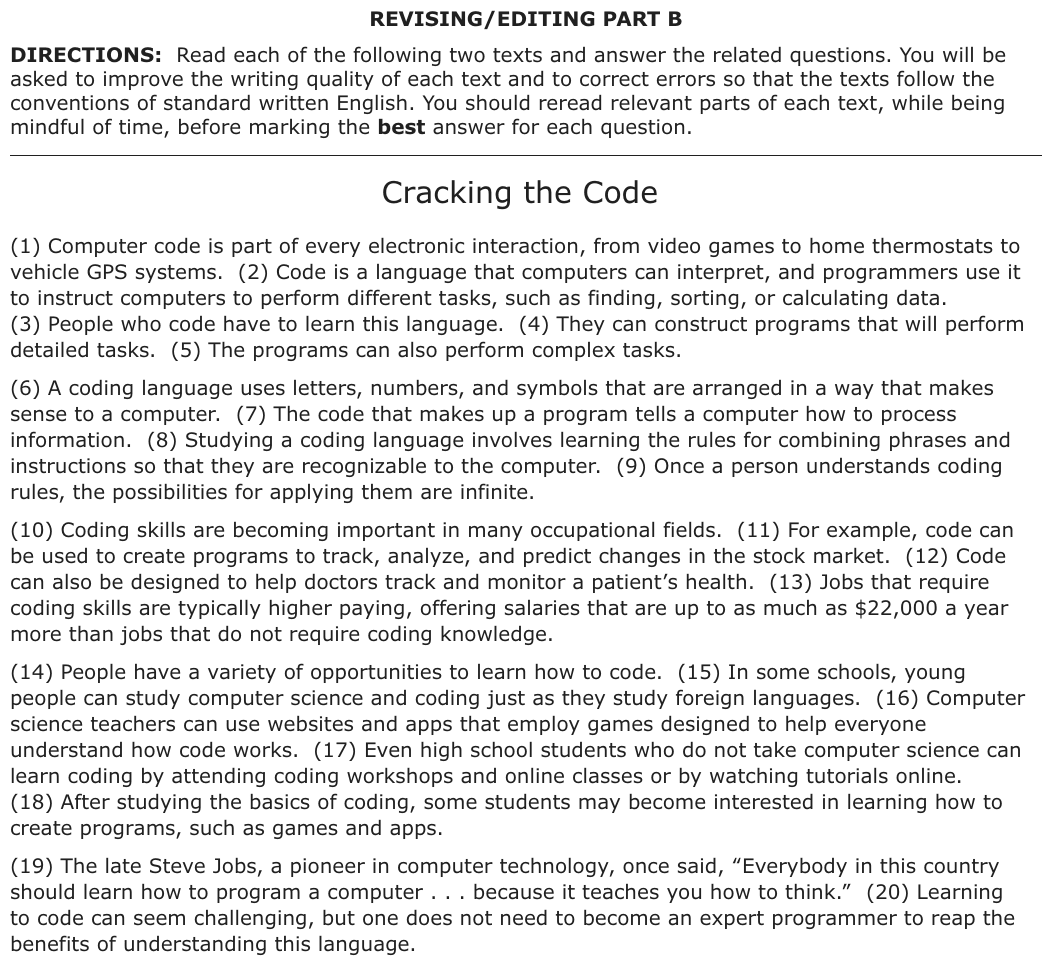
Which revision of sentence 10 provides the best transition to the argument in the third paragraph (sentences 10–13)?
- ALearning a coding language may be difficult, but coding skills are becoming important in many occupational fields.
- BLearning a coding language is useful because coding skills are becoming important in many occupational fields.
- CEmployers in most industries realize that people with coding skills can demand higher salaries in many occupational fields.
- DEven though programming is its own unique field, coding skills are becoming important in many occupational fields.
Show the answer
Correct answer: B
The question asks for the best revision of sentence 10 to provide a transition to the argument in the third paragraph.
A. Incorrect. Some readers may choose this option because the second paragraph does discuss the complexities of coding; however, it does not discuss the difficulties of learning coding. The third paragraph demonstrates some of the complex ways coding is used in specific fields but does not illustrate how difficult learning coding may be.
B. CORRECT. This sentence provides the best revision of the transition sentence. The second paragraph ends with “the possibilities for applying them are infinite” (sentence 9), which supports the idea that people in “many occupational fields” (sentence 10) can benefit from having coding skills. The third paragraph illustrates this idea by providing specific examples of occupations that benefit from coding (stock market traders and doctors).
C. Incorrect. While sentence 13 suggests that employers recognize the value of coding skills, sentences 11 and 12 give examples of different industries that employ people who know how to code. The transition sentence should introduce the idea that coding skills are valuable to potential employees.
D. Incorrect. Some readers may choose this option because the second paragraph provides a brief definition of coding—“A coding language uses letters, numbers, and symbols that are arranged in a way that makes sense to a computer” (sentence 6)—which shows how this element of programming works, but the second paragraph does not specifically discuss what makes the field of computer programming unique. The third paragraph discusses how coding can be used in a variety of occupational fields (sentence 10).
Question analysis
This transitions question asks which revision of sentence 10, the opening sentence of the third paragraph of “Cracking the Code,” would best lead into that paragraph’s argument. Students must link the second paragraph, on how coding languages work, to the third, on coding in fields such as stock trading and medicine, and judge four versions that each begin differently.
- NYS standards
- 7W1d transitions in arguments
- Grade level
- Grade 7 reading and task
- Compared with grade 7
- At grade 7 Grade 7 transition questions often ask for one connecting word. This one asks for a whole topic sentence, so students must sum up two paragraphs and see how they connect, though the passage’s plain language keeps it within typical grade 7 work.
- Estimated difficulty
- Moderate: several steps, or a close reading with one strong distractor.
- Thinking it demands
- Depth of knowledge 2, skills and concepts · mainly evaluate
- What makes it hard
- How sentences fit together moderate
- A very close wrong answer moderate
- Evidence
- Answered from several paragraphs or stanzas
- Reading level
- Passage: about grade 10, 357 words; question and choices: about grade 13, 84 words.
- Students, last 30 days
- Not enough answers yet to show (it takes 10).
Why it is hard, traps and wrong answers (shows the answer)
Why it is hard
Three of the four versions end with the original sentence 10, so the choice lies entirely in the opening words and the link they claim. A concession about difficulty sounds like a natural essay move, and sentence 20 even calls coding challenging, but nothing in paragraphs 2 or 3 sets difficulty against importance. Students who first name the real link between the paragraphs, that coding knowledge is worth having because many fields need it, can test each opening against that.
How sentences fit together moderate Working it out
The new opening must look back to paragraph 2, which ends on the “infinite” possibilities of knowing coding rules, and ahead to the stock-market and medical examples, so two paragraphs have to be tracked at once. (Halliday & Hasan, 1976)
A very close wrong answer moderate Choosing the answer
The concession version shares the key’s first words, “Learning a coding language,” and its whole closing clause; only the middle differs, “may be difficult, but” against “is useful because.” (Embretson & Wetzel, 1987; Gorin & Embretson, 2006; Ascalon et al., 2007)
Strategy: Sum up paragraph 2 and paragraph 3 in a few words each, then test every version of sentence 10 against both summaries, paying close attention to what its opening words claim.
Traps
- Wrong transition: A connecting word or phrase that signals the wrong relationship, such as contrast where the idea continues.
- Off the point: Adds or keeps something that does not support the paragraph's or the passage's focus, or an introduction or conclusion that misses the main point.
The wrong answers, classified
A Wrong transition (Halliday & Hasan, 1976)
Borrows sentence 20’s point that coding “can seem challenging” and sets it against importance with “but,” though neither paragraph 2 nor paragraph 3 raises difficulty, so the contrast connects nothing.
C Too narrow (King et al., 2004)
Picks up sentence 13’s higher salaries and speaks for employers, so the opening covers only the paragraph’s last point and gives no link back to paragraph 2 on coding languages.
D Off the point (Halliday & Hasan, 1976)
Takes paragraph 2’s technical account of code as proof that programming is “its own unique field,” an idea the passage never develops, and sets it against wider use with “Even though.”
Working it out, step by step
Figure out what the question asks
This asks for the best transition. A transition links one part of a piece of writing to the next, like a bridge. Sentence 10 opens the third paragraph. A good opening looks back at paragraph 2 and points ahead to paragraph 3. So first sum up both paragraphs.
Sum up paragraphs 2 and 3
Paragraph 2 explains that learning a coding language means learning its rules. It ends with sentence 9: “Once a person understands coding rules, the possibilities for applying them are infinite.” Infinite means without end. Paragraph 3 then gives examples of uses: tracking the stock market and helping doctors watch a patient’s health. Sentence 13 adds that coding jobs usually pay more.
Name the link between them
Paragraph 2 is about learning the language. Paragraph 3 shows why that learning pays off: many kinds of jobs use it. So the bridge should say that learning a coding language is worth it, because so many jobs need coding. “Occupational fields” are types of jobs.
Check each choice
- A does not fit. “May be difficult, but” sets up a contrast about how hard coding is. Neither paragraph talks about that.
- B fits. “Learning a coding language” looks back at paragraph 2. “Because” gives the reason it is useful, and paragraph 3 then shows that reason with examples.
- C does not fit. It is only about higher salaries, the last point in paragraph 3. It doesn’t link back to paragraph 2.
- D does not fit. The passage never says programming is “its own unique field.” That contrast connects to nothing.
Choose the answer
Watch out: A starts with the same words as B. Admitting that something is hard also sounds like a good essay move. Sentence 20 even says coding “can seem challenging.” But that comes at the very end, and paragraphs 2 and 3 never mention it. So the answer is B.
Why this answer and not the closest wrong one
A is the closest wrong answer. It shares B’s first words and its whole ending. Only the middle is different. A sets difficulty against importance, but neither paragraph is about difficulty. B tells why learning the language from paragraph 2 matters. Then paragraph 3 backs that up with examples of jobs.
More questions like this
The original DOE question
Question 3 of 3
2018 Test B English, question 8Passage The Local Library
The Local Library
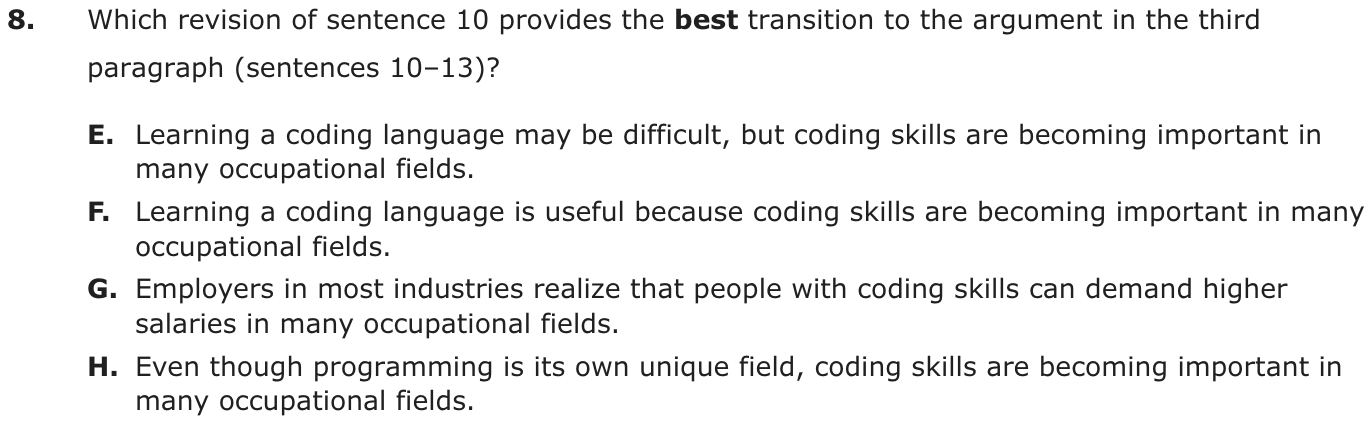
(1) According to a 2015 survey, more than two-thirds of Americans own a smartphone, which means that obtaining information or communicating with people is easier than ever before. (2) With the swipe of a finger, the tap of an icon, or a verbal command, people have instant access to articles, blogs, news, and social networking websites. (3) Even with all these immediately available sources of information, one of the best resources for many members of the community also happens to be one of the oldest. (4) The public library is a great place for people to get information.
(5) The public library serves a truly critical role in promoting community. (6) With the explosion of digital media in recent years, people in different locations can now communicate almost instantaneously. (7) And yet many people complain of feeling more isolated and alone than ever before. (8) The library stands in a rare position to help community members meet this universal need for human connection and companionship.
(9) Furthermore, libraries provide certain amenities, such as access to the Internet, for free to all people. (10) A student who does not have a computer at home can research and type a paper for school. (11) Similarly, an unemployed adult without access to the Internet can make use of library resources to find job opportunities. (12) The free items that are found at the library can help people get a lot done.
(13) Public libraries also offer a variety of resources to community members. (14) One important resource is the local librarian, who does far more than check out books and collect fines. (15) Other library resources include free or low-cost tutoring and training programs. (16) Additionally, lectures, book groups, and town meetings promote critical thinking and community engagement. (17) A typical librarian holds a master’s degree and can help library patrons navigate through the flood of information available in print and on the Internet.
(18) The hallmark of a public library is that its materials and services are accessible to all. (19) The library connects people to a network of information and resources and is an important part of a community.
Question
Where should sentence 17 be moved in order to improve the organization of the fourth paragraph (sentences 13–17)?
- Ato the beginning of the paragraph (before sentence 13)
- Bbetween sentences 13 and 14
- Cbetween sentences 14 and 15
- Dbetween sentences 15 and 16
Show the answer
Correct answer: C
The question asks where sentence 17 should be moved in order to improve the organization of the fourth paragraph. Sentence 17 describes a typical librarian and the assistance he or she provides in the library.
Option C correctly places sentence 17, an example of what else the librarian does, after the librarian is introduced in sentence 14.
Option A is incorrect because it places the sentence before the main idea of the paragraph, which states that public libraries offer a variety of resources. Sentence 17 is an example of one of the resources, so it would not be placed at the beginning of the paragraph before the main idea.
Option B is incorrect because it moves the sentence to before the librarian is introduced in the paragraph.
Option D is incorrect because sentences 15 and 16 have shifted away from the topic of the librarian, so the details in sentence 17 would not logically fit between them.
Question analysis
This organization question asks where a sentence about librarians’ training and skills belongs in the library essay’s paragraph on resources. Students read sentences 13 through 17 and look for the most logical spot for the detail. Several positions can seem reasonable at first, so the paragraph’s order of ideas has to be traced carefully.
- Grade level
- Grade 7 reading and task
- Compared with grade 7
- At grade 7 Ordering sentences so each detail follows the idea it explains is regular grade 7 revision work. This paragraph is only five sentences long and its topic shifts are easy to track, so it matches typical classroom practice.
- Estimated difficulty
- Straightforward: two steps or one careful reading.
- Thinking it demands
- Depth of knowledge 2, skills and concepts · mainly analyze
- What makes it hard
- How sentences fit together moderate
- A very close wrong answer minor
- Evidence
- Answered from one paragraph or stanza
- Reading level
- Passage: about grade 11, 341 words; question and choices: about grade 7, 33 words.
- Students, last 30 days
- Not enough answers yet to show (it takes 10).
Why it is hard, traps and wrong answers (shows the answer)
Why it is hard
This is a short paragraph with clear signals, so the work is in reading them: “One important resource” in sentence 14 introduces the librarian, and “Other library resources” in sentence 15 marks the move away. Students who notice only that sentence 17 is about librarians can put it on the wrong side of sentence 14. The question rewards tracing how each sentence hands off to the next.
How sentences fit together moderate Working it out
Sentence 17 begins “A typical librarian,” which makes sense right after sentence 14 names “the local librarian” as a resource and before sentence 15 turns away with “Other library resources.” (Halliday & Hasan, 1976)
A very close wrong answer minor Choosing the answer
“Between sentences 13 and 14” and “between sentences 14 and 15” both keep the detail beside the librarian sentence; the only difference is whether it comes before or after sentence 14 introduces the librarian. (Embretson & Wetzel, 1987; Gorin & Embretson, 2006; Ascalon et al., 2007)
Strategy: Identify what sentence 17 describes, then find the sentence it adds to most directly and check that the move keeps the paragraph’s ideas in a logical order.
The wrong answers, classified
A Sentence in the wrong place (Halliday & Hasan, 1976)
Treats “A typical librarian holds a master’s degree” as a general opener, though it would then come before sentence 13’s topic sentence about the library’s resources.
B Sentence in the wrong place (Halliday & Hasan, 1976)
Rightly keeps the detail beside the librarian sentence but puts it first, so readers learn the librarian’s degree before sentence 14 has introduced the librarian at all.
D Sentence in the wrong place (Halliday & Hasan, 1976)
Links the librarian’s degree to the “training programs” of sentence 15, though by then the paragraph has left librarians for tutoring and lectures.
Working it out, step by step
Figure out what the question asks
This is an organization question. You must decide where sentence 17 makes the most sense in paragraph 4, so the ideas come in a clear order.
Read sentence 17
Sentence 17 says: “A typical librarian holds a master’s degree and can help library patrons navigate through the flood of information available in print and on the Internet.” Patrons are the people who use the library. To navigate means to find your way. So the sentence is all about librarians.
Find the sentence it belongs with
Sentence 14 is the first to bring up librarians: “One important resource is the local librarian, who does far more than check out books and collect fines.” Sentence 17 tells more about what librarians do. So it should come right after sentence 14.
Then sentence 15 starts “Other library resources,” which moves on to a new topic. All the librarian facts should come before that.
Check each choice
- A is wrong. Sentence 13 is the topic sentence, the one that tells what the paragraph is about. One detail can’t go before it.
- B is wrong. The paragraph would talk about “a typical librarian” before sentence 14 introduces the librarian.
- C is right. Sentence 17 comes right after the sentence that introduces the librarian.
- D is wrong. By sentence 15, the paragraph has moved on to tutoring and training programs.
Watch out: B also puts sentence 17 next to sentence 14, but on the wrong side of it.
Choose the answer
The new order is 13, 14, 17, 15, 16. The paragraph names its topic, explains the librarian, then moves to other resources. So the answer is C.
Why this answer and not the closest wrong one
B is the closest wrong answer, since it also keeps sentence 17 beside sentence 14. But in B, the reader hears about “a typical librarian” before learning that librarians are a resource. In C, sentence 14 introduces “the local librarian,” and sentence 17 then adds details. That is the logical order.
More questions like this
The original DOE question

The passage “The Local Library” as printed (page 120)