Question
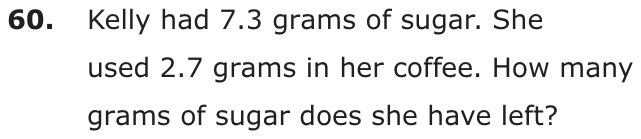
Kelly had 7.3 grams of sugar. She used 2.7 grams in her coffee. How many grams of sugar does she have left?
Grid-in question: work out the answer and enter it as a number.
Show the answer
Correct answer: 4.6
Subtract the number of grams of sugar Kelly used in her coffee from the original amount she had.
Question analysis
Kelly has 7.3 grams of sugar and uses 2.7 grams of it in her coffee. This short grid-in word problem asks how many grams she has left. It tests subtracting decimals, and because the tenths digit being taken away is the larger one, the subtraction needs regrouping.
- NYS standards
- 6.NS.3 multi-digit decimal operations
- Grade level
- Grade 6 content, by NYS standard
- Compared with grade 7
- Below grade 7 Subtracting decimals is grade 6 fluency work, and this needs one subtraction in a short, familiar setting. Grade 7 problems usually bring in negative numbers or several steps; the only care here is regrouping in the tenths.
- Estimated difficulty
- Routine: one familiar step, little to misread.
- Thinking it demands
- Depth of knowledge 2, skills and concepts · mainly apply
- What makes it hard
- Solution
- 1 step
- Reading level
- Question and choices: about grade 2, 20 words.
- Students, last 30 days
- Not enough answers yet to show (it takes 10).
Why it is hard, traps and wrong answers (shows the answer)
Why it is hard
One subtraction in a two-sentence story, so the only real risk is the regrouping in the tenths column. Students who skip the borrow, or who borrow and forget to reduce the ones, still produce a tidy decimal, and nothing on the page flags it. Adding the result back to the 2.7 grams used should return the 7.3 grams Kelly started with.
Error-prone arithmetic minor Working it out
The 7 tenths being taken away is more than the 3 tenths in 7.3, so one of the 7 wholes must be regrouped as ten tenths before 13 − 7 = 6. (Brown & Burton, 1978; Junker & Sijtsma, 2001)
An answer in an unexpected form minor Choosing the answer
The difference is gridded with no choices to compare, so a regrouping slip that gives 5.4 or 5.6 looks just as finished as the right amount. (Enright, Morley & Sheehan, 2002)
Strategy: Line up the decimal points and subtract the grams used from the grams Kelly started with, regrouping one whole as ten tenths when the tenths column needs it.
Traps
- A faulty procedure: A systematic but wrong procedure: adding fractions straight across, applying an exponent to each term of a sum, dropping a sign when moving a term.
- An arithmetic slip: The right method with a plausible arithmetic error: a digit, a place value or a times-table fact.
- Wrong operation: Adds instead of multiplying, divides the wrong way round, turns a ratio or rate upside down, or undoes a step in the wrong direction (subtracts what should be added back).
The wrong answers, classified
5.4 A faulty procedure (Brown & Burton, 1978; Tatsuoka, 1983)
Subtracts the smaller digit from the larger in each column, 7 − 3 = 4 tenths and 7 − 2 = 5 ones, instead of regrouping a whole as ten tenths.
5.6 An arithmetic slip (Junker & Sijtsma, 2001)
Regroups to get 13 − 7 = 6 tenths but forgets to reduce the ones after borrowing, so the ones digit stays 7 − 2 = 5.
10 Wrong operation (Hegarty, Mayer & Monk, 1995; King et al., 2004)
Adds the two amounts, 7.3 + 2.7 = 10, instead of taking the sugar used in the coffee away from the 7.3 grams Kelly had.
Worked solution, step by step
Formulas used
- Amount left
- Start is the amount you had at first. Used is the amount taken away. Left is what remains. Taking part of an amount away is subtraction, so you subtract the amount used from the start.
Sort out the question
Kelly started with 7.3 grams of sugar. She used 2.7 grams in her coffee. You need the grams she has left.
Left means what remains after some is taken away. So subtract the amount used from the amount she started with.
Regroup to subtract the tenths
Line up the decimal points, so tenths sit over tenths. A tenth is one of ten equal parts of a whole. Start with the tenths. You can’t take 7 tenths from 3 tenths. So break 1 of the 7 wholes into 10 tenths. Now you have 6 wholes and 13 tenths.
That leaves 6 tenths.
Watch out: taking the smaller digit from the bigger one, 7 − 3, skips the regrouping. It gives 5.4, which is wrong.
Subtract the whole grams
After regrouping, the wholes column has 6, not 7.
That leaves 4 wholes. Put the decimal point back: 4 wholes and 6 tenths is 4.6 grams.
Watch out: forgetting to change the 7 to a 6 gives 5.6. Adding instead of subtracting gives 10. So you would grid 4.6.
Check your answer
Add back the sugar she used: . That is the amount Kelly started with, so 4.6 grams is right. An estimate agrees too: about 7 − 3 = 4 grams.
More questions like this
The original DOE question