Question
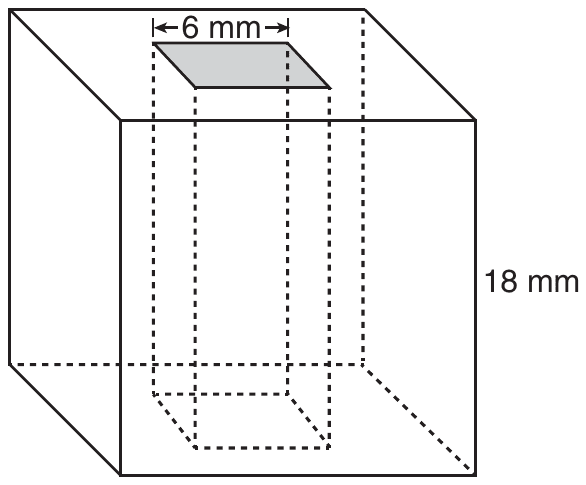
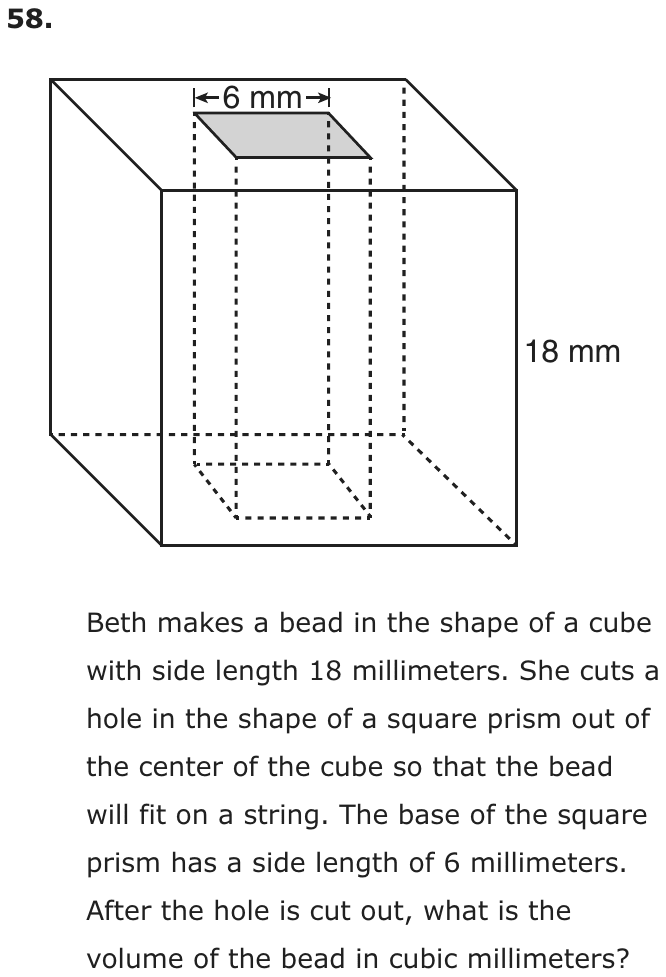
Beth makes a bead in the shape of a cube with side length 18 millimeters. She cuts a hole in the shape of a square prism out of the center of the cube so that the bead will fit on a string. The base of the square prism has a side length of 6 millimeters. After the hole is cut out, what is the volume of the bead in cubic millimeters?
Grid-in question: work out the answer and enter it as a number.
Show the answer
Correct answer: 5184
First, find the volume of the cube using the formula .
The length, width, and height of the cube are equal (18 mm).
Next, find the volume of the cut-out square prism, with equal length and width (6 mm), and height of 18 mm.
Finally, subtract the volume of the prism from the volume of the cube.
Question analysis
Beth makes a bead from a cube 18 millimeters on each side and cuts a square prism-shaped hole, 6 millimeters across, through its center for a string. Students find the volume of the bead that is left, in cubic millimeters. It tests the volume of rectangular prisms, and the hole's height is not given in words, so it has to be read from the figure.
- Grade level
- Grade 7 content, by NYS standard
- Compared with grade 7
- At grade 7 Finding the volume of a solid made by removing one rectangular prism from another is grade 7 work. This case is direct, but the hole's height is not stated in words, and cubing 18 by hand is heavier arithmetic, typed with no choices.
- Estimated difficulty
- Moderate: several steps, or a close reading with one strong distractor.
- Thinking it demands
- Depth of knowledge 2, skills and concepts · mainly apply
- What makes it hard
- Solution
- 3 steps
- Reading level
- Question and choices: about grade 6, 69 words.
- Students, last 30 days
- Not enough answers yet to show (it takes 10).
Why it is hard, traps and wrong answers (shows the answer)
Why it is hard
The method is short, cube minus hole, but the hole’s height is never stated and has to be read from the drawing. Students who picture the hole as a 6 mm cube take away only 216 cubic millimeters, and those who stop at either volume grid a number that looks finished. Seeing the hole as a square shaft, 6 by 6 by 18, and checking that the bead holds less than the cube catches all three slips.
Reading a figure, table or graph moderate Understanding the question
The stem gives only the 6 mm side of the hole’s square base; that the hole runs the full 18 mm, from the top face to the bottom, shows only in the figure’s dashed edges. (Lesh, Post & Behr, 1987; Kirsch & Mosenthal, 1990)
Something you must already know minor Working it out
Neither volume formula is given: the cube needs edge × edge × edge, and the square hole needs its 36 square millimeter base times its 18 mm length. (Anderson & Krathwohl, 2001)
Error-prone arithmetic minor Working it out
Cubing 18 by hand, 324 × 18 = 5,832, and then 6 × 6 × 18 = 648 are multi-digit products, and a carrying slip in either changes the final difference. (Brown & Burton, 1978; Junker & Sijtsma, 2001)
An answer in an unexpected form minor Choosing the answer
The volume is gridded with no choices to compare, so entering the hole’s 648 or the whole cube’s 5,832 brings no warning that a step is missing. (Enright, Morley & Sheehan, 2002)
Strategy: Find the volume of the whole cube, then the volume of the square hole, which runs from the top face to the bottom face, and subtract the hole from the cube.
Traps
- Answers a different question: A choice is right for another quantity: the other unknown, the rest instead of the part, the part instead of the whole.
- Misreads the figure: Reads a value, label or tick spacing in a figure, table or graph wrongly.
- Stops one step early: A choice is a number from partway through the solution.
The wrong answers, classified
648 Answers a different question (King et al., 2004; Hegarty, Mayer & Monk, 1995)
Finds the volume of the hole, 6 × 6 × 18 = 648 cubic millimeters, and enters the material removed instead of the bead that is left.
5616 Misreads the figure (Lesh, Post & Behr, 1987; Kirsch & Mosenthal, 1990)
Takes the hole to be a 6 mm cube, 6 × 6 × 6 = 216, though the figure shows it running the full 18 mm, so 5,832 − 216 = 5,616.
5832 Stops one step early (King et al., 2004; Gierl et al., 2017)
Finds the volume of the whole cube, 18 × 18 × 18 = 5,832 cubic millimeters, and stops before taking away the hole cut through its center.
Worked solution, step by step
Formulas used
- Volume of a rectangular prism
- V is the volume, the space inside a solid, in cubic units. l is the length, w is the width and h is the height. A cube is a prism whose length, width and height are all equal. Multiplying counts the unit cubes that fill the box, layer by layer.
Sort out the question
The bead starts as a cube, a box whose edges are all 18 millimeters long. A hole is cut through its middle. The hole is a square prism, a box with a square base. Each side of that square is 6 millimeters.
You need the volume of the bead that is left, in cubic millimeters. Volume is the space a solid takes up.
Read the hole’s height from the figure
The words don’t say how tall the hole is. Look at the figure. The gray square sits on the top face. Its dashed edges run all the way down to the bottom face.
So the hole is as tall as the cube, 18 millimeters. The hole measures 6 by 6 by 18 millimeters.
Find the volume of the cube
Use the volume formula. All three measures of the cube are 18.
Work it in two parts: , then . The whole cube is 5,832 cubic millimeters.
Find the volume of the hole
Use the same formula for the hole: 6 by 6 by 18.
The hole is 648 cubic millimeters.
Watch out: the hole is not a small 6 mm cube. Using would give 5,616, which is wrong.
Subtract the hole from the cube
The bead is the cube with the hole taken out. So subtract.
The bead’s volume is 5,184 cubic millimeters.
Watch out: 648 is the part cut out, and 5,832 is the cube before the cut. Neither one is the bead. So you would grid 5184.
Check your answer
Picture the cube cut into tall columns, each the size of the hole. It is 3 columns wide and 3 deep, so it holds columns. The hole takes 1, leaving 8. And . It matches.
More questions like this
The original DOE question