Question
Based on the circle graph, how many pounds of milk and eggs does the average American consume each year?
- A300
- B368
- C460
- D552
Show the answer
Correct answer: D
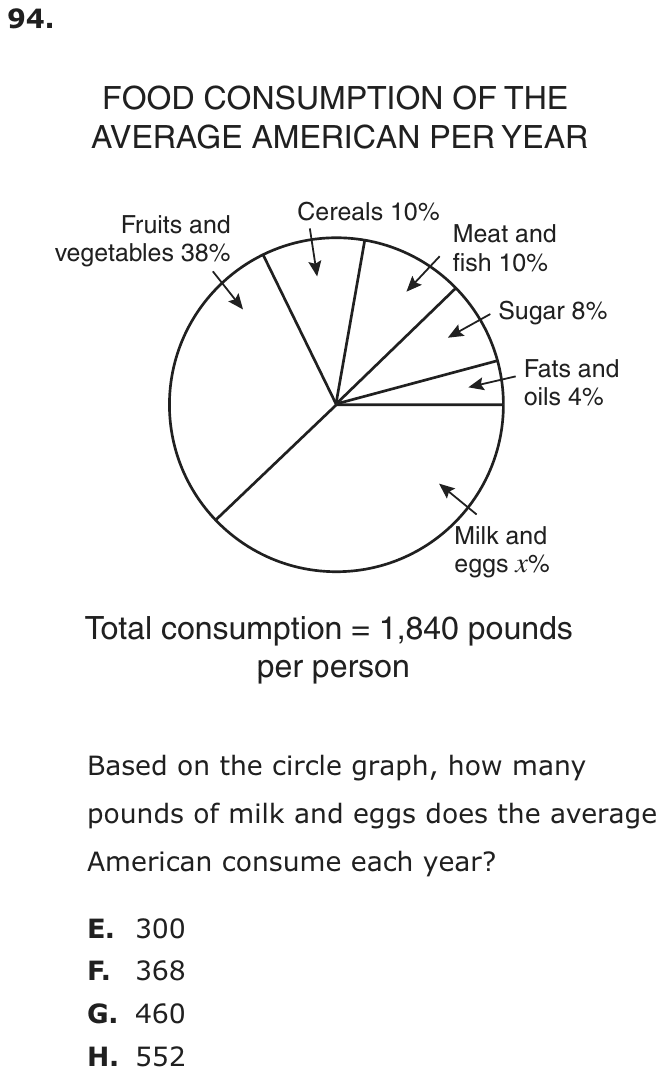
First, determine the missing percentage for “milk and eggs” consumed, based on the circle graph.
Then, determine 30% of 1,840 pounds. Multiply:
Question analysis
A circle graph shows how the 1,840 pounds of food the average American eats in a year divide among six groups, with the percent for milk and eggs left as x. Students find how many pounds of milk and eggs that is. They first work out the missing percent, then take that percent of the total.
- Grade level
- Grade 6 content, by NYS standard
- Compared with grade 7
- Below grade 7 Reading a circle graph and finding a percent of a total are grade 6 skills. Finding the missing sector from 100% adds one easy step, so this is shorter and simpler than typical grade 7 multistep percent problems.
- Estimated difficulty
- Straightforward: two steps or one careful reading.
- Thinking it demands
- Depth of knowledge 2, skills and concepts · mainly apply
- What makes it hard
- Reading a figure, table or graph moderate
- Error-prone arithmetic minor
- Solution
- 2 steps
- Reading level
- Question and choices: about grade 9, 19 words.
- Students, last 30 days
- Not enough answers yet to show (it takes 10).
Why it is hard, traps and wrong answers (shows the answer)
Why it is hard
Two short steps decide the question: find the missing percent from the other five, then take that percent of 1,840 pounds. The drawing does not help, since the milk-and-eggs sector is drawn larger than the 38% sector beside it, so the share must come from the labels. Students who find the 30 and then pick the choice whose digits match it skip the second step.
Reading a figure, table or graph moderate Understanding the question
Milk and eggs is labeled only x%, so its share comes from the five labeled sectors, 100 − 70 = 30, and the 1,840-pound total sits in a caption below the circle. (Lesh, Post & Behr, 1987; Kirsch & Mosenthal, 1990)
Error-prone arithmetic minor Working it out
Taking 30% of 1,840 by hand, 0.3 × 1,840 = 552, means a decimal times a four-digit number, best done as 184 × 3. (Brown & Burton, 1978; Junker & Sijtsma, 2001)
Strategy: Subtract the five labeled percents from 100% to find x, then multiply the 1,840-pound total by that percent written as a decimal.
Traps
- Stops one step early: A choice is a number from partway through the solution.
The wrong answers, classified
A Stops one step early (King et al., 2004; Gierl et al., 2017)
Finds the missing share, 30%, and stops; 300 is the choice whose digits match it, though 30% of 1,840 pounds is still to be taken.
B Little reason to choose it (Haladyna & Downing, 1993; Rodriguez, 2005)
No common working gives 368, which is 20% of 1,840; it would need a slip such as 80 for the labeled percents' sum, so it mostly draws guesses.
C Little reason to choose it (Haladyna & Downing, 1993; Rodriguez, 2005)
No common working gives 460, a quarter of 1,840; the sector is drawn larger than a quarter, so even judging by eye does not lead here.
Worked solution, step by step
Formulas used
- Parts of a circle graph
- A circle graph shows one whole split into parts. Each part, or section, shows its percent. The whole is 100%, so all the percents add up to 100. Use it to find a missing section.
- Percent of a number
- p is the percent. The whole is the full amount. The part is the piece that matches the percent. Percent means out of 100, so p% is p hundredths of the whole.
Sort out the question
The circle graph splits all the food an average American eats in a year into six sections. The total is 1,840 pounds per person. Five sections show a percent. Milk and eggs shows only x%. You need the pounds of milk and eggs. First find x. Then find x% of 1,840 pounds.
Trust the labels, not the drawing
This graph is not drawn to scale, though it does not say so. The milk and eggs section looks bigger than the fruits and vegetables section, which is labeled 38%. But you will see that milk and eggs is smaller. So don’t judge the size of any section by eye here. Work only from the printed numbers.
Find the missing percent
All six sections add to 100%. Put in the five labeled percents and x.
Milk and eggs is 30% of the total. That is less than 38%, though it is drawn bigger.
Find 30% of 1,840 pounds
Another way: 10% of 1,840 is 184. 30% is 3 times that, . Watch out: don’t stop at 30. Choice A, 300, only looks like 30. So the answer is D, 552 pounds.
Check your answer
Estimate. 30% is a bit less than one third. One third of 1,840 is about 613. So the answer should be a bit under 613, and 552 is. Also, , which is 30%. Choice C, 460, is only one quarter, 25%.
More questions like this
The original DOE question