Passage Cracking the Code
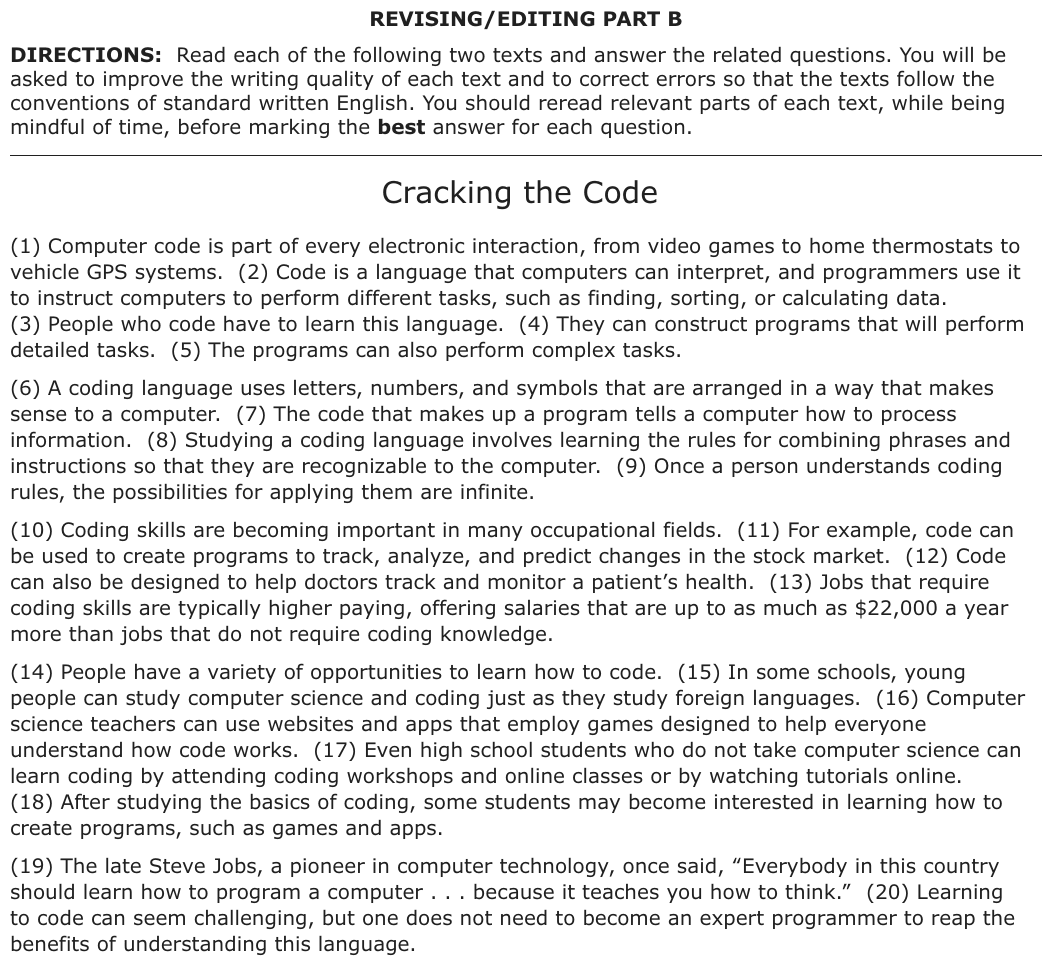
Cracking the Code
(1) Computer code is part of every electronic interaction, from video games to home thermostats to vehicle GPS systems. (2) Code is a language that computers can interpret, and programmers use it to instruct computers to perform different tasks, such as finding, sorting, or calculating data. (3) People who code have to learn this language. (4) They can construct programs that will perform detailed tasks. (5) The programs can also perform complex tasks.
(6) A coding language uses letters, numbers, and symbols that are arranged in a way that makes sense to a computer. (7) The code that makes up a program tells a computer how to process information. (8) Studying a coding language involves learning the rules for combining phrases and instructions so that they are recognizable to the computer. (9) Once a person understands coding rules, the possibilities for applying them are infinite.
(10) Coding skills are becoming important in many occupational fields. (11) For example, code can be used to create programs to track, analyze, and predict changes in the stock market. (12) Code can also be designed to help doctors track and monitor a patient’s health. (13) Jobs that require coding skills are typically higher paying, offering salaries that are up to as much as $22,000 a year more than jobs that do not require coding knowledge.
(14) People have a variety of opportunities to learn how to code. (15) In some schools, young people can study computer science and coding just as they study foreign languages. (16) Computer science teachers can use websites and apps that employ games designed to help everyone understand how code works. (17) Even high school students who do not take computer science can learn coding by attending coding workshops and online classes or by watching tutorials online. (18) After studying the basics of coding, some students may become interested in learning how to create programs, such as games and apps.
(19) The late Steve Jobs, a pioneer in computer technology, once said, “Everybody in this country should learn how to program a computer . . . because it teaches you how to think.” (20) Learning to code can seem challenging, but one does not need to become an expert programmer to reap the benefits of understanding this language.
Question
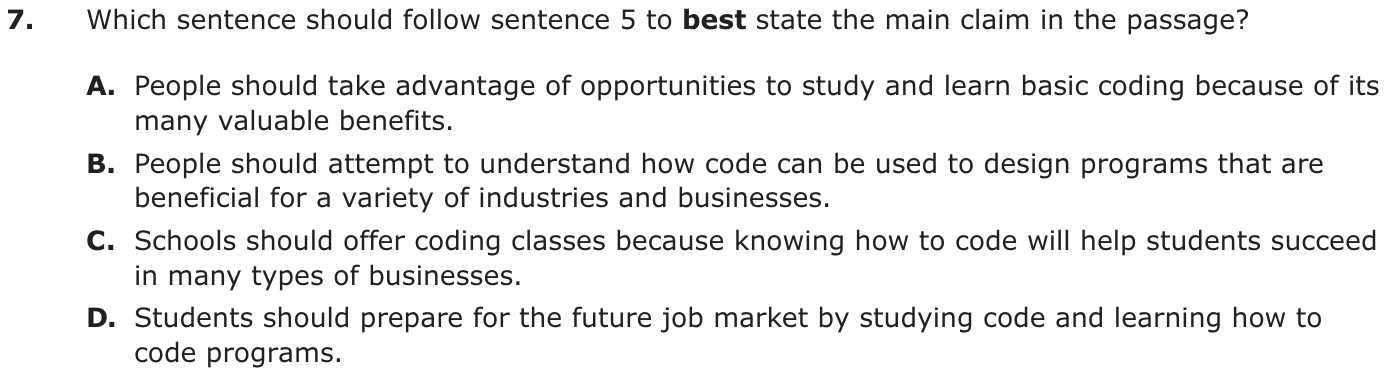
Which sentence should follow sentence 5 to best state the main claim in the passage?
- APeople should take advantage of opportunities to study and learn basic coding because of its many valuable benefits.
- BPeople should attempt to understand how code can be used to design programs that are beneficial for a variety of industries and businesses.
- CSchools should offer coding classes because knowing how to code will help students succeed in many types of businesses.
- DStudents should prepare for the future job market by studying code and learning how to code programs.
Show the answer
Correct answer: A
The question asks for the sentence that should follow sentence 5 to best state the main claim in the passage.
A. CORRECT. This sentence logically follows sentence 5 and introduces the main idea of the passage: that due to the high demand for coding skills across a wide range of industries and disciplines, learning basic coding skills can provide a range of opportunities for personal growth.
B. Incorrect. While this sentence incorporates a point made in the passage about how coding can benefit many occupational fields (sentence 10), this idea alone does not address the entire argument in the passage. This sentence does not capture the passage’s emphasis on the variety of ways people can learn how to code (sentence 14).
C. Incorrect. While this sentence incorporates ideas about opportunities to learn coding skills in school (fourth paragraph), the larger claim presented in the passage is not about opportunities schools should offer in order to help students learn to code. The passage primarily focuses on the opportunities offered to people who take on the challenge of learning to code.
D. Incorrect. Although the passage discusses the opportunities that are available to some students to learn coding skills in school (sentences 15–16), this point is a supporting detail of the passage, not the main claim of the passage.
Question analysis
This introduction question asks which sentence, added after sentence 5 of “Cracking the Code,” would best state the main claim of the passage. Students must work out what the whole argument is driving at, across paragraphs on what code is, how it is used at work and where people can learn it, and then choose among four sentences that each sound like a claim.
- NYS standards
- 7W1a introducing claims and counterclaims
- Grade level
- Grade 7 reading and task
- Compared with grade 7
- At grade 7 Introducing a precise claim is a core grade 7 argument skill. Students must find the claim behind all five paragraphs, since the first paragraph only explains what code is, and compare four sentences that each tell someone what to do.
- Estimated difficulty
- Straightforward: two steps or one careful reading.
- Thinking it demands
- Depth of knowledge 2, skills and concepts · mainly evaluate
- What makes it hard
- Evidence in several places moderate
- Every choice must be checked minor
- Evidence
- Answered from the whole text
- Reading level
- Passage: about grade 10, 357 words; question and choices: about grade 10, 91 words.
- Students, last 30 days
- Not enough answers yet to show (it takes 10).
Why it is hard, traps and wrong answers (shows the answer)
Why it is hard
The claim is clearest at the very end, where sentence 20 says anyone can benefit from understanding code without becoming an expert. Each wrong option grows out of one paragraph, the industries of paragraph 3 or the students and schools of paragraph 4, so it sounds supported but speaks to too few people or asks for the wrong action. The question rewards naming the whole argument before reading the options.
Evidence in several places moderate Working it out
The first paragraph only explains what code is, so the claim must be pieced together from later parts: coding’s value at work in paragraph 3, the ways to learn in paragraph 4 and sentence 20’s benefits for non-experts. (Kirsch & Mosenthal, 1990; Gorin & Embretson, 2006)
Every choice must be checked minor Choosing the answer
All four options are “should” statements built from real material in the passage, so each has to be checked for whom it addresses and what it asks them to do. (Embretson & Wetzel, 1987)
Strategy: Before reading the choices, note in a phrase what each paragraph adds, then say in one sentence what the whole passage wants its readers to do, and pick the option that matches all of it.
Traps
- Too narrow: A single detail offered as the central idea or a summary, or a summary that keeps minor details and leaves out an essential part.
- Off the point: Adds or keeps something that does not support the paragraph's or the passage's focus, or an introduction or conclusion that misses the main point.
The wrong answers, classified
B Too narrow (King et al., 2004)
Builds on the stock-market and medical programs of paragraph 3, but asks people only to understand how code serves industries, never to learn it, and leaves out the ways to learn.
C Off the point (Halliday & Hasan, 1976)
Takes the schools of sentence 15 as the heart of the argument and turns the claim into a duty for schools, a demand the passage never makes of them.
D Too narrow (King et al., 2004)
Joins the higher-paying jobs of sentence 13 to the students of paragraph 4, but limits the claim to students preparing for jobs, while the passage addresses everyone and promises benefits beyond pay.
Working it out, step by step
Figure out what the question asks
This asks for the main claim of the whole passage. A claim is the main point a writer argues for. The new sentence goes after sentence 5, at the end of the first paragraph. So it should tell the reader what the whole passage will argue. Each choice tells someone what they “should” do. Find the one that fits all five paragraphs.
Sum up each paragraph
- Paragraph 1 (sentences 1–5): code is everywhere, and coders must learn its language.
- Paragraph 2 (sentences 6–9): how a coding language works.
- Paragraph 3 (sentences 10–13): coding skills matter in many jobs and can mean higher pay.
- Paragraph 4 (sentences 14–18): “People have a variety of opportunities to learn how to code.”
- Paragraph 5 (sentences 19–20): everybody should learn, and you don’t have to be an expert.
Find the claim in the ending
The end of a passage often makes its point clearest. Sentence 19 quotes Steve Jobs: “Everybody in this country should learn how to program a computer.” Sentence 20 says “one does not need to become an expert programmer to reap the benefits of understanding this language.” To reap benefits is to get good things from something. So the claim is this: everyone should learn at least basic coding, because it helps in many ways.
Check each choice
- A fits. It speaks to all people. “Basic coding” matches sentence 20. “Opportunities” matches paragraph 4. “Many valuable benefits” covers jobs, pay and more.
- B does not fit. It asks people only to understand how businesses use code, the idea of paragraph 3. It never says to learn coding.
- C does not fit. The passage never tells schools what to do. Schools are just one place to learn, in sentence 15.
- D does not fit. It speaks only to students, and only about jobs. The passage speaks to everybody.
Choose the answer
Watch out: D sounds right because the passage does talk about students and jobs. But those are only parts of paragraphs 3 and 4. Only A covers who the passage speaks to and why they should learn. So the answer is A.
Why this answer and not the closest wrong one
D is a close wrong answer, because studying code for good jobs is part of the passage. But D limits the claim to students and to jobs. Sentence 19 says “Everybody” should learn. The reason Steve Jobs gives is that it “teaches you how to think,” which is not about jobs at all. A speaks to all people and all the benefits.
More questions like this
The original DOE question
The passage “Cracking the Code” as printed (page 40)