Passage Cracking the Code
Cracking the Code
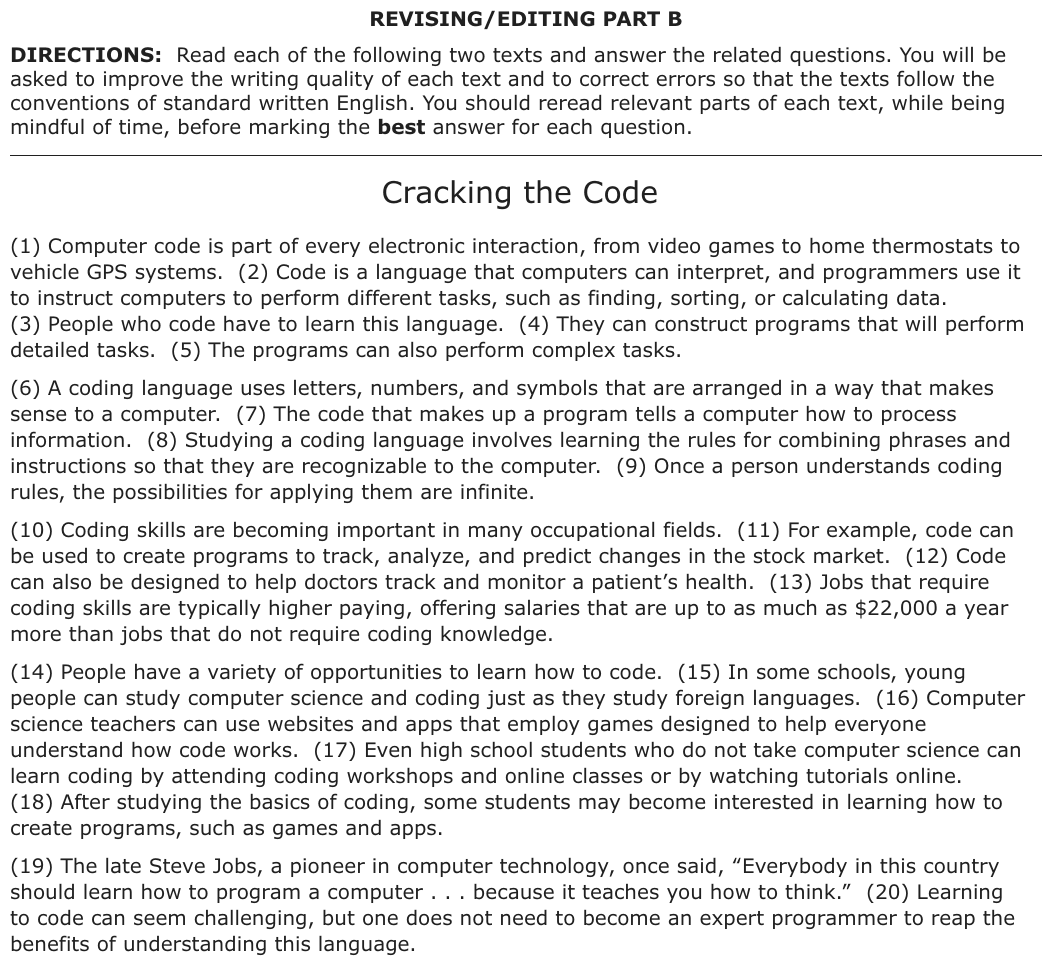
(1) Computer code is part of every electronic interaction, from video games to home thermostats to vehicle GPS systems. (2) Code is a language that computers can interpret, and programmers use it to instruct computers to perform different tasks, such as finding, sorting, or calculating data. (3) People who code have to learn this language. (4) They can construct programs that will perform detailed tasks. (5) The programs can also perform complex tasks.
(6) A coding language uses letters, numbers, and symbols that are arranged in a way that makes sense to a computer. (7) The code that makes up a program tells a computer how to process information. (8) Studying a coding language involves learning the rules for combining phrases and instructions so that they are recognizable to the computer. (9) Once a person understands coding rules, the possibilities for applying them are infinite.
(10) Coding skills are becoming important in many occupational fields. (11) For example, code can be used to create programs to track, analyze, and predict changes in the stock market. (12) Code can also be designed to help doctors track and monitor a patient’s health. (13) Jobs that require coding skills are typically higher paying, offering salaries that are up to as much as $22,000 a year more than jobs that do not require coding knowledge.
(14) People have a variety of opportunities to learn how to code. (15) In some schools, young people can study computer science and coding just as they study foreign languages. (16) Computer science teachers can use websites and apps that employ games designed to help everyone understand how code works. (17) Even high school students who do not take computer science can learn coding by attending coding workshops and online classes or by watching tutorials online. (18) After studying the basics of coding, some students may become interested in learning how to create programs, such as games and apps.
(19) The late Steve Jobs, a pioneer in computer technology, once said, “Everybody in this country should learn how to program a computer . . . because it teaches you how to think.” (20) Learning to code can seem challenging, but one does not need to become an expert programmer to reap the benefits of understanding this language.
Question
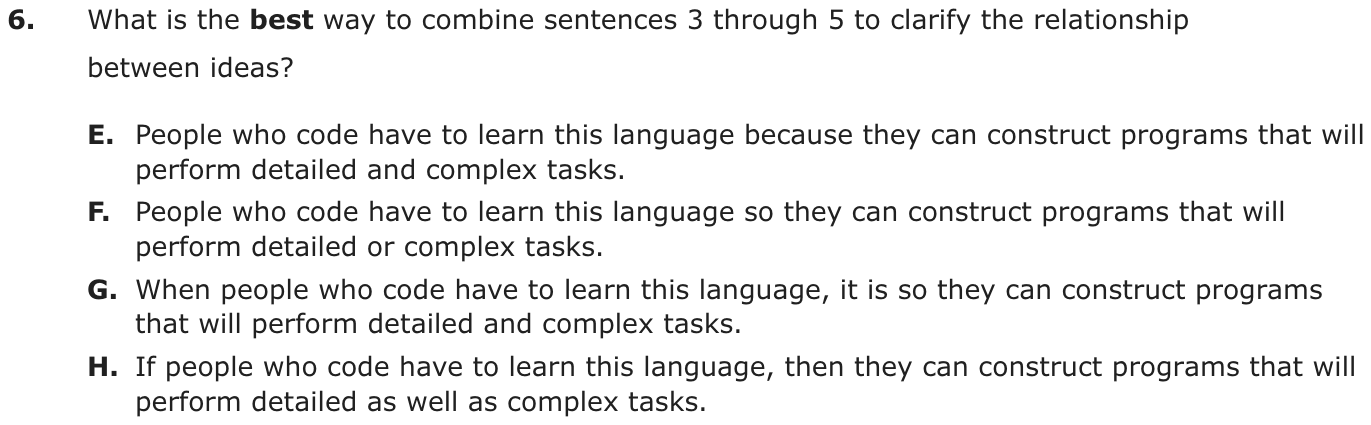
What is the best way to combine sentences 3 through 5 to clarify the relationship between ideas?
- APeople who code have to learn this language because they can construct programs that will perform detailed and complex tasks.
- BPeople who code have to learn this language so they can construct programs that will perform detailed or complex tasks.
- CWhen people who code have to learn this language, it is so they can construct programs that will perform detailed and complex tasks.
- DIf people who code have to learn this language, then they can construct programs that will perform detailed as well as complex tasks.
Show the answer
Correct answer: B
The question asks for the best way to combine sentences 3 through 5 to clarify the relationship between ideas.
A. Incorrect. While this sentence shows a relationship between the ideas, it does not clarify the relationship accurately. Learning the language of code does not depend on people’s previous ability to construct programs that will perform detailed and complex tasks. The word “because” incorrectly indicates that people can already construct complex programs prior to learning the coding language that would allow them to do so.
B. CORRECT. This sentence accurately shows the relationship between the ideas of the sentences. Before people can construct programs that will perform detailed and complex tasks, they have to learn a coding language. Knowing that language will, in turn, allow them to build programs that can perform detailed and complex tasks.
C. Incorrect. This sentence does not accurately express the relationship between ideas because the sentence implies that some people who code do not have to learn the language to perform their job functions. The passage clearly states that “computer code is part of every electronic interaction” (sentence 1) and that “programmers use it to instruct computers to perform different tasks” (sentence 2).
D. Incorrect. The conditional (If . . . then) construction of the sentence in Option D does not convey the intended relationship of the ideas in the sentences. The “then” statement (“they can construct programs that will perform detailed as well as complex tasks”) does not follow the condition of the “if” statement (“people who code have to learn this language”).
Question analysis
This sentence-combining question uses the first paragraph of “Cracking the Code,” a passage about computer coding, and asks for the best way to join sentences 3 through 5: coders must learn the language, they can build programs for detailed tasks, and those programs can also handle complex ones. Each version links the ideas with a different word, so students must judge which states the relationship accurately.
- Grade level
- Grade 7 reading and task
- Compared with grade 7
- At grade 7 Joining short sentences with a word that shows how their ideas relate is typical grade 7 work. Here three sentences become one and every version is grammatical, so the choice rests on whether the joining words state the logic accurately.
- Estimated difficulty
- Moderate: several steps, or a close reading with one strong distractor.
- Thinking it demands
- Depth of knowledge 2, skills and concepts · mainly evaluate
- What makes it hard
- A very close wrong answer moderate
- How sentences fit together moderate
- Every choice must be checked minor
- Evidence
- Answered from one paragraph or stanza
- Reading level
- Passage: about grade 10, 357 words; question and choices: about grade 9, 101 words.
- Students, last 30 days
- Not enough answers yet to show (it takes 10).
Why it is hard, traps and wrong answers (shows the answer)
Why it is hard
Every version is a correct sentence carrying the same facts, so the question tests logic rather than grammar: what does learning the language make possible? The look-alike joined by “because” is the main danger, since it seems to give a reason for learning. Careful readers may also pause over the key’s “detailed or complex tasks,” looser than sentence 5’s “also,” but the joining word, not that slip, is what separates the best sentence from the rest.
A very close wrong answer moderate Choosing the answer
The version joined by “because” matches the key word for word except for its linking word and “and” in place of “or,” so the decision rests on which way the link between learning and building runs. (Embretson & Wetzel, 1987; Gorin & Embretson, 2006; Ascalon et al., 2007)
How sentences fit together moderate Working it out
Sentence 3 states a requirement and sentences 4 and 5 state what meeting it allows, so the combined sentence must present learning the language as the means and building programs as the purpose. (Halliday & Hasan, 1976)
Every choice must be checked minor Choosing the answer
All four versions are grammatical and keep the same facts; only the opening or joining words change, “because,” “so,” “When … it is so” and “If … then,” and each must be weighed. (Embretson & Wetzel, 1987)
Strategy: Before reading the choices, decide in your own words how sentence 3 relates to sentences 4 and 5, then check whether each version’s opening or joining word signals that same relationship.
Traps
- Wrong transition: A connecting word or phrase that signals the wrong relationship, such as contrast where the idea continues.
- Wordy, vague or informal: A revision is grammatical but wordy, imprecise or too casual for the passage.
The wrong answers, classified
A Wrong transition (Halliday & Hasan, 1976)
Hears “because” as giving the reason to learn the language, but it treats the ability to build detailed and complex programs as already there, when that ability comes from learning.
C Wordy, vague or informal (Connors & Lunsford, 1988)
Is drawn by the formal ring of “When … it is so,” which buries the purpose in a clumsy frame and suggests coders must learn the language only on some occasions.
D Wrong transition (Halliday & Hasan, 1976)
Keeps learning before building but frames it with “If … then,” turning a stated requirement into a mere possibility, though having to learn a language does not by itself let anyone build programs.
Working it out, step by step
Figure out what the question asks
This asks you to join three short sentences into one. The new sentence must show how the ideas connect. All four choices are correct sentences with the same facts. What changes is the joining word. So first decide how the ideas connect. Then find the joining word that says so.
Read sentences 3 through 5
Sentence 3 says “People who code have to learn this language.” Sentence 4 says “They can construct programs that will perform detailed tasks.” Sentence 5 adds “The programs can also perform complex tasks.” To construct is to build. Detailed tasks have many small parts. Complex tasks are complicated and hard to do.
Name the link between the ideas
Why do coders have to learn the language? So that they can build programs. Learning comes first. Building programs is the goal it makes possible. A word that shows a goal, or purpose, is “so” (short for “so that”). Example: I practice piano so I can play in the concert. The practice comes first, and the concert is the goal.
Check each choice
- A does not fit. “Because” gives a reason that is already true. It says coders learn the language because they can already build programs. That gets the order backward.
- B fits. “So” shows that building programs is the goal of learning the language. It says “detailed or complex tasks” where sentence 5 means both, a small slip. But its joining word is right.
- C does not fit. “When” suggests coders only sometimes have to learn the language. And “it is so” is wordy.
- D does not fit. “If” makes learning sound like a maybe. The passage says coders “have to learn” it. That is a must.
Choose the answer
Watch out: A is the most tempting. It matches B almost word for word, and “because” sounds like a reason to learn. But it points the wrong way. B shows that learning leads to building. So the answer is B.
Why this answer and not the closest wrong one
A is the closest wrong answer. It uses the same words as B except for the joining word. “Because” makes building programs the reason coders learn the language, as if they could already do it. “So” makes building programs the goal that learning leads to. Learning comes first, so B shows the link correctly.
More questions like this
The original DOE question
The passage “Cracking the Code” as printed (page 40)