Question
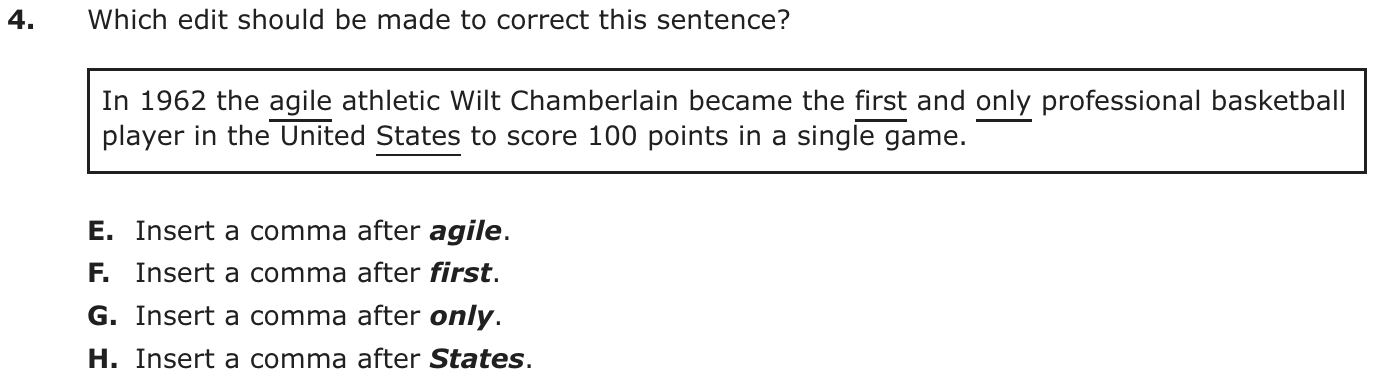
Which edit should be made to correct this sentence?
In 1962 the agile athletic Wilt Chamberlain became the first and only professional basketball player in the United States to score 100 points in a single game.
- AInsert a comma after agile.
- BInsert a comma after first.
- CInsert a comma after only.
- DInsert a comma after States.
Show the answer
Correct answer: A
The question asks which edit should be made to correct the sentence.
A. CORRECT. The sentence in the box needs a comma to separate the coordinate adjectives. Coordinate adjectives describe characteristics of the same noun or subject and are connected with a comma or “and.” This option is the only one that places a comma where it is needed, between the coordinate adjectives “agile” and “athletic.”
B. Incorrect. The option incorrectly adds a comma in the middle of the phrase “first and only,” which modifies, or gives additional information about, “professional basketball player.”
C. Incorrect. The option incorrectly adds a comma between two adjectives that are not coordinate adjectives. “Only” is part of the phrase “first and only” and is modifying “professional basketball player.”
D. Incorrect. The option is incorrect because a comma is not needed to set off the phrase “to score 100 points in a single game.”
Question analysis
This punctuation question gives one sentence about Wilt Chamberlain, the basketball player who scored 100 points in a single professional game in 1962, and asks which comma edit corrects it. All four choices add a comma, three after describing words and one after the country’s name, so students must decide which spot a comma rule truly requires.
- NYS standards
- 7L2 capitalization, punctuation, and spelling
- Grade level
- Grade 7 reading and task
- Compared with grade 7
- At grade 7 Deciding where a comma belongs in one sentence is typical grade 7 editing, and the rule tested here is part of the grade 7 language standards. The sentence sounds natural as printed, so the needed comma must be found by rule, not by ear.
- Estimated difficulty
- Straightforward: two steps or one careful reading.
- Thinking it demands
- Depth of knowledge 1, recall and reproduction · mainly apply
- What makes it hard
- A rule that doesn't sound wrong moderate
- Every choice must be checked minor
- Evidence
- Answered from one sentence or line
- Reading level
- Question and choices: about grade 7, 54 words.
- Students, last 30 days
- Not enough answers yet to show (it takes 10).
Why it is hard, traps and wrong answers (shows the answer)
Why it is hard
The sentence sounds natural as printed, so a student listening for pauses could put a comma in almost any of the four places. The question rewards knowing the test for coordinate adjectives: when “and” fits between two describing words and their order can be swapped, a comma belongs there. “Agile and athletic” passes that test, while “only and professional” fails, because “first and only” works as one unit that limits the whole phrase “professional basketball player.”
A rule that doesn't sound wrong moderate Working it out
The missing comma falls between “agile” and “athletic,” two adjectives that each describe Chamberlain, and the phrase reads smoothly without it, so the error has to be found by rule rather than by ear. (Connors & Lunsford, 1988)
Every choice must be checked minor Choosing the answer
All four edits add a comma, and two of the spots come between describing words, after “agile” and after “only,” so each pair must be tested with “and” before one is chosen. (Embretson & Wetzel, 1987)
Strategy: Take the four marked words one at a time, say what the words on either side of each are doing, and add a comma only where a rule calls for one, not wherever you would pause.
Traps
- Punctuation: A comma, semicolon, colon, dash or apostrophe used where it does not belong, or missing where it does.
The wrong answers, classified
B Punctuation (Connors & Lunsford, 1988)
Hears an emphatic pause in “the first and only,” as if writing “the first, and only,” though a single comma there splits a pair that works as one unit.
C Punctuation (Connors & Lunsford, 1988)
Believes any two describing words in a row need a comma and spots “only professional,” though “only” cannot be swapped with “professional” or joined to it by “and.”
D Punctuation (Connors & Lunsford, 1988)
Puts a comma before “to score 100 points in a single game” because the sentence is long, though that phrase tells what made him the first player and takes no comma.
Working it out, step by step
Figure out what the question asks
This is a punctuation question. Punctuation means marks like commas and periods. Each choice adds one comma to the sentence about Wilt Chamberlain. Only one of those commas is needed. Find the spot where a comma rule calls for one. Don’t just go by where you would pause when you read it aloud.
Learn the rule for describing words
An adjective is a describing word. Sometimes two adjectives in a row each describe the same noun (a naming word). They are equal partners, so a comma goes between them.
Two quick tests tell you. Can you put “and” between them? Can you swap their order? If both work, use a comma. Example: a long, boring movie. You could also say a long and boring movie or a boring, long movie.
Test agile and athletic
The sentence begins “In 1962 the agile athletic Wilt Chamberlain.” Agile means quick and light on your feet. Athletic means strong and good at sports. Both words describe Chamberlain. Now try the tests. The agile and athletic Wilt Chamberlain makes sense. So does the athletic, agile Wilt Chamberlain. Both tests pass, so a comma belongs after “agile.”
Check each choice
- A fits. “Agile” and “athletic” are equal describing words, so they need a comma.
- B does not fit. “First and only” is a pair already joined by “and.” One comma does not go inside a pair like that. You write salt and pepper, not salt, and pepper.
- C does not fit. Try the “and” test: only and professional makes no sense. “Only” goes with “first,” not with “professional.”
- D does not fit. The words after “States” tell what he was the first to do. They finish the idea, so no comma goes before them.
Choose the answer
Watch out: C is tempting because “only professional” is also two describing words in a row. But that pair fails the “and” test. The fixed sentence begins In 1962 the agile, athletic Wilt Chamberlain. So the answer is A: insert a comma after agile.
Why this answer and not the closest wrong one
C is the closest wrong answer. Like A, it puts a comma between two describing words. But only A’s pair passes the tests. You can say agile and athletic, but you can’t say only and professional. “Only” belongs with “first.” Together, “first and only” describe the whole phrase “professional basketball player.”
More questions like this
The original DOE question