Question
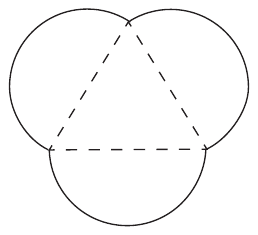
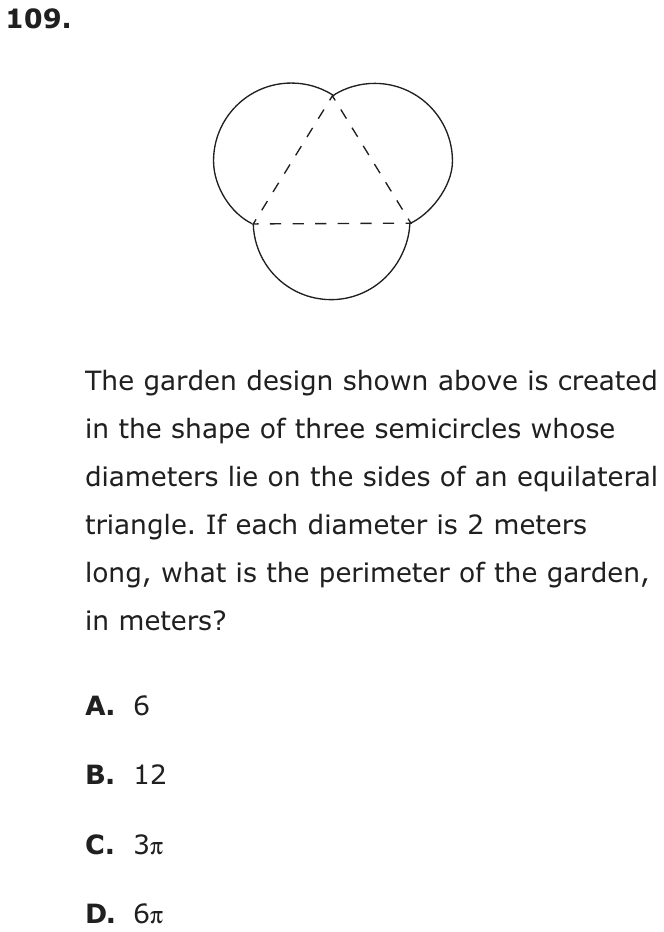
The garden design shown above is created in the shape of three semicircles whose diameters lie on the sides of an equilateral triangle. If each diameter is 2 meters long, what is the perimeter of the garden, in meters?
- A6
- B12
- C
- D
Show the answer
Correct answer: C
The perimeter (or circumference) of one of the three semicircles is . Since there are 3 semicircles that make up the perimeter, the perimeter is .
Question analysis
A garden is outlined by three semicircles whose diameters, each 2 meters long, are the sides of an equilateral triangle. Students find the perimeter of the garden in meters. It tests the circumference of a circle applied to half circles, and the figure mixes straight dashed sides with curved ones, so deciding what counts as the outline matters.
- NYS standards
- 7.G.4 circle area and circumference
- Grade level
- Grade 7 content, by NYS standard
- Compared with grade 7
- At grade 7 Applying the circumference formula is a grade 7 standard. Here it is used for a semicircle and repeated three times, a short extension of routine classwork, with a dashed triangle inside the figure to look past.
- Estimated difficulty
- Straightforward: two steps or one careful reading.
- Thinking it demands
- Depth of knowledge 2, skills and concepts · mainly apply
- What makes it hard
- Solution
- 3 steps
- Reading level
- Question and choices: about grade 8, 40 words.
- Students, last 30 days
- Not enough answers yet to show (it takes 10).
Why it is hard, traps and wrong answers (shows the answer)
Why it is hard
The perimeter is just three half-circles, and each is half of π × 2. The figure’s dashed triangle invites measuring straight sides instead, and remembering the whole circle’s circumference without halving it gives a choice twice too large. Tracing the garden’s outer edge with a finger before computing shows that only the curves count.
Reading a figure, table or graph minor Understanding the question
The dashed triangle lies inside the garden, so its three 2-meter sides are not part of the perimeter; only the three curved arcs bound the garden. (Lesh, Post & Behr, 1987; Kirsch & Mosenthal, 1990)
Something you must already know minor Working it out
The circumference formula is not given, and each arc is half of a circle with a 2-meter diameter, so students must take half of π × 2. (Anderson & Krathwohl, 2001)
Strategy: Find the circumference of a full circle with a 2-meter diameter, take half of it for one semicircle, and multiply by the number of semicircles in the outline.
Traps
- Wrong formula: Uses a related but wrong formula: perimeter for area, diameter for radius, area for volume, or a misremembered one.
- Answers a different question: A choice is right for another quantity: the other unknown, the rest instead of the part, the part instead of the whole.
- A formula you must know: Needs a formula the test does not give: area, circumference, volume, probability rules.
The wrong answers, classified
A Answers a different question (King et al., 2004; Hegarty, Mayer & Monk, 1995)
Adds the three dashed sides of the triangle, 3 × 2 = 6, measuring the triangle inside the garden instead of its curved outline.
B Little reason to choose it (Haladyna & Downing, 1993; Rodriguez, 2005)
No common working gives 12, which is twice the triangle’s perimeter and matches no arc length, so it mostly draws guesses.
D Wrong formula (King et al., 2004)
Uses a whole circumference, π × 2, for each of the three arcs, forgetting that each one is only half a circle, which doubles the perimeter.
Worked solution, step by step
Formulas used
- Circumference of a circle
- C is the circumference, the distance around a circle. d is the diameter, the straight line across the circle through its center. π is a number a little more than 3.14. The distance around any circle is π times as long as the distance across it.
- Arc of a semicircle
- A semicircle is half of a circle. Its arc is the curved part. d is the diameter, the straight side. The arc is half of the full circle’s circumference, so take half of π times d.
Sort out the figure
The garden’s edge is made of three semicircles, or half circles. Each one sits on a side of the dashed triangle. Each side is a diameter, 2 meters long. The perimeter is the distance around the outside. Here that is only the three arcs, the curved parts. The dashed triangle is inside, so it does not count.
Find a full circle’s circumference
Picture the whole circle that one semicircle comes from. Its diameter is 2 meters. Use the circumference formula.
The full circle would measure meters around.
Find the length of one arc
Each semicircle’s arc is half of that circle. Use the arc formula.
One arc is meters long.
Watch out: Using the full circle’s for each arc doubles the answer. That gives , choice D.
Add the three arcs
The garden’s edge is three equal arcs.
The perimeter is meters.
Watch out: The dashed sides add to 2 + 2 + 2 = 6 meters, choice A. That is the triangle, not the curved edge.
So the answer is C, meters.
Check your answer
Estimate. is about 3 × 3.14 = 9.42 meters. A curved path is longer than the straight line across it. So the edge should be longer than the triangle’s 6 meters, and 9.42 is.
More questions like this
The original DOE question