Question
Four slips of paper numbered 1, 2, 3, and 4 were placed in a bag:
- One slip was selected from the bag, and the number recorded.
- Without replacement, a second slip was chosen.
- This process continued until no more slips remained in the bag.
- One part of a tree diagram representing the sample space is shown.
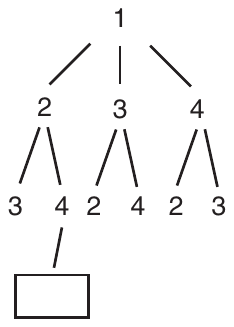
Which number should be placed in the box to complete this part of the tree diagram?
- A1
- B2
- C3
- D4
Show the answer
Correct answer: C
The “without replacement” statement means that the bag contained four slips for the first draw, three slips for the second draw, two slips for the third draw, and one slip for the last draw. Following the branch from the top and navigating down to the box, the 1 was chosen first, the 2 was chosen second, and the 4 was chosen third. The only remaining number is 3. The element would be 1243.
Question analysis
Four slips numbered 1 to 4 are drawn from a bag one at a time without replacement, and part of a tree diagram of the outcomes is shown. Students decide which number belongs in the empty box at the end of one branch. It tests reading a tree diagram and understanding what drawing without replacement means.
- NYS standards
- 7.SP.8b sample spaces for compound events
- Grade level
- Grade 7 content, by NYS standard
- Compared with grade 7
- Below grade 7 Tree diagrams for compound events are a grade 7 topic, but here the tree is already drawn and only one box is empty. Following a single branch to that box is shorter than typical grade 7 work with sample spaces.
- Estimated difficulty
- Routine: one familiar step, little to misread.
- Thinking it demands
- Depth of knowledge 2, skills and concepts · mainly understand
- What makes it hard
- Solution
- 2 steps
- Reading level
- Question and choices: about grade 5, 68 words.
- Students, last 30 days
- Not enough answers yet to show (it takes 10).
Why it is hard, traps and wrong answers (shows the answer)
Why it is hard
Only one branch matters, and once it is read as the slips drawn so far, 1, 2 and 4, the last slip left in the bag is the only one missing. Errors come from not counting the top 1 as a draw, from forgetting that a drawn slip stays out, or from copying a nearby number in the diagram instead of following the path.
Reading a figure, table or graph minor Understanding the question
The box hangs below the branch 1, then 2, then 4, and students must read that path from the top as the order of the first three draws. (Lesh, Post & Behr, 1987; Kirsch & Mosenthal, 1990)
Strategy: Follow the branch from the top down to the box, list the slips already drawn on that path, and name the one still left in the bag.
Traps
- Without replacement: In a second pick there is one fewer item, which changes the probability.
- Misreads the figure: Reads a value, label or tick spacing in a figure, table or graph wrongly.
The wrong answers, classified
A Misreads the figure (Lesh, Post & Behr, 1987; Kirsch & Mosenthal, 1990)
Treats the 1 at the top as the start of the diagram rather than the first slip drawn, so 1 seems still to be in the bag.
B Without replacement (Fischbein & Schnarch, 1997)
Lets slip 2, already drawn second on this branch, come up again, missing that a slip drawn without replacement stays out of the bag.
D Numbers taken from the question (Hegarty, Mayer & Monk, 1995)
Copies 4, the number directly above the box, reading the diagram as a pattern of numbers rather than as the order of the draws.
Worked solution, step by step
Sort out the question
The bag holds four slips: 1, 2, 3 and 4. Slips are drawn one at a time. “Without replacement” means a drawn slip does not go back in the bag. So each number can be drawn only once.
Read the tree diagram
A tree diagram shows the orders the draws can happen in. Each row going down is one draw. The 1 at the top is the first slip drawn. The numbers below it are the choices for the second draw, and so on.
Follow the path to the box
Start at the top and go down the lines to the box.
- First draw: 1
- Second draw: 2
- Third draw: 4
- Fourth draw: the box
Slips 1, 2 and 4 are already out of the bag.
Find the slip that is left
The bag started with 1, 2, 3 and 4. Only slip 3 has not been drawn. So it must be the fourth draw.
Watch out: The 1 at the top counts as a draw, so 1 is not left. That trap is choice A. Slip 2 was already drawn, so choice B can’t be right. And 4 is just the number above the box, choice D.
So the answer is C, 3.
Check your answer
Read the whole path: 1, 2, 4, 3. Each number from 1 to 4 shows up exactly once. That is just what should happen when no slip goes back in the bag.
More questions like this
The original DOE question