Question

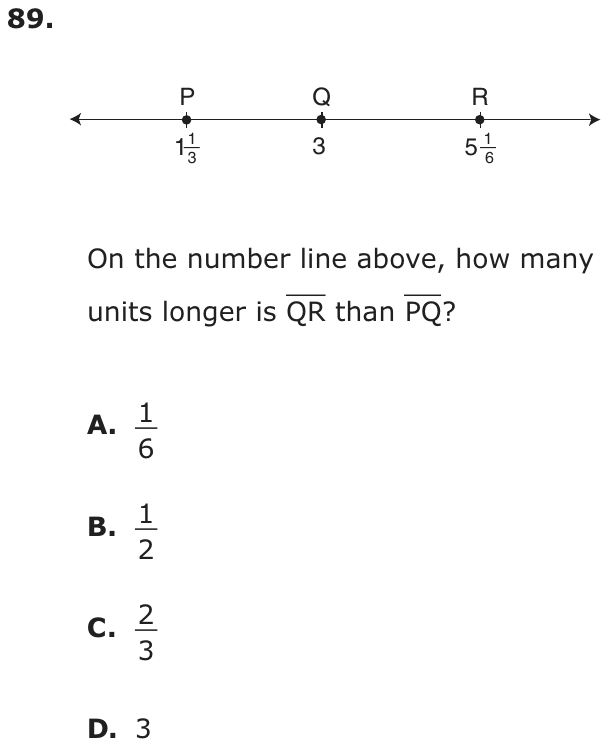
On the number line above, how many units longer is than ?
- A
- B
- C
- D3
Show the answer
Correct answer: B
First, find the lengths of the given segments:
Then, find the difference:
Question analysis
A number line shows three points labeled with mixed numbers and a whole number, and students find how many units longer one segment is than another. It tests subtracting mixed numbers with unlike denominators to find distances. Regrouping when the fraction being subtracted is the larger one is where most errors happen.
- Grade level
- Grade 7 content, by NYS standard
- Compared with grade 7
- At grade 7 Finding distances between points on a number line is grade 7 work. Here the points are mixed numbers with different denominators, so finding two distances and their difference makes it a typical but careful grade 7 task.
- Estimated difficulty
- Straightforward: two steps or one careful reading.
- Thinking it demands
- Depth of knowledge 2, skills and concepts · mainly apply
- What makes it hard
- Error-prone arithmetic moderate
- Reading a figure, table or graph minor
- Solution
- 3 steps
- Reading level
- Question and choices: about grade 9, 16 words.
- Students, last 30 days
- Not enough answers yet to show (it takes 10).
Why it is hard, traps and wrong answers (shows the answer)
Why it is hard
This is three subtractions, so most errors are in the fractions rather than the plan. Taking 1 1/3 from a whole number such as 3 tempts students to subtract only the whole parts and keep the 1/3, which reverses which segment looks longer. Rewriting every coordinate in sixths, 8/6, 18/6 and 31/6, turns the work into whole-number subtraction of numerators.
Error-prone arithmetic moderate Working it out
Both lengths subtract mixed numbers with different denominators, 5 1/6 − 3 and 3 − 1 1/3, and the second needs regrouping before the two results are compared in sixths. (Brown & Burton, 1978; Junker & Sijtsma, 2001)
Reading a figure, table or graph minor Understanding the question
The three coordinates come from the labels under P, Q and R, and the segments QR and PQ must each be measured from Q at 3, the point they share. (Lesh, Post & Behr, 1987; Kirsch & Mosenthal, 1990)
Strategy: Find each length by subtracting the left endpoint from the right one, writing the mixed numbers in sixths, then subtract the shorter length from the longer.
Traps
- A faulty procedure: A systematic but wrong procedure: adding fractions straight across, applying an exponent to each term of a sum, dropping a sign when moving a term.
- Numbers taken from the question: Combines the numbers in the question without a model of the situation, or is simply a number that appears in the question.
The wrong answers, classified
A A faulty procedure (Brown & Burton, 1978; Tatsuoka, 1983)
Subtracts only the whole numbers in 3 − 1 1/3 and keeps the 1/3, giving PQ as 2 1/3, then compares it with 2 1/6 and gets 1/6.
C Little reason to choose it (Haladyna & Downing, 1993; Rodriguez, 2005)
No common working gives 2/3; it is only the fraction part of PQ’s length, 1 2/3, so it mostly draws guesses.
D Numbers taken from the question (Hegarty, Mayer & Monk, 1995)
Picks 3, the coordinate of point Q, a number read off the line rather than a difference between two lengths.
Worked solution, step by step
Formulas used
- Length on a number line
- The length of a segment is the distance between its two end points. Subtract the number on the left from the number on the right. Subtracting tells how many units you move to get from one point to the other.
- Mixed number to improper fraction
- a is the whole number part. b over c is the fraction part, with b on top and c on the bottom. Each whole holds c parts, so a wholes hold a × c parts. Then add the b extra parts. An improper fraction has a top bigger than its bottom.
Read the number line
Point P is at . Point Q is at 3. Point R is at .
The bar over QR means segment QR, the piece of the line from Q to R. You need how much longer QR is than PQ. So find both lengths, then subtract.
Find the length of QR
R is on the right, and Q is on the left. Use the length rule.
QR is units long.
Find the length of PQ
Q is on the right, and P is on the left.
Take it in two parts. First, 3 − 1 = 2. Then take away the extra . That gives . So PQ is units long.
Watch out: Don’t just do 3 − 1 and keep the . That gives , which is too long. It leads to choice A.
Write both lengths in sixths
The fractions have different bottoms, 6 and 3. Change both lengths to sixths so you can subtract. Use the mixed number rule.
Subtract the lengths
Take the shorter length away from the longer one.
QR is unit longer than PQ.
So the answer is B, .
Check your answer
Write every point in sixths. P is , Q is and R is . QR is 31 − 18 = 13 sixths. PQ is 18 − 8 = 10 sixths. The difference is 3 sixths, which is one half.
More questions like this
The original DOE question